The Ripuarian Franks gain control of Cologne, …
Years: 462 - 462
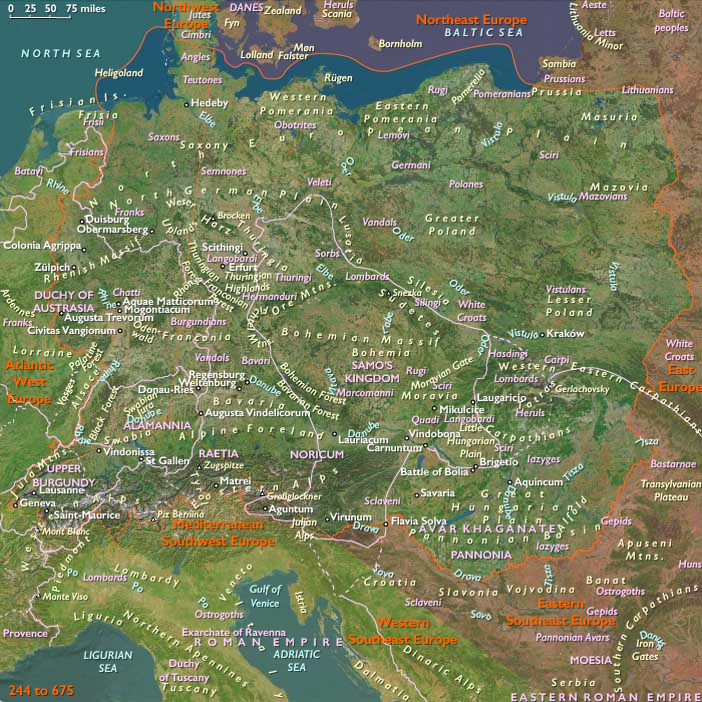
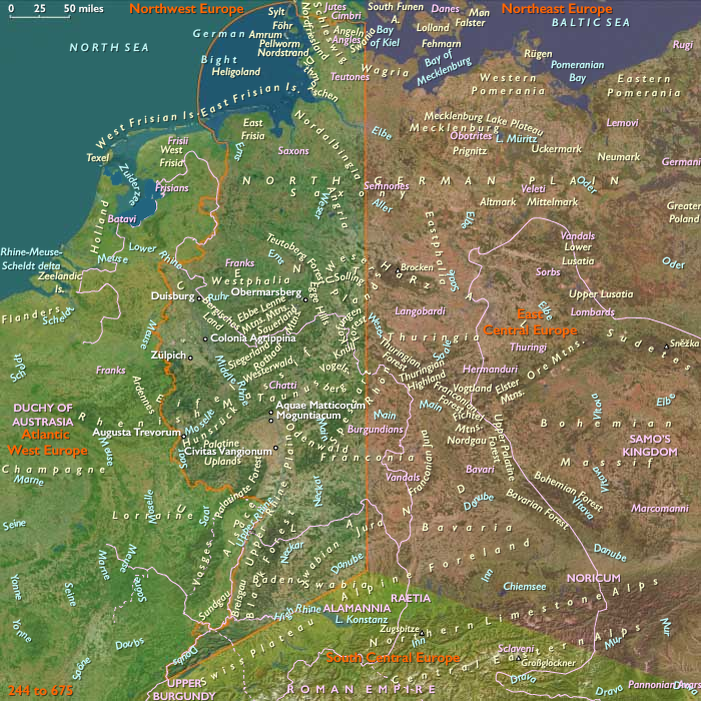
The Ripuarian Franks gain control of Cologne, long the capital of a Roman province, in 462.
Locations
People
Groups
Topics
Subjects
Regions
Subregions
Related Events
Filter results
Showing 10 events out of 58611 total
Olybrius, the husband of the princess Placidia, who is held in Vandal captivity, becomes the second candidate for the western throne.
Genseric supports Olybrius to assume the vacant Western throne because Gaiseric's son Huneric and Olybrius had married the two daughters of Valentinian III, and with Olybrius on the throne, Genseric could exert great influence on the Western Empire.
Therefore Genseric has freed Licinia Eudoxia and her daughter Placidia (Olybrius' wife), but he has not ceased his raids on Italy's coasts.
His project had failed, however, as Ricimer, who had become the magister militum of the West, had chosen Libius Severus as new Emperor.
Emperor Leo I has paid a large ransom for Licinia Eudoxia and Placidia, who returned after seven years of captivity in Carthage.
Placidia has joined her husband at Constantinople, where she bears him a daughter, Anicia Juliana, in 462.
The Monastery of Stoudios is founded in this year by the consul Stoudios, a Roman patrician who had settled in Constantinople, and is consecrated to Saint John the Baptist.
Its first monks come from the monastery of Acoemetae.
The Statue of Zeus, one of the Seven Wonders of the Ancient World, is destroyed by fire in 462 after being moved to Constantinople.
No copy of the statue has ever been found, and details of its form are known only from ancient Greek descriptions and representations on coins.
The Visigoths had settled in Aquitaine as foederati of the Western Roman Empire in the 450s under Theodoric II.
Sidonius Apollinaris refers to Septimania as "theirs" during the reign of Avitus (455–456), but Sidonius is probably considering Visigothic settlement of and around Toulouse The Visigoths were then holding the Toulousain against the legal claims of the Empire, though they had more than once offered to exchange it for the Auvergne.
The Empire, controlled by Ricimer in the name of Libius Severus, grants the Visigoths the western half of the province of Gallia Narbonensis to settle in 462.
The Visigoths occupy Provence (eastern Narbonensis) as well.
Rousillon, corresponding roughly to the present-day southern French département of Pyrénées-Orientales (Eastern Pyrenees), has formed formed part of the Roman province of Gallia Narbonensis from 121 BCE to CE 462, when it is ceded with the rest of Septimania to the Visigoth Theodoric II.
The Rise of the Merovingians and the Frankish-Roman Alliance
The Merovingians, a ruling dynasty of the Salian Franks, derive their name from their legendary chief (regulus), Merovech. As their influence expands, they push their domains southward, possibly reaching as far as the Somme River, bringing them deeper into northern Gaul and closer to the last remnants of Roman authority in the region.
Childeric I and His Alliance with Aegidius
As the Merovingians solidify their rule, Childeric I, the king of the Salian Franks based in Tournai, takes an unconventional step—he aligns himself with Aegidius, the Roman magister militum who rules the Domain of Soissons, the last Roman enclave in Gaul.
This alliance serves mutual interests:
- For Aegidius – He gains a military ally against external threats, particularly the Visigoths and rival Franks.
- For Childeric – He secures Roman recognition and access to imperial military resources, further legitimizing his authority.
The Shifting Power Balance in Gaul
This partnership demonstrates the gradual blending of Roman and Frankish power. While Childeric remains a barbarian warlord, his collaboration with Aegidius signals the transition from Roman rule to Frankish dominancein northern Gaul.
After Aegidius’ death, his successor Syagrius will continue to govern Soissons, but his defeat by Clovis I in 486 CE will mark the final triumph of the Merovingians—and the definitive end of Roman Gaul.
The Defeat of the Visigoths and the Rule of Aegidius Over the Franks
During the mid-fifth century, the Visigoths under King Theodoric II continue to expand their dominion in Gaul, pushing northward beyond their stronghold in Aquitania. However, their ambitions are checked by the Franks near Orléans, where they suffer a defeat while attempting to cross the Loire River. This battle further weakens Visigothic influence in northern Gaul and solidifies the Franks’ growing dominance in the region.
Aegidius' Rule Over the Franks During Childeric’s Exile
According to Gregory of Tours, Aegidius, the Roman magister militum of northern Gaul, even assumes control over the Franks during the temporary banishment of Childeric I. The exact cause of Childeric’s exile is unclear, but Gregory suggests he may have lost favor among his people, leading to his temporary removal from power.
During this period, Aegidius effectively governs the Frankish territories, demonstrating how Roman authority and Frankish leadership intertwined in northern Gaul. However, Childeric later returns from exile, reclaiming his position as king of the Salian Franks, possibly with Aegidius’ approval or assistance.
The Strengthening of Frankish Autonomy
While Aegidius maintains some level of influence over the Franks, these events signal an increasing Frankish independence from Roman oversight. Childeric’s return, followed by the future conquests of his son Clovis I, will mark the transformation of Francia from a Roman-allied territory into a rising barbarian kingdom, ultimately shaping the post-Roman order in Western Europe.

Olybrius is elected Roman consul by the Eastern court in Constantinople.
The Civil War and Consolidation of the Suebi Kingdom
Throughout the mid-fifth century, the Suebi in Galicia endure a period of civil war and internal fragmentation, as their kingdom operates under a diarchy, with rival factions vying for control. The situation is further complicated by ongoing conflicts with the native Gallo-Roman population, leading to widespread unrest.
The End of Civil War: The Rise of Remismund (464 CE)
In the south, after the death of King Maldras, his faction continues under Frumar, but his rule is short-lived. By 464 CE, Frumar’s death brings an end to this prolonged period of internal strife, paving the way for a unified Suebi ruleunder Remismund, a figure with both diplomatic and military experience.
Remismund’s Diplomatic and Military Acumen
- An Experienced Diplomat – Before becoming king, Remismund had served as an ambassador, traveling between Galicia and Gaul, likely engaging in negotiations with the Visigoths and maintaining ties with various factions.
- Unifying the Suebi – As king, he successfully unites the divided Suebi factions, restoring internal stability and consolidating his authority.
- Relations with the Visigoths – His rule gains recognition—perhaps even approval—from Theodoric II, king of the Visigoths, who sends him gifts and weapons, further legitimizing his reign. Additionally, Theodoric strengthens ties by arranging for Remismund to marry a Gothic princess, reinforcing a Visigothic-Suebi alliance.
The Restoration of Order in Galicia
With his rule secured, Remismund restores peace to the Suebi kingdom, ensuring its continued survival in the post-Roman world. Under his leadership, the Suebi maintain their autonomy in Galicia, though they remain under the shadow of the powerful Visigothic Kingdom, which will later dominate much of the Iberian Peninsula.
The Mysterious Death of Aegidius (464 CE)
Aegidius, the last Roman commander in northern Gaul, continues to rule the Domain of Soissons until his death in 464 CE, though the exact circumstances surrounding it remain uncertain and debated.
Diplomatic Engagements Before His Death
According to the chronicler Hydatius, Aegidius sends an embassy to the Vandals via the Atlantic in May 464, suggesting that he is actively seeking alliances or reinforcements against growing threats in Gaul. Hydatius likely learns of this mission when the ships carrying the embassy pass Gallaecia on their way south.
Conflicting Accounts of His Death
- Poison or Assassination – Hydatius also records Aegidius' death later in 464, attributing it to either poison or an ambush. Some speculate that his murder may have been orchestrated by one of Childeric I’s enemies, possibly a rival seeking to undermine the Gallo-Roman-Frankish alliance.
- Plague – Gregory of Tours, writing centuries later, offers a different explanation, implying that Aegidius died of the plague, which may reflect a contemporary belief rather than verified fact.
- Violent End – Given the instability of the time, it is equally plausible that Aegidius fell in battle or was assassinated by a political adversary, perhaps by agents of the Visigoths or rival Gallo-Roman factions.
Aegidius’ Legacy and the Fate of Soissons
- His death marks a turning point for the Domain of Soissons, which remains the last bastion of Roman rule in Gaul.
- His son, Syagrius, succeeds him, continuing to rule independently until 486 CE, when Clovis I of the Franks conquers the region, marking the final collapse of Roman authority in Gaul.
- His alliance with Childeric I and his campaigns against the Saxons foreshadow the growing Frankish dominance in northern Gaul.
Regardless of the exact cause of his demise, Aegidius’ rule represents the last vestiges of Roman resistance in an empire that is rapidly crumbling, and his death accelerates the transformation of Gaul into a land ruled by barbarian successor states.