
Filters:
The Execution of Syagrius and the Expansion …
Years: 487 - 487
The Execution of Syagrius and the Expansion of the Frankish Realm (486–487 CE)
After his defeat at the Battle of Soissons (486 CE), Syagrius flees southward, seeking refuge with the Visigothsunder King Alaric II. However, his former Roman allies prove unreliable when faced with the military power of Clovis I.
The Fate of Syagrius
- Clovis, now the undisputed ruler of northern Gaul, demands that the Visigoths hand over Syagrius.
- Alaric II, unwilling to provoke a war with the rising Frankish power, complies with Clovis' demand.
- Syagrius is delivered to Clovis, who, according to Gregory of Tours, has him stabbed to death in secret, eliminating the last Roman claimant to power in Gaul.
The Expansion of the Frankish Kingdom
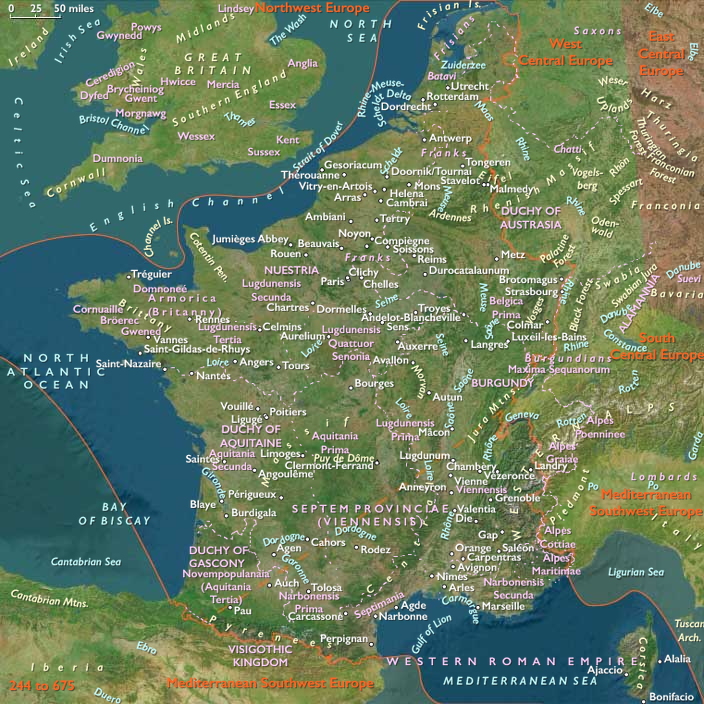
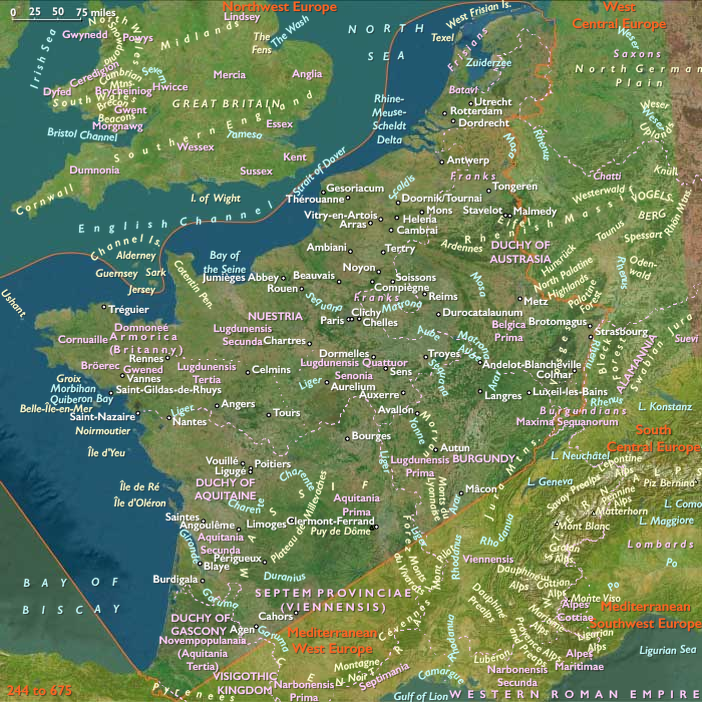
With Syagrius dead and his domain absorbed, Clovis nearly doubles the size of the Frankish realm, incorporating the former Roman province of Belgica Secunda.
- Soissons becomes the Frankish capital, replacing Tournai as Clovis' primary residence.
- The Frankish frontier expands southward, reaching the Loire River, bringing Clovis into direct territorial contact with the Visigoths.
- The Frankish realm, originally centered in Toxandria (modern Belgium and the southern Netherlands), now dominates northern Gaul.
The Growing Tension Between Franks and Visigoths
By 487 CE, the new Frankish-Visigothic border along the Loire River sets the stage for future conflict:
- Clovis, now ambitious for further expansion, views the Visigoths as his next major rival in Gaul.
- The Visigoths, already expanding into Provence and Hispania, face the growing threat of Frankish encroachment from the north.
This marks a turning point in the struggle for Gaul, as Clovis positions the Franks as the dominant power in the former Western Roman territories, setting the stage for his eventual conquest of the Visigothic kingdom in 507 CE.
Locations
People
Groups
- Franks
- Goths (East Germanic tribe)
- Visigothic Kingdom of Toulouse
- Soissons, (Gallo-Roman) Domain of
- Francia (Merovingians)
Topics
Commodoties
Subjects
Regions
Subregions
Years: 487 - 487
Locations
People
Groups
- Franks
- Goths (East Germanic tribe)
- Visigothic Kingdom of Toulouse
- Soissons, (Gallo-Roman) Domain of
- Francia (Merovingians)
Topics
Commodoties
Subjects
Regions
Subregions