
The Rise of Clovis and the Frankish …
Years: 482 - 482
The Rise of Clovis and the Frankish Conquest of Gaul (481 CE Onward)
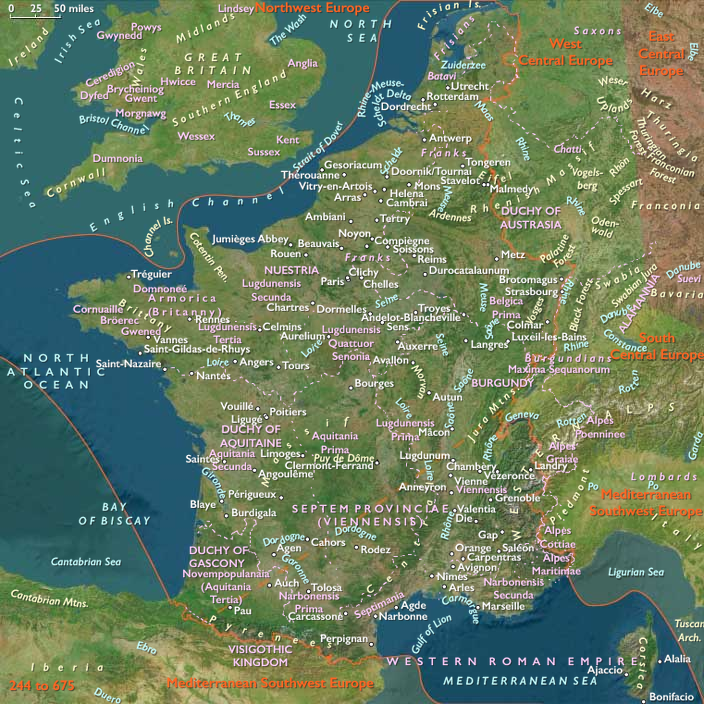
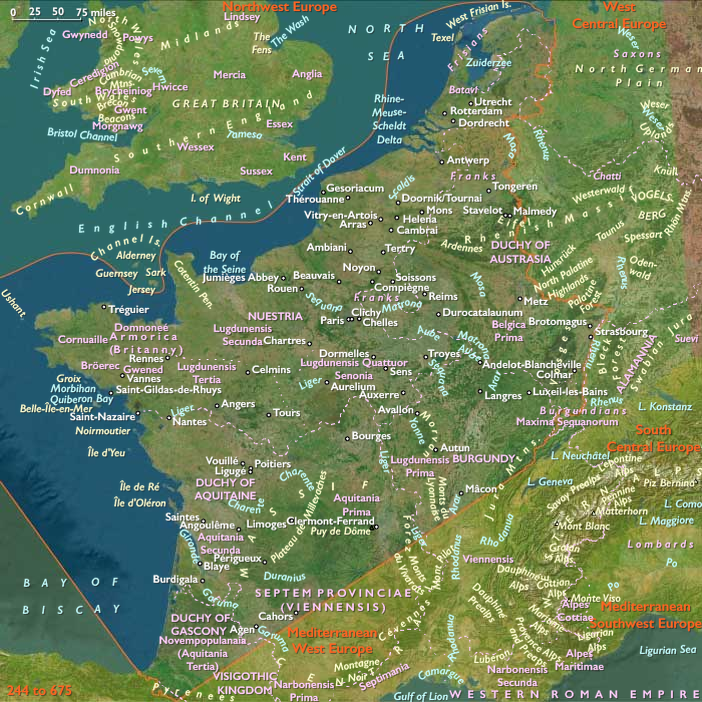
In 481 CE, Clovis, son of Childeric I and Basina of Thuringia, ascends as ruler of the Salian Franks based in Tournai, in the former Roman province of Gallia Belgica. Though initially controlling only a small Frankish realm, Clovis embarks on a relentless campaign of expansion, laying the foundations for what will become the Frankish Kingdom and, ultimately, medieval France.
Clovis’ Early Rule and the Consolidation of the Franks
- Clovis inherits a fragmented collection of Frankish tribes, including the Salians and parts of the Ripuarian Franks, who live along the Rhine River.
- Unlike previous Frankish reguli, who ruled as local chieftains, Clovis moves toward centralized kingship, asserting dominance over rival Frankish warlords.
- His capital at Tournai serves as the starting point for the Frankish conquest of Gaul.
The Frankish Conquest of Central and Southern Gaul
Under Clovis, the Franks push southward, expanding into Roman-held and Visigothic-controlled territories:
1. Defeat of Syagrius and the End of Roman Gaul (486 CE)
- Clovis first targets the last Roman stronghold in northern Gaul—the Domain of Soissons, ruled by Syagrius, the last Roman dux.
- At the Battle of Soissons (486 CE), Clovis defeats Syagrius, marking the final collapse of Roman rule in Gaul.
- With Syagrius eliminated, Clovis absorbs the former Roman territories in northern Gaul, strengthening his control.
2. Expansion Against the Alemanni (496 CE)
- Clovis then turns eastward to face the Alemanni, who threaten Frankish lands.
- At the Battle of Tolbiac (496 CE), Clovis achieves a decisive victory, securing eastern Gaul and gaining control over parts of the Rhine Valley.
- This battle is also a turning point for Clovis’ religious identity—according to tradition, he converts to Christianity (Catholic Nicene, not Arian) after his victory, an event that will transform the Franks into champions of Catholicism in the West.
3. Conquest of the Burgundians and Visigoths
- By the early sixth century, Clovis moves against the Burgundians, gradually bringing them under Frankish influence.
- In 507 CE, he wages war against the Visigothic Kingdom of Toulouse, defeating King Alaric II at the Battle of Vouillé.
- With this victory, Clovis annexes Aquitaine, securing central and southern Gaul for the Franks.
The Emergence of the Frankish Kingdom
By the time of Clovis’ death in 511 CE, the Franks have transformed from a loose tribal confederation into the most powerful kingdom in Western Europe:
- Clovis unites northern, central, and much of southern Gaul, creating a new Frankish political and military order.
- His conversion to Catholic Christianity, rather than Arianism (which was practiced by most Germanic rulers), wins him the support of the Roman Catholic Church and the Gallo-Roman aristocracy.
- The Frankish Kingdom emerges as the dominant successor to the Western Roman Empire, replacing Visigothic and Burgundian power in Gaul.
This marks the beginning of the Merovingian dynasty, which will shape the early medieval history of Francia and Western Europe.
Locations
People
Groups
- Franks
- Gallia Lugdunensis (Roman province)
- Gallia Belgica (Roman province)
- Goths (East Germanic tribe)
- Gaul, Diocese of
- Visigothic Kingdom of Toulouse
- Burgundians, (second) Kingdom of the
- Roman Empire, Eastern: Leonid dynasty
- Septimania
- Soissons, (Gallo-Roman) Domain of
- Francia (Merovingians)
Topics
Commodoties
Subjects
Regions
Subregions
Years: 482 - 482
Locations
People
Groups
- Franks
- Gallia Lugdunensis (Roman province)
- Gallia Belgica (Roman province)
- Goths (East Germanic tribe)
- Gaul, Diocese of
- Visigothic Kingdom of Toulouse
- Burgundians, (second) Kingdom of the
- Roman Empire, Eastern: Leonid dynasty
- Septimania
- Soissons, (Gallo-Roman) Domain of
- Francia (Merovingians)
Topics
Commodoties
Subjects
Regions
Subregions