Clovis' Pursuit of the Visigoths and the Annexation of Aquitaine (507–508 CE)
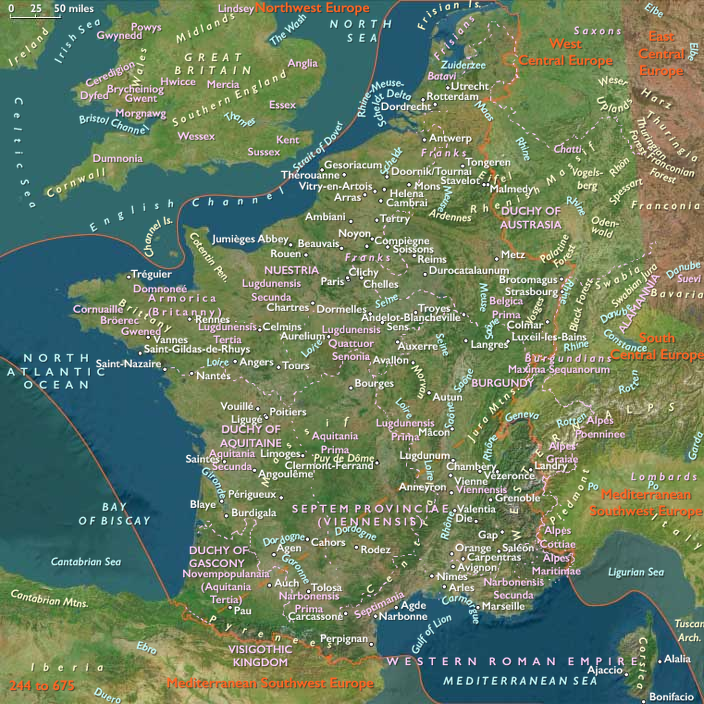
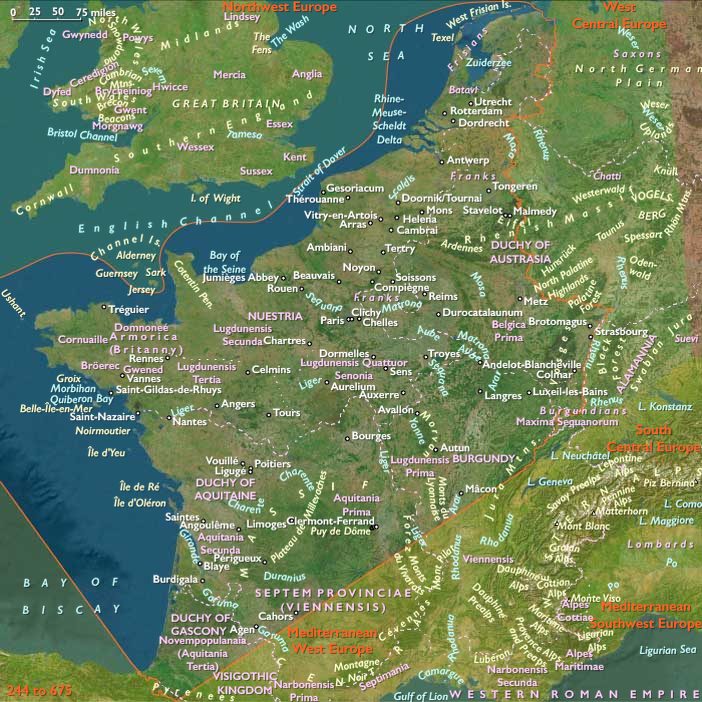
Following his decisive victory at the Battle of Vouillé (507 CE), Clovis I continues his campaign against the Visigothic Kingdom of Toulouse, seeking to eliminate their presence in Gaul altogether.
The Frankish Advance into Aquitaine
- After defeating and killing King Alaric II, Clovis presses southward, capturing key cities including Angoulême, a strategic stronghold in Aquitaine.
- The Visigothic resistance collapses, forcing the surviving Visigoths to retreat further south rather than be subjugated by the Franks.
The Visigothic Retreat to Septimania
- Rather than surrendering to Frankish rule, the remaining Visigoths regroup in Septimania, the narrow coastal strip between the Pyrenees and the Rhône River.
- They establish Narbonne as their new regional center, preserving their last foothold in Gaul.
- Visigothic Hispania, centered in Toledo, becomes the new political heart of the kingdom, shifting the kingdom’s focus away from Gaul.
Clovis Annexes Aquitaine
- With the Visigoths confined to Septimania, Clovis incorporates all of Aquitaine into his kingdom.
- This dramatically expands Frankish territory, bringing former Roman cities, trade routes, and infrastructure under his control.
- The Gallo-Roman elite in Aquitaine, many of whom were already disillusioned with Arian Visigothic rule, welcome Clovis as a Catholic king, strengthening his legitimacy.
The Aftermath and Long-Term Consequences
- The Franks are now the dominant power in Gaul, having eliminated Visigothic authority north of Septimania.
- Clovis' expansion into Aquitaine ensures that the Franks control most of the former Roman province of Gallia.
- The Visigoths, now centered in Spain, shift their focus southward, marking the beginning of their Iberian dominance.
This conquest cements Clovis' position as the ruler of Gaul, and by 508 CE, he has effectively replaced the Visigoths as the strongest kingdom in Western Europe.