Clement of Alexandria, living in exile in …
Years: 215 - 215
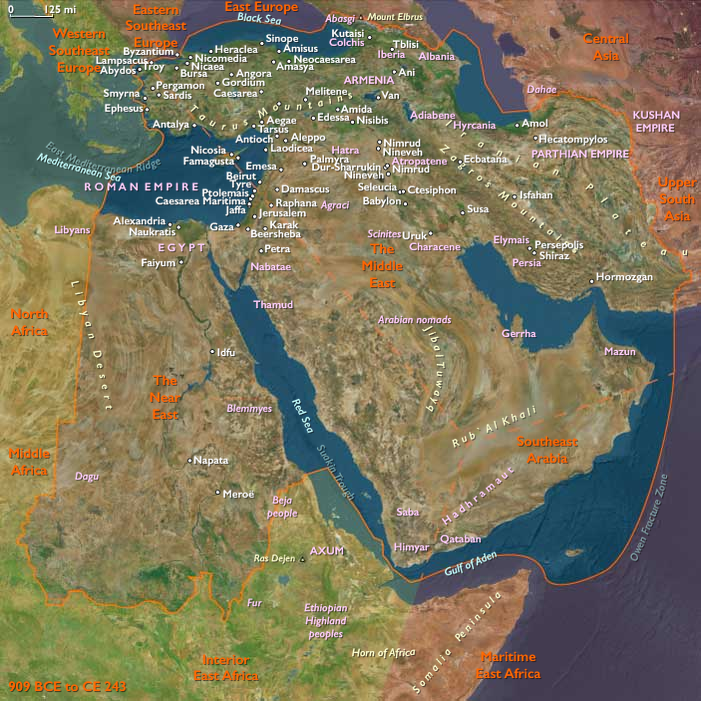
Clement of Alexandria, living in exile in Cappadocia since 202, produces a number of influential works that marry Christian faith to Platonic philosophy.
One of the founders of the Alexandrine tradition in Christian theology, Clement is best known for three works.
His Protrepticus ("Exhortation to the Greeks"), is an attempt to convert followers of pagan gods; his Paedagogus ("Tutor"), is an explanation of the world in terms of the "logos," or mind of God; and in his Stromata ("Miscellanies"), he maintains that philosophy is God's gift to the Greeks.
He dies in 215 (later considered as one of the Fathers of the Church and, by some, a Christian gnostic).
Locations
People
Groups
Topics
Subjects
Regions
Subregions
Related Events
Filter results
Showing 10 events out of 60700 total
Cao Cao again launches a campaign to conquer Hanzhong in 215.
Initially, Zhang Lu has no hope of standing against Cao Cao's armies, and plans to surrender.
His younger brother Zhang Wei, however, insists on fighting and leads his army against the invading forces.
He is soon killed in battle, and again Zhang Lu considers surrendering.
His advisor Yan Pu tells him that in surrendering so readily, they would have no position to negotiate from.
Instead, Zhang Lu retreats to his fortress at Bazhong.
When leaving his capital, he does not destroy his wealth and treasures, nor attempt to take them with him, instead leaving them behind saying "These things belong to the country, not to me."
Cao Cao is greatly impressed by this, and sends a messenger to Zhang Lu asking him to surrender.
Yan Pu's plan is successful, as Zhang Lu and his forces are warmly welcomed by Cao Cao.
He is given the title General who Suppresses the South and his five sons are granted the rank of marquis.
He marries his daughter to a younger son of Cao Cao, Cao Yu.
As further demonstration of the bad blood between Zhang Lu and Ma Chao, when Cao Cao turns Ma Chao's son Ma Qiu over to Zhang Lu, he immediately executes him.
Following Cao Cao’s defeat of Zhang Lu and subsequent seizure of Hanzhong, Sima Yi and Liu Ye advise him to take advantage of the victory to attack Yi Province, since it is still unstable under Liu Bei's new government and Liu himself is away in Jing Province.
Cao Cao refuses and leaves Xiahou Yuan, Zhang He and Xu Huang to defend Hanzhong.
Origen, a Platonist, emphasizes Bible study as essential to the proper understanding of Christianity.
Master of Alexandria’s Christian Catechetical School from 203, he continues to draw large numbers of students through his manner of life as much as through his teaching.
According to the church historian Eusebius of Caesarea, Origen took the command in Matthew 19:12 to mean that he should castrate himself.
This story will be accepted during the Middle Ages and in the twelfth century will be cited by Abelard in his letters to Heloise.
Scholars within the past century have questioned this, surmising that this may have been a rumor circulated by his detractors.
The 1903 Catholic Encyclopedia does not report this.
However, Peter Brown, a renowned historian of late antiquity, will find no reason to deny the truth of Eusebius' claims.
Origen during the reign of emperor Caracalla had paid a brief visit to Rome in about 211-212, but the relative laxity during the bishopric of Zephyrinus seems to have disillusioned him, and on his return to Alexandria he had resumed his teaching with zeal increased by the contrast.
The school has far outgrown the strength of a single man, however; the catechumens press eagerly for elementary instruction, and the baptized seek interpretation of the Bible.
Under these circumstances, Origen entrusts the teaching of the catechumens to Heraclas, the brother of the martyr Plutarch, his first pupil.
His own interests become increasingly centered in exegesis, and he accordingly studies Hebrew, though there is no certain knowledge concerning his instructor in that language.
From about this period (212-213) dates Origen's acquaintance with Ambrose of Alexandria, whom he is instrumental in converting from Valentinianism to orthodoxy.
Later (about 218) Ambrose, a man of wealth, will make a formal agreement with Origen to promulgate his writings, and all the subsequent works of Origen (except his sermons, which were not expressly prepared for publication) will be dedicated to Ambrose.
In 213 or 214, Origen had visited Arabia at the request of the prefect, who wished to have an interview with him; and Origen accordingly spent a brief time in Petra, after which he returned to Alexandria.
When the inhabitants of Alexandria heard Caracalla's claims that he had killed his brother Geta in self-defense, they had produced a satire mocking this as well as Caracalla's other pretensions.
Caracalla savagely responds to this insult in 215 by slaughtering the deputation of leading citizens who have unsuspectingly assembled before the city to greet his arrival, and then unleashes his troops for several days of looting and plunder in Alexandria.
According to historian Cassius Dio, over twenty thousand people were killed.
The schools are shut and foreigners expelled.

Caracalla, in 215, introduces the antoninianus, a "double denarius" weighing 5.1 grams and containing 2.6 grams of silver—a purity of fifty-two percent.
A temple built on Quirinal Hill and dedicated to Serapis was, by most surviving accounts, the most sumptuous and architectonically ambitious of those built on the hill; its remains are still visible between Palazzo Colonna and the Pontifical Gregorian University.
This is one of a number of colossal temples built by the Severan emperors and dedicated to exotic foreign deities.
The sanctuary, which lies between today's piazza della Pilotta and the large square facing Quirinal Palace, is built by Caracalla on the western slopes of the hill, covering over thirteen thousand square meters (3.2 acres), as its sides measured one hundred and thirty-five meters by ninety-eight meters.
It is composed by a long courtyard (surrounded by a colonnade) and by the ritual area, where statues and obelisks have been erected.
Designed to impress its visitors, the temple boasts twelve columns 21.17 meters (69 feet 5 inches) tall and two meters (six feet seven inches) in diameter, visually sitting atop a marble stairway that connects the base of the hill to the sanctuary.
An enormous fragment of entablature, weighing approximately one hundred tons and thirty four cubic meters in volume (the largest in Rome), belongs to the original temple, as do the statues of the Nile and the Tiber, moved by Michelangelo to the Capitoline Hill in front of the Senate building.
Zhang Lu, who dies not long after surrendering to Cao Cao, is created a marquess.
The Five Pecks of Rice religion is continued by his sons, eventually to evolve under the Tang Dynasty into the Taoist religion known as Zhengyi Dao, or the Way of Complete Orthodoxy.
Cao Pi was born in 187 to Cao Cao and one of his favorite concubines, Lady Bian.
At the time of Cao Pi's birth, Cao Cao was a mid-level officer in the imperial guards in the capital Luoyang, with no hint that he would go on to the great campaigns he eventually carried out after the collapse of the imperial government in 190.
In the period after 190 when Cao Cao was constantly waging war, it is not known where Cao Pi and his mother Lady Bian were, or what their activities were.
The lone reference to Cao Pi during this period was in 204, when he took Yuan Xi's wife Lady Zhen as his wife.
(Lady Zhen gave birth to Cao Pi's eldest son Cao Rui only eight months later—which created murmurs that Cao Rui might have been biologically Yuan Xi's son and not Cao Pi's, although the possibilities appeared farfetched.)
The next immediate reference to Cao Pi's activities was in 211, when he was commissioned to be commander of the imperial guards and deputy prime minister.
This position made him assistant to his father, who was then prime minister and effectively in control of the imperial government.
His older brother Cao Ang had died earlier, and Cao Pi is now the oldest son of Cao Cao.
Futher, his mother Lady Bian is now Cao Cao's wife (after Cao Ang's adoptive mother, Cao Cao's first wife Lady Ding, was deposed), thus making Cao Pi the presumptive heir to Cao Cao.
However, his status as heir is not immediately made legal, and for years there are lingering doubts on whom Cao Cao intends to make heir.
Cao Cao greatly favors Cao Zhi, a younger son of his also by Lady Bian, who is known for his literary talents.
Both Cao Pi and Cao Zhi are talented poets, but Cao Zhi is more highly regarded as a poet and speaker.
By 215, the brothers were in concord on the surface but each had his own set of associates fighting each other under the surface.
Initially, Cao Zhi's party appears to be prevailing, and in 216 they are successful in falsely accusing two officials supporting Cao Pi—Cui Yan and Mao Jie.
Cui is executed, while Mao is deposed.
However, the situation shifts after Cao Cao receives advice from his strategist Jia Xu, who concludes that changing the general rules of succession (primogeniture) would be disruptive—using Yuan Shao and Liu Biao as counterexamples.
Cao Pi is also burnishing his image among the people and creates the sense that Cao Zhi is wasteful and lacking actual talent in governance.
Zhang He, in anticipation of a prolonged war, leads his army to Dangqu in order to relocate the population of Ba to Hanzhong.
Meanwhile, Liu Bei appoints Zhang Fei as Administrator of Baxi and orders him to take over the region.
Zhang Fei and Zhang He face each other for fifty days, which concludes with a victory for the former, following a surprise attack on the latter.
Narrowly escaping, Zhang He retreats to Nanzheng on foot, and the Ba region becomes part of Liu Bei's territory.
Artabanus IV of Parthia had rebelled against his brother Vologases VI of Parthia soon after the latter's succession to the throne around 212 and gained control over a greater part of the empire.
Vologases VI maintains himself in a part of Babylonia.
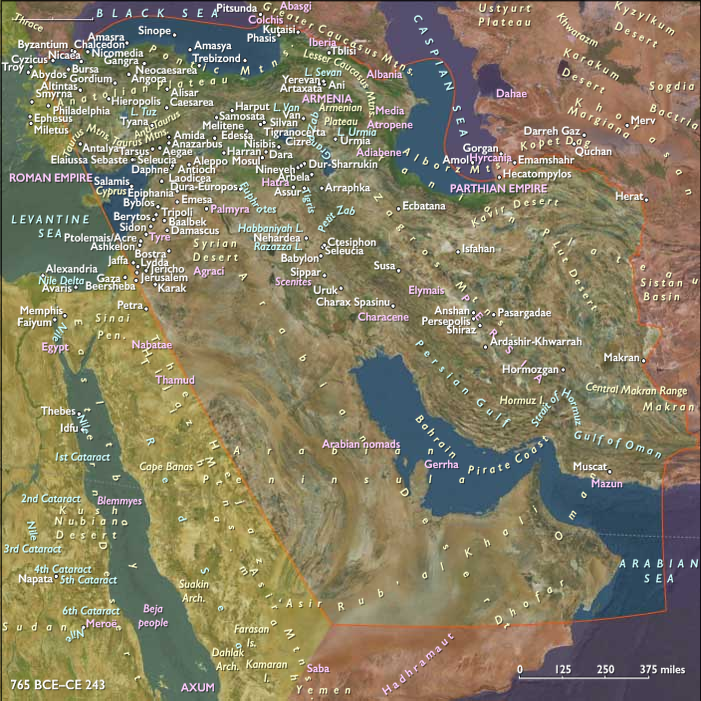
The Roman emperor Caracalla, wishing to make use of this civil war for a conquest of the East in imitation of his idol, Alexander the Great, marches into Mesopotamia under the pretext of marrying one of Artabanus' daughters.
Caracalla, according to the historian Herodian, tricked the Parthians in 216 into believing that he accepted a marriage and peace proposal, but then had the bride and guests slaughtered after the wedding celebrations.
The thereafter ongoing conflict and skirmishes become known as the Parthian war of Caracalla.
After deposing the kings of Osroene and Armenia to make them Roman provinces once more, he crosses the Tigris, destroys the towns, and spoils the tombs of Arbela, but when Artabanus advances at the head of an army, …
…Caracalla retires to Edessa.
The Praetorian prefect Macrinus is among Caracalla’s staff, as are other members of the praetorian guard.
Born in Caesarea (modern Cherchell, Algeria) in the Roman province of Mauretania to an equestrian family, Macrinus had received an education which allowed him to ascend to the Roman political class.
Over the years he had earned a reputation as a skilled lawyer.
Under the emperor Septimius Severus he became an important bureaucrat, and Caracalla in 212 had appointed him prefect of the Praetorian guard after the murder of Papianus.
While Macrinus likely enjoys the trust of Caracalla, this may have changed when, according to tradition, he was prophesied to depose and succeed the Emperor.
Rumors spread regarding Macrinus' alleged desire to take the throne for himself.
Given Caracalla's tendency towards murdering political opponents, Macrinus probably fears for his own safety should the Emperor become aware of this prophecy.
According to Dio, Caracalla had already taken the step of re-assigning members of Macrinus' staff.
The expulsion of foreigners from Alexandria causes Ambrose to take refuge in Caesarea, where he seems to have made his permanent home; and Origen leaves Egypt, apparently going with Ambrose to Caesarea, where he spends some time.
Here, in conformity with local usage based on Jewish custom, Origen, though not ordained, preaches and interprets the Scriptures at the request of the bishops Alexander of Jerusalem and Theoctistus of Caesarea.
When, however, the confusion in Alexandria subsides, Demetrius, bishop of Alexandria, who views this activity as a breach of discipline, orders him, probably in about 216, to return to Alexandria.
Seeking to secure his own legacy, Caracalla also commissions one of Rome's last major architectural achievements, the colossal and richly decorated Baths of Caracalla, the largest public baths ever built in ancient Rome.
Reportedly built in Rome between 212 and 216, the builders would have had to install over 2,000 tons of material every day for six years in order to complete it in this time period.
Chris Scarre provides a slightly longer construction period 211-217 CE. ("Seventy Wonders of the Ancient World" edited by Chris Scarre [1999], p. 178).
Records show that the idea for the baths had been drawn drawn up by Septimius Severus, and merely completed or opened in the lifetime of Caracalla.
This would allow for a longer construction time frame.
The main room of the baths is larger than St. Peter's Basilica, and can easily accommodate over two thousand Roman citizens at one time.
The bath house opens in 216, complete with libraries, private rooms and outdoor tracks.
Internally it is lavishly decorated with gold-trimmed marble floors, columns, mosaics and colossal statuary.
Colossal cisterns rest beneath the stadium against the rear walls.
Opposite, across the acres of gardens, is the enormous central building.
Planned in strict symmetry, the four main halls, on a central axis, are the circular caldarium (hot bath), topped with a dome more than one hundred feet (thirty-three meters) high; the tepidarium (warm bath); the huge triple-vaulted frigidarium (cold bath), which is two hundred feet (sixty-six meters) long; and the even bigger natatio (swimming pool, probably open to the sky).
Marble revetments, mosaic floors, and decorative statuary ornament the awesome concrete structure.