
Circumstances have hindered Baldwin from accomplishing anything …
Years: 1245 - 1245
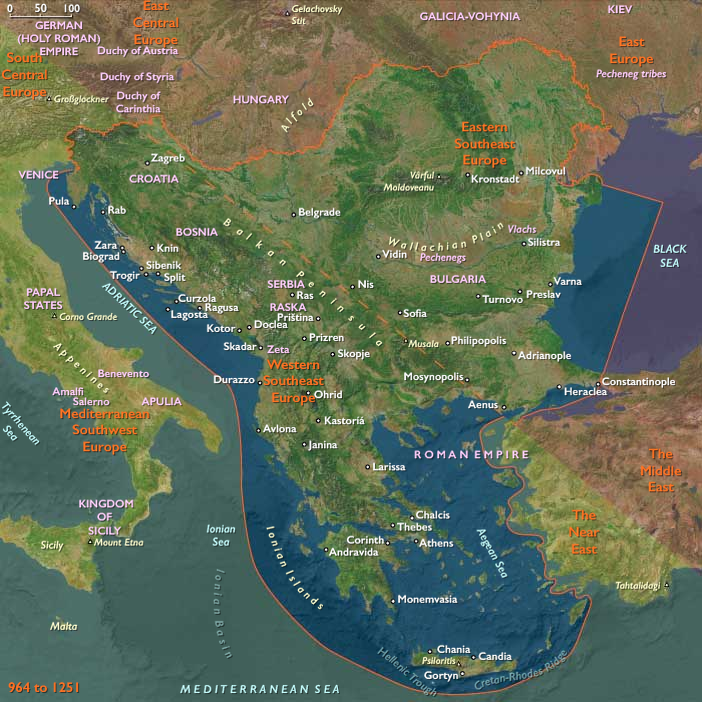
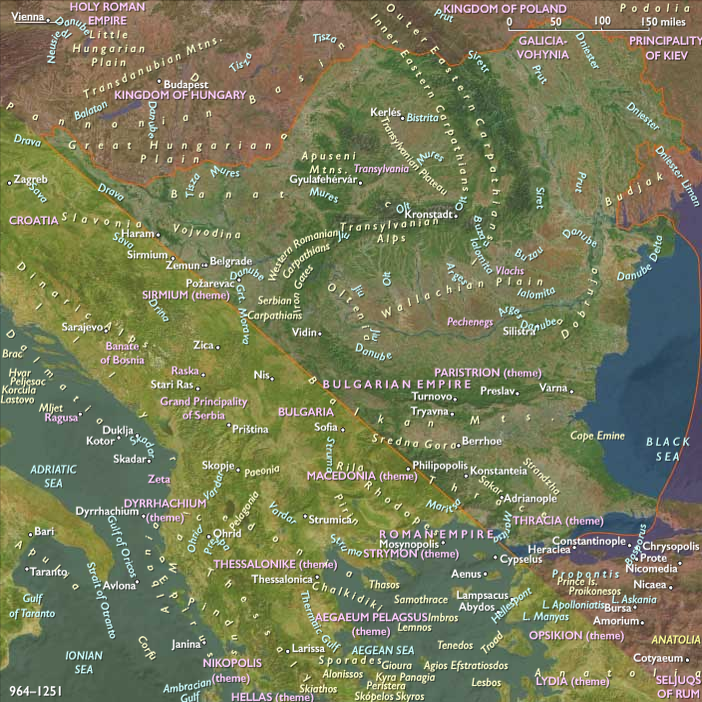
Circumstances have hindered Baldwin from accomplishing anything with the aid from Europe: by 1245, his treasury is empty, and he is forced to break up parts of the imperial palace for firewood.
He travels again to the West, first to Italy and then to France, where he will spend two years.
The empress Marie and Philip of Toucy govern during his absence.
Locations
People
Groups
- Papal States (Republic of St. Peter)
- Flemish people
- Flanders, County of
- Italy, Kingdom of (Holy Roman Empire)
- French people (Latins)
- France, (Capetian) Kingdom of
- Italians (Latins)
- Latin Empire of Constantinople (“Romania”)
Topics
Commodoties
Subjects
Regions
Subregions
Related Events
Filter results
Showing 10 events out of 19 total
English cannon had first been used at the Battle of Crécy, in 1346, during the Hundred Years' War.
It was during this period, the Middle Ages, that cannons had become standardized, and more effective in both the anti-infantry and siege roles.
Several technological advancements had been made by end of the fifteenth century, making cannon more mobile.
Wheeled gun carriages and trunnions became common, and the invention of the limber further facilitated the transportation of artillery.
As a result, field artillery has become viable, and begun to emerge, often used alongside the larger cannon intended for sieges.
The better gunpowder, improved, cast-iron projectiles, and the standardization of calibers mean that even relatively light cannon can be deadly.
Cannon were made by the sixteenth century in a great variety of lengths and bore diameters, but the general rule is that the longer the barrel, the longer the range.
Some cannon made during this time have barrels exceeding ten feet (three meters) in length, and can weigh up to twenty thousand pounds pounds (ninety-one hundred kilograms).
Consequently, large amounts of gunpowder are needed, to allow them to fire stone balls several hundred yards.
The first single-cast iron cannon is made in England in 1543.
St. Philip's Church had been planned when the nearby medieval church of St. Martin in the Bull Ring became insufficient to house its congregation because of the growing population of Birmingham.
The land, previously named The Barley Close, had been donated in 1710 by Robert Philips.
It is one of the highest points in the district and is said to be at the same level as the cross on St. Paul's Cathedral in London.
Following an Act of Parliament, construction had commenced in 1711, to the design of Thomas Archer, and is ready for consecration in 1715, when it is dedicated to the Apostle Philip as a tribute to the benefactor Robert Philips.
It appears to have been Archer's first church, apart from a rebuilt chancel at Chicheley attributed to him.
Construction had been estimated to cost twenty thousand pounds, however, the final figure is only five thousand and twelve pounds (six hundred and sixty thousand pounds as of 2012).
This is because many of the materials had been donated and transported to the site at no cost.
St. Philip's will serve as a Parish church from 1715 to 1905, when it will become the cathedral of the newly formed Diocese of Birmingham in the West Midlands.
Franklin belongs to a gentleman's club (designated "honest Whigs" by Franklin), which holds stated meetings, and includes members such as Richard Price and Andrew Kippis.
He is also a corresponding member of the Lunar Society of Birmingham, which includes such other scientific and industrial luminaries as Matthew Boulton, James Watt, Josiah Wedgwood and Dr. Darwin.
James Watt had demonstrated the first practical steam engine in 1769.
His improvements are fundamental to the changes brought by the Industrial Revolution in both Britain and the world.
The first engines are finally installed and working in commercial enterprises in 1776.
These first engines are used for pumps and produced only reciprocating motion to move the pump rods at the bottom of the shaft.
Orders begin to pour in and for the next five years the Scottish inventor will be very busy installing more engines, mostly in Cornwall for pumping water out of mines.
In 1714 and 1715, the townspeople, as part of a "Church-and-King" mob, had attacked Dissenters (Protestants who do not adhere to the Church of England or follow its practices) in the Sacheverell riots during the London trial of Henry Sacheverell, and in 1751 and 1759 Quakers and Methodists had been assaulted.
During the anti-Catholic Gordon Riots in 1780, large crowds had assembled in Birmingham.
In 1766 and 1782 ,mobs had protested high food prices; they will do so again in 1795, and 1800.
Up until the late 1780s, religious divisions had not affected Birmingham's elite.
Dissenter and Anglican lived side by side harmoniously: they were on the same town promotional committees; they pursued joint scientific interests in the Lunar Society; and they worked together in local government.
They stood united against what they viewed as the threat posed by unruly plebeians.
After the riots, however, scientist and clergyman Joseph Priestley argues in his An Appeal to the Public on the Subject of the Birmingham Riots (1791) that this cooperation had not in fact been as amicable as generally believed.
Priestley reveals that disputes over the local library, Sunday Schools, and church attendance had divided Dissenters from Anglicans.
In his Narrative of the Riots in Birmingham (1816), stationer and Birmingham historian William Hutton will agree, arguing that five events stoked the fires of religious friction: disagreements over inclusion of Priestley's books in the local public library; concerns over Dissenters' attempts to repeal the Test and Corporation Acts; religious controversy (particularly involving Priestley); an "inflammatory hand-bill"; and a dinner celebrating the outbreak of the French Revolution.
Alongside this notice is a threat: "an authentic list" of the participants will be published after the dinner.
On the same day, "an ultra-revolutionary" handbill, written by James Hobson (although his authorship is not known at this time), had entered circulation.
Town officials offer one hundred guineas for information regarding the publication of the handbill and its author, to no avail.
The Dissenters find themselves forced to plead ignorance and decry the "radical" ideas promoted by the handbill.
It is becoming clear by July 12 that there will be trouble at the dinner.
At this point, Joseph Priestley's friends, fearing for his safety, dissuade him from attending the dinner.
About ninety resolute sympathizers of the French Revolution come to celebrate on the 14th; the banquet is led by James Keir, an Anglican industrialist who is a member of the Lunar Society of Birmingham.
When the guests arrive at the hotel at 2 or 3 p.m., they are greeted by sixty or seventy protesters who temporarily disperse while yelling, rather bizarrely and confusingly, "no popery".
By the time the celebrants end their dinner, around 7 or 8 p.m., a crowd of hundreds had gathered.
The rioters throw stones at the departing guests and sack the hotel.
The crowd then moved on to the Quaker meeting-house, until someone persuades them instead to attack the New Meeting chapel, where Priestley presides as minister.
The New Meeting chapel is burned to the ground, quickly followed by the Old Meeting, another Dissenting chapel.
The rioters proceed to Priestley's home, Fairhill at Sparkbrook.
Priestley barely has time to evacuate and he and his wife flee from Dissenting friend to friend during the riots.
Writing shortly after the event, Priestley will describe the first part of the attack, which he witnesses from a distance.
His son, William, stays behind with others to protect the family home, but they are overcome and the property is eventually looted and razed to the ground.
Priestley's valuable library, scientific laboratory, and manuscripts are largely lost in the flames.
The Earl of Aylesford attempts to stem the mounting violence on the night of the 14th, but despite having the help of other magistrates, he is unable to control the crowd.
Thomas Woodbridge, the Keeper of the Prison, deputizes several hundred people to help him quell the mob, but many of these join in with the rioters themselves.
The crowd destroys John Ryland's home, Baskerville House, and drinks the supplies of liquor that they find in the cellar.
When the newly appointed constables arrive on the scene, the mob attacks and disarms them.
One man is killed.
The local magistrates and law enforcement, such as it is, does nothing further to restrain the mob and will not read the Riot Act until the military arrives on July 17.
Other rioters burn down banker John Taylor's home at Bordesley Park.
They burn Cox's farm at Warstock and loot and attack the home of a Mr. Taverner.
When they reach Kingswood, Warwickshire, they burn the Dissenting chapel and its manse.
By this time, Birmingham has shut down—no business is being conducted.
The Baptist Meeting at Kings Heath, another Dissenting chapel, is also destroyed.
William Russell and William Hutton try to defend their homes, but to no avail—the men they have hired refused to fight the mob.
When the rioters arrived at John Taylor's other house at Moseley, Moseley Hall, they carefully move all of the furniture and belongings of its current occupant, the frail Dowager Lady Carhampton, a relative of George III, out of the house before they burn it: they are specifically targeting those who disagree with the king's policies and who, in not conforming to the Church of England, resist state control.
The homes of George Russell, a Justice of the Peace, Samuel Blyth, one of the ministers of New Meeting, Thomas Lee, and a Mr. Westley all come under attack on the 15th and 16th.
The manufacturer, Quaker, and member of the Lunar Society Samuel Galton only saves his own home by bribing the rioters with ale and money.
Years: 1245 - 1245
Locations
People
Groups
- Papal States (Republic of St. Peter)
- Flemish people
- Flanders, County of
- Italy, Kingdom of (Holy Roman Empire)
- French people (Latins)
- France, (Capetian) Kingdom of
- Italians (Latins)
- Latin Empire of Constantinople (“Romania”)
