
Robert Henri's vigorous ideas attract a group …
Years: 1897 - 1897
Robert Henri's vigorous ideas attract a group of young illustrators from the Philadelphia press: John Sloan, Everett Shinn, George Luks, and William J. Glackens.
A Cincinnati native, Henri had studied painting at the Pennsylvania Academy of the Fine Arts, Philadelphia, from 1884 to 1888, and at both the Académie Julian and the École des Beaux-Arts in Paris.
Upon returning to the United States in 1892 at twenty-seven, he became an instructor at the School of Design for Women in Philadelphia.
By 1895, Henri had come to reconsider his earlier love of Impressionism, calling it a "new academicism."
He was urging his friends and proteges to create a new, more realistic art that would speak directly to their own time and experience.
He believes that it is the right moment for American painters to seek out fresh, less genteel subjects in the modern American city.
The paintings by Henri, Sloan, Glackens, Luks, Shinn, and others of their acquaintance that are inspired by this outlook willl eventually come to be called the Ashcan School of American art.
They spurn academic painting and Impressionism as an art of mere surfaces.
Ashcan painters will begin to attract public attention in the same decade in which the realist fiction of Stephen Crane, Theodore Dreiser, and Frank Norris finds its audience and the muckraking journalists are calling attention to slum conditions.
For several years, Henri divides his time between Philadelphia and Paris, where he meets the Canadian artist James Wilson Morrice.
Morrice introduces Henri to the practice of painting pochades on tiny wood panels that can be carried in a coat pocket along with a small kit of brushes and oil.
This method facilitates the kind of spontaneous depictions of urban scenes that will come to be associated with his mature style.
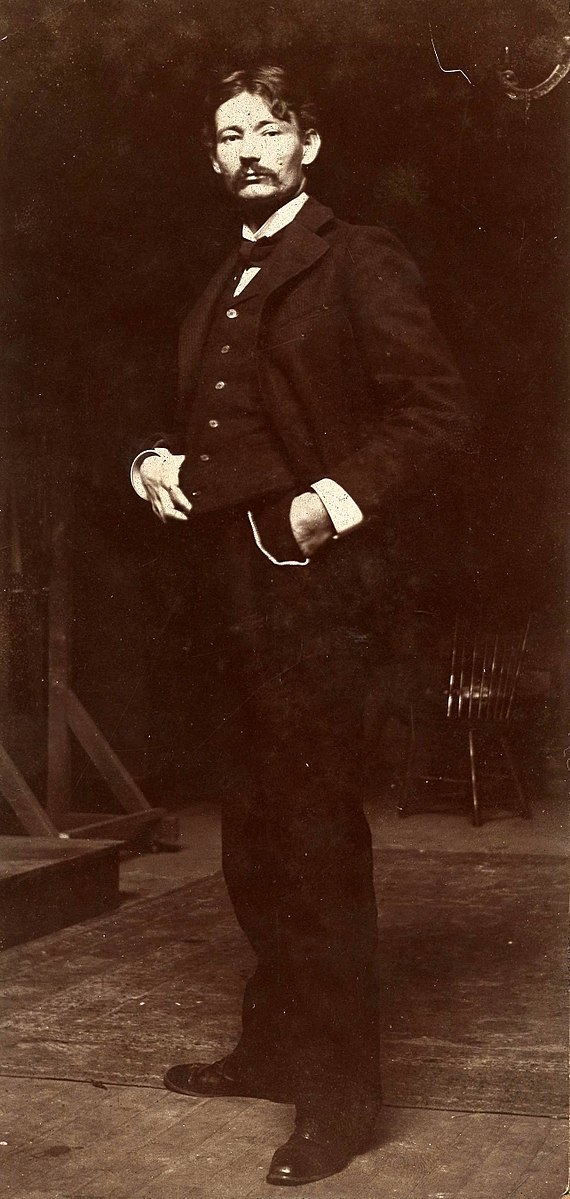
Robert Henri (circa 1897) 19 cm x 9 cm (Original); Archives of American Art
Locations
People
- Everett Shinn
- Frank Norris
- George Luks
- James Wilson Morrice
- John Sloan
- Robert Henri
- Stephen Crane
- Theodore Dreiser
- William J. Glackens
Groups
Topics
Subjects
Regions
Subregions
Related Events
Showing 10 events out of 9270 total
Years: 1897 - 1897
Robert Henri (circa 1897) 19 cm x 9 cm (Original); Archives of American Art
Locations
People
- Everett Shinn
- Frank Norris
- George Luks
- James Wilson Morrice
- John Sloan
- Robert Henri
- Stephen Crane
- Theodore Dreiser
- William J. Glackens
Groups
Topics
Subjects
Regions
Subregions