
Cicero, whose father is a well-to-do member …
Years: 79BCE - 79BCE
Cicero, whose father is a well-to-do member of the equestrian order with good connections in Rome but as a semi-invalid cannot enter public life, has compensated for this by studying extensively.
He has used his knowledge of Greek to translate many of the theoretical concepts of Greek philosophy into Latin, thus translating Greek philosophical works for a larger audience.
It is precisely his broad education that ties him to the traditional Roman elite.
Cicero according to Plutarch was an extremely talented student, whose learning attracted attention from all over Rome, affording him the opportunity to study Roman law under Quintus Mucius Scaevola.
Cicero's fellow students were Gaius Marius Minor, Servius Sulpicius Rufus (who became a famous lawyer, one of the few whom Cicero considered superior to himself in legal matters), and Titus Pomponius.
The latter two became Cicero's friends for life, and Pomponius (who later received the nickname "Atticus") would become Cicero's longtime chief emotional support and adviser.
Cicero had wanted to pursue a public civil service career along the steps of the Cursus honorum.
An intellectual first and foremost with no taste for military life, he had nevertheless served both Gnaeus Pompeius Strabo and Lucius Cornelius Sulla in 90 BCE–88 BCE as they campaigned in the Social War.
Cicero in around 83-81 BCE had started his career as a lawyer.
His first major case, of which a written record is still extant, was his defense of Sextus Roscius in 80 BCE on the charge of patricide.
Taking this case was a courageous move for Cicero; patricide was considered an appalling crime, and the people whom Cicero accused of the murder, the most notorious being Chrysogonus, were favorites of Sulla.
It would have been easy for the dictator Sulla at this time to have the unknown Cicero murdered.
Cicero's defense was an indirect challenge to Sulla, and on the strength of his case, Roscius had been acquitted.
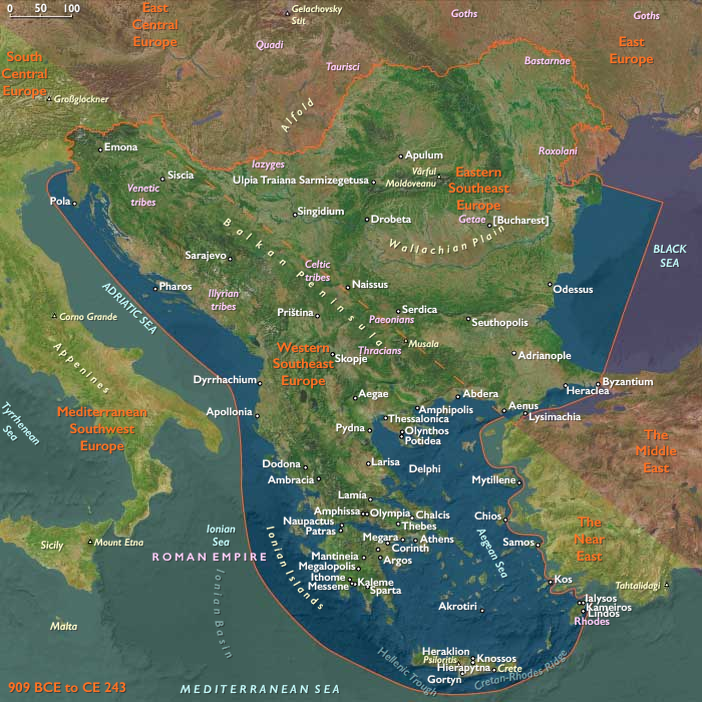
Cicero leaves in 79 for Greece, Asia Minor and Rhodes, perhaps because of the potential wrath of Sulla.
He journeys first to Athens, where he becomes reacquainted with his old classmate Titus Pomponius, who so loves Athens and its culture that he has taken upon himself the nickname "Atticus", or "Man of Attica.”
Atticus introduces Cicero to some significant Athenians, where his his chief instructor is the rhetorician Apollonius Molon of Rhodes.
Locations
People
Groups
Topics
Commodoties
Subjects
Regions
Subregions

Years: 79BCE - 79BCE
Locations
People
Groups
Topics
Commodoties
Subjects
Regions
Subregions