Christopher quickly represses a peasant rebellion in …
Years: 1441 - 1441
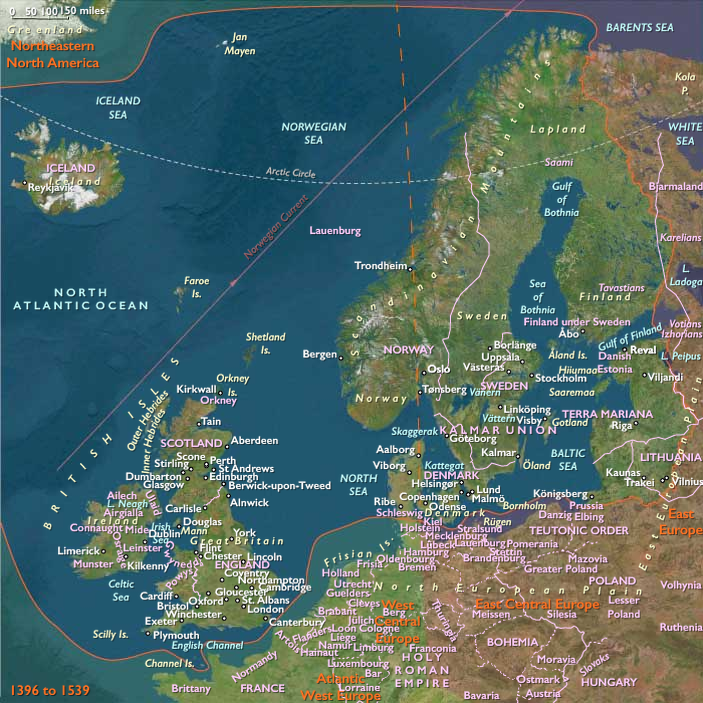
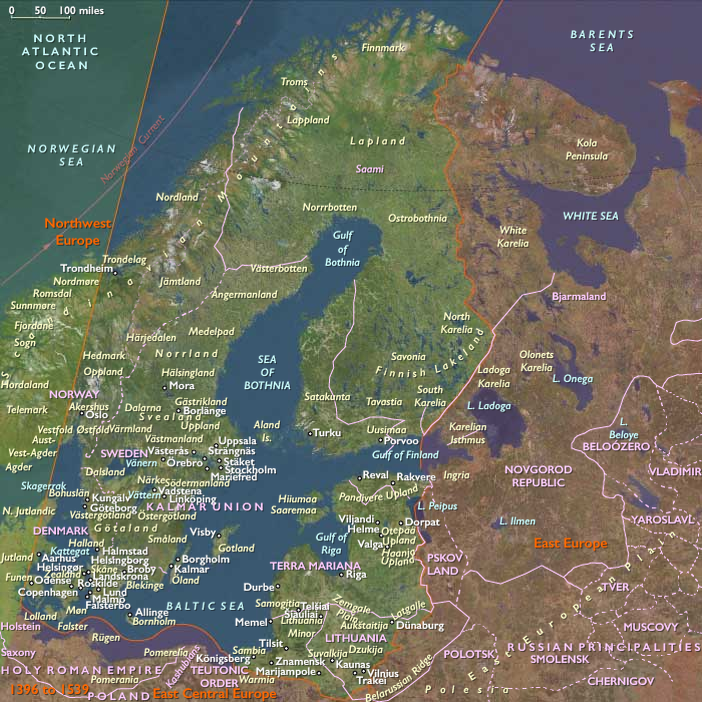
Christopher quickly represses a peasant rebellion in north Jutland in 1441.
He yields, however, to the towns of the Hanseatic League and restores their commercial privileges in Scandinavia, despite the protests of Danish merchants.
Locations
People
Groups
Subjects
Regions
Subregions
Related Events
Filter results
Showing 10 events out of 41809 total
Nanjing (Nanking) receives its present name in 1441.
Farmers living around Kyoto attack the pawnbrokers in 1441 and demand that the Muromachi bakufu—the government of the shogun, or hereditary military dictator, of Japan—declare a moratorium on debts.
Hereafter, uprisings will occur on a greater or lesser scale almost yearly—testimony to the fading power of both the bakufu and the shoen system, the private, tax-free, often autonomous estates or manors whose rise had from the eighth century undermined the political and economic power of the emperor and contributed to the growth of powerful local clans.
The Golden Horde has begun fragmenting into a number of khanates, including that of…
…Kazan', formed in 1438 under Ulugh Muhammad, and …
…the Crimea Khanate.
The Khanate of the Crimea originates in the early fourteenth century when certain Turkish clans of the Golden Horde Empire cease their nomadic life in the Desht-i Kipchak (Kypchak Steppes of today's Ukraine and southern Russia) and decide to make Crimea their yurt (homeland).
At this time, the Golden Horde of Mongol empire had governed the Crimean peninsula as an ulus since 1239, with its capital at Qirim (Staryi Krym).
The local separatists had invite a Genghisid contender for the Golden Horde throne, Hacı Giray, to become their khan.
Accepting their invitation, Hacı Giray had traveled from exile in Lithuania and has warred for independence against the Horde from 1420 to 1441, in the end achieving success.
The Crimean Tatars, led by Haci Giray, establish a khanate at Bakhchysarai in 1446.
Haci Giray had ascended the throne after a long struggle against the khans of the Golden Horde for the independence of the Crimean Khanate in which he was supported by the Grand Duchy of Lithuania.
While some sources state he came to power as early as 1428 or 1434, the first coins of Haci Giray are not earlier than 1441.
The founder the Giray Dynasty of the Crimean Khans, Haci Giray introduces the new state symbol: "taraq tamğa" or "the trident of Girays", which is a derivation from the scales insignia of Golden Horde.
He establishes his residence in Salaçıq village (the vicinities of modern Bakhchisaray near the Çufut Qale fortress).
A contemporary European source, The Chronicle of Dlugosz, described him as a person of outstanding personal values and a perfect governor.
The Prussian Confederation or Alliance against Lordship is formed on February 21, 1440 by a group of fifty-three gentry and clergy and nineteen Prussian cities, under the leadership of the Hanseatic cities of Danzig (Gdańsk), Elbing (Elbląg), and Thorn (Toruń).
Led by Johannes von Baysen, a disgruntled Teutonic Knight, its purpose is the resistance against high taxes and policies of the Teutonic Order, which rules the Monastic State of the Teutonic Knights, based on Prussian lands.
The Ottoman armies are at first successful against a Hungarian-Serbian-Karaman alliance, but in 1441, Hunyadi, recently named governor (vajda) of Transylvania, leads an army of mainly Slavs and Magyars against advancing Turkish troops, winning the Battle of Semendria in 1441.
Muhammad ibn Falah and his followers had been defeated in 1440 in a clash with the authorities, but in February 1441 they manage to capture the city of Hoveyzeh, which becomes the seat of the extremist Musha'sha' movement.
Warfare persists, but Muhammad ibn Falah is able to consolidate his power in the vicinity of Hoveyzeh and the Tigris River.
He owes his success as much to the weakness and division of his opponents as to his own messianic zeal and doctrinal propaganda.
The doctrinal foundations of the Musha'sha' are found in Muhammad ibn Falah's Kalam al-mahdi (“The Words of the Mahdi”).
Written in the style of the Qur'an, the book contains a rigid code of conduct regulating the affairs of the community.
Beside acting as the spiritual leader of the Musha'sha', he is also the military and temporal ruler of the movement.
A theologian reputed to be descended from the seventh Shi'ite imam, Musa al-Kazim, Muhammad ibn Fala had received a traditional Islamic religious education in al-Hillah, a famous center for Shi'ite studies.
As a student he had been noted for his extremist religious views, which bordered on heresy, and he had been excommunicated from the faith by his teacher, himself a noted Shi'ite theologian.
Muhammad ibn Falah from 1436 onward has actively propagated his views among Arab tribesmen, trying to create a coalition of discontented Arab tribes on what is now the border between Iraq and Iran.
This coalition is held together by his contention that he is the mahdi (the “divinely guided one”) and the representative of 'Ali (whom the Shi'ites regard as the legitimate successor to the Prophet Muhammad).

Two different subtribes of the Mossi people, the Yonyonse and the Ninsi, inhabit the central plateau of what is today Burkina Faso.
They have been in constant conflict until 1441 when Wubri, a Yonyonse hero and an important figure in Burkina Faso’s history, leads his tribe to victory.
He now renames the area from “Kumbee-Tenga”, as the Ninsi had called it, to “Wogodogo”, meaning "where people get honor and respect."
The structures of this and similar Mossi states seem to have been erected about the fifteenth century by relatively small bands of immigrants who eventually merged with the autochthonous Gur-speaking inhabitants of the Volta basin.
Their success in conquering and organizing the Gur villages into kingdoms seems to have been due to their possession of cavalry, which subsequently will remain a badge of royalty and of aristocracy.