
Christian, anointed by the restored Archbishop Gustav …
Years: 1520 - 1520
November
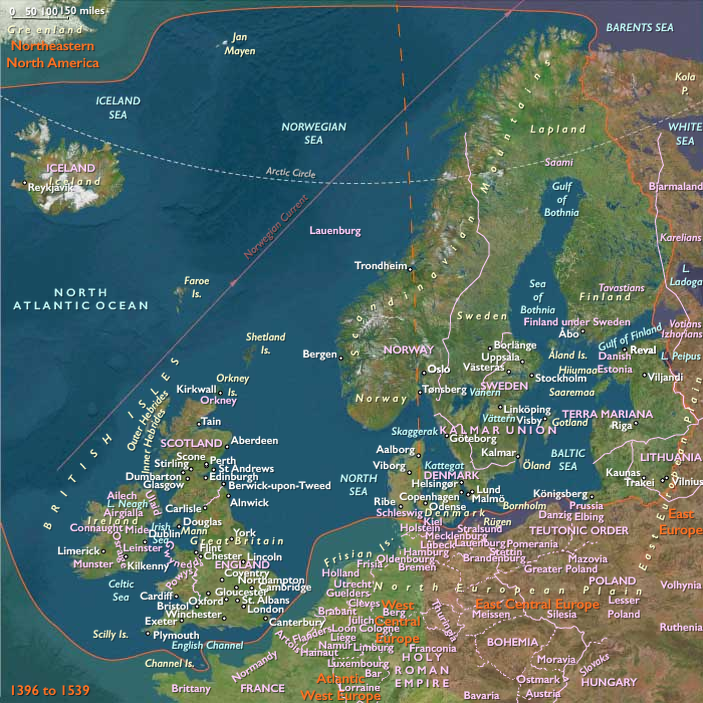
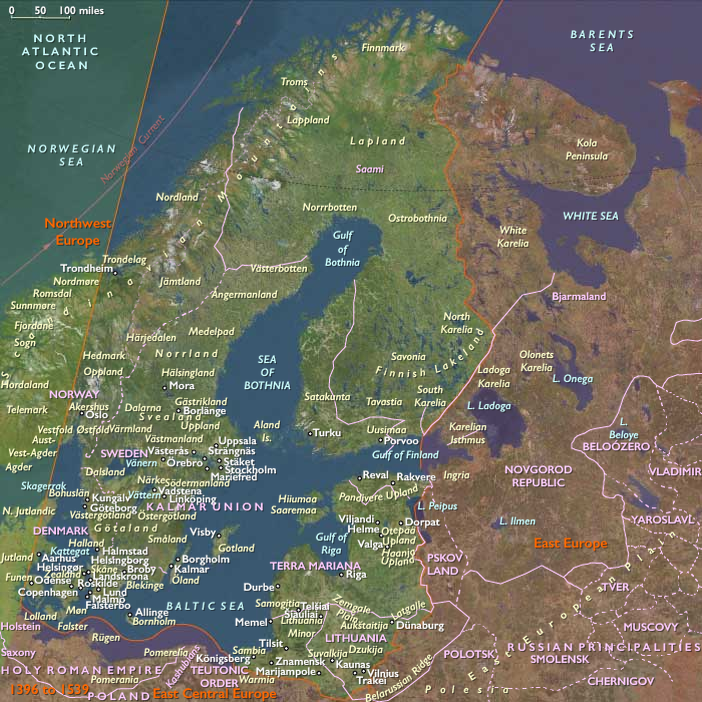
Christian, anointed by the restored Archbishop Gustav Trolle in Storkyrkan Cathedral on November 4, takes the usual oath to rule the kingdom through native-born Swedes only.
A banquet is held for the next three days.
On the evening of November 7, Christian summons many Swedish leaders to a private conference at the palace.
At dusk on November 8, Danish soldiers, with lanterns and torches, enter a great hall of the royal palace and take away several noble guests.
Later in the evening, many others of the king's guests are imprisoned.
The following day, November, 9 a council, headed by Archbishop Trolle, sentences the prisoners to death for heresy; the main point of the accusation is their having united in a pact to depose Trolle a few years earlier.
The deposition of a bishop as a crime against the church and, as the king has no authority to issue pardons for this act, he can punish them without violating his pledge.
However, many of the accused are also leading men of the Sture party and thus potential opponents of the Danish kings.
Christian now takes his revenge, known as the Stockholm Bloodbath.
At noon, the anti-unionist bishops of Skara and Strängnäs are led out into the great square and beheaded.
Fourteen noblemen, three burgomasters, fourteen town councilors and about twenty common citizens of Stockholm are then hanged or decapitated.
Kristina's brother Erik Nilsson, Lord of Tullgarn, is executed by beheading, as are many other Swedish magnates.
Gyllenstierna inherits Tullgarn, little benefit as it now does her.
Her husband's remains are exhumed and burned publicly at the stake as a heretic.
Lady Kristina is declared a great traitor and rebel, and as such King Christian calls upon her and publicly asks her to choose: which does she prefer, to be burned at the stake or to be buried alive?
Confronted with this choice, she is unable to reply and faints with horror.
After this, Christian is advised to spare her life.
To save her life, she cedes a large part of her property to Christian.
Gyllenstierna's mother Sigrid is sentenced to be drowned (the only woman condemned to death), but avoids execution by surrendering all her estates.
The executions continue throughout the following day.
According to the chief executioner Jörgen Homuth, eighty-two people are executed.
The details and death toll are uncertain, for Christian himself wanted the public execution to have as strong effect as possible, and later, King Gustav I of Sweden is likely to have boosted the figures to support his Danish War.
Christian justifies the massacre in a proclamation to the Swedish people as a measure necessary to avoid a papal interdict, but, when apologizing to the Pope for the decapitation of the bishops, he blames his troops for performing unauthorized acts of vengeance.
The Stockholm Bloodbath precipitates a lengthy hostility towards Danes in Sweden, and henceforth the two nations will almost continuously be hostile toward each other.
These hostilities, developing into a struggle for hegemony in the Scandinavian and North German area, will last for nearly three hundred years.
Memory of the Bloodbath will serve to let Swedes depict themselves (and often, actually regard themselves) as the wronged and aggrieved party, even when they are the ones who eventually take the political and military lead, such as the conquest and annexation of Scania until the Treaty of Roskilde in 1658.
Locations
People
Groups
- Christians, Roman Catholic
- Lübeck, Free City of
- Kalmar Union (of Denmark, Norway and Sweden)
- Sweden, autonomous Kingdom of
Topics
Commodoties
Subjects
Regions
Subregions
Years: 1520 - 1520
November
Locations
People
Groups
- Christians, Roman Catholic
- Lübeck, Free City of
- Kalmar Union (of Denmark, Norway and Sweden)
- Sweden, autonomous Kingdom of
Topics
Commodoties
Subjects
Regions
Subregions