
Christ in the House of Martha and …
Years: 1655 - 1655
Christ in the House of Martha and Mary, a painting finished in 1655 by the Dutch painter Johannes Reijniersz Vermeer, is today housed in the National Gallery of Scotland in Edinburgh.
Relatively little is known about Vermeer's life.
He seems to have been exclusively devoted to his art, living out his life in the city of Delft.
The only sources of information are some registers, a few official documents and comments by other artists; it was for this reason that Thoré Bürger named him "The Sphinx of Delft".
Johannes had been baptized on October 31, 1632, in the Reformed Church.
His father, Reijnier Janszoon, was a middle-class worker of silk or caffa (a mixture of silk and cotton or wool).
As an apprentice in Amsterdam, Reijnier had lived on fashionable Sint Antoniesbreestraat, then a street with many resident painters.
He had married Digna Baltus in 1615.
The couple had moved to Delft and had a daughter, Gertruy, who had been baptized in 1620.
Reijnier in 1625 had been involved in a fight with a soldier named Willem van Bylandt, who died from his wounds five months later; Reijnier began dealing in paintings around this time.
He had in 1631 leased an inn called "The Flying Fox" and in 1641 bought a larger inn on the market square, named after the Belgian town "Mechelen".
The acquisition of the inn constitutes a considerable financial burden.
When Vermeer's father died in October of 1652, Vermeer had assumed operation of the family's art business.
Johannes in April 1653 had married a Catholic girl named Catharina Bolenes (Bolnes); the blessing took place in a nearby and quiet village Schipluiden.
For the groom it is a good match: his mother-in-law, Maria Thins, is significantly wealthier than he, and it is probably she who had insisted Vermeer convert to Catholicism before the marriage on April 5.
It is unclear where and with whom Vermeer had apprenticed as a painter.
Speculation that Carel Fabritius may have been his teacher is based upon a controversial interpretation of a text written in 1668 by the printer Arnold Bon.
Art historians have found no hard evidence to support this.
Some scholars think Vermeer was trained under the Catholic painter Abraham Bloemaert.
Vermeer's style is similar to that of some of the Utrecht Carravagists, whose works are depicted as paintings-within-paintings in the backgrounds of several of his compositions.
In Delft Vermeer probably competes with Pieter de Hoogh and Nicolaes Maes who produce genre works in a similar style.
Vermeer had on December 29, 1653, become a member of the Guild of Saint Luke, a trade association for painters.
The guild's records make clear Vermeer did not pay the usual admission fee.
It was a year of plague, war and economic crisis; not only Vermeer's financial circumstances were difficult.
The city of Delft had in 1654, suffered the terrible explosion known as the Delft Thunderclap that destroyed a large section of the city, along with the home, studio, paintings and life of Fabritius.
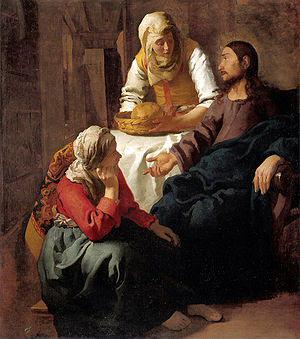
Johannes Vermeer: Christ in the House of Martha and Mary (1655) Oil on canvas, 160 cm × 142 cm (63 in × 56 in), National Gallery of Scotland, Edinburgh
Locations
People
Groups
Topics
Subjects
Regions
Subregions
Related Events
Showing 10 events out of 31579 total
Years: 1655 - 1655
Johannes Vermeer: Christ in the House of Martha and Mary (1655) Oil on canvas, 160 cm × 142 cm (63 in × 56 in), National Gallery of Scotland, Edinburgh
Locations
People
Groups
Topics
Subjects
Regions
Subregions