Chinese traders begin traveling south into present …
Years: 501BCE - 490BCE
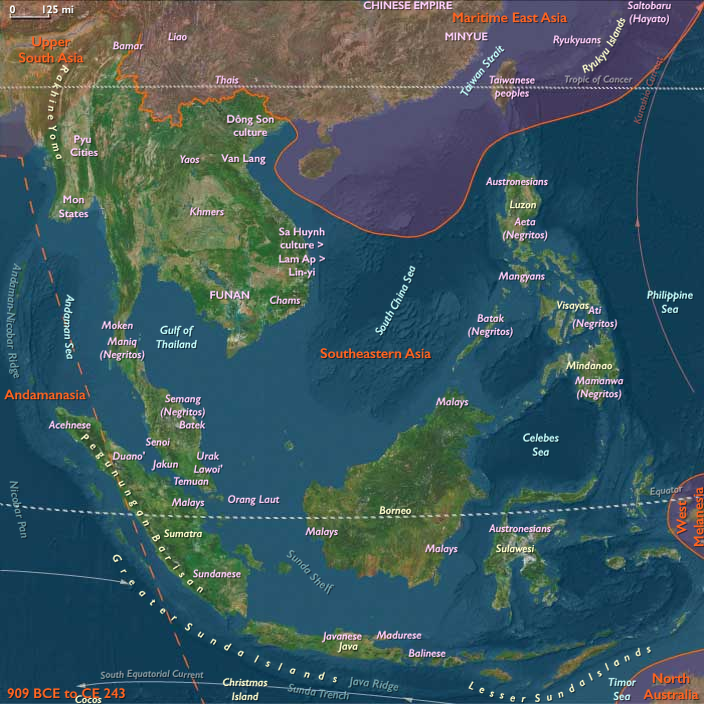
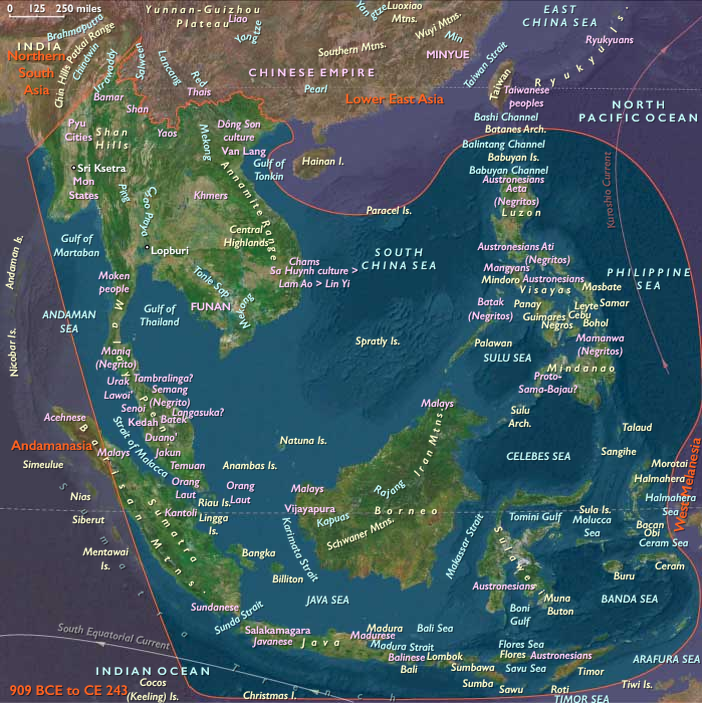
Chinese traders begin traveling south into present northern Vietnam around 500.
Groups
Topics
Subjects
Regions
Subregions
Related Events
Filter results
Showing 10 events out of 65695 total
The Middle East: 501–490 BCE
Cultural Shifts and Prelude to Conflict
Around 500 BCE, significant urban development occurs along the Arabian coast, exemplified by the thriving town at Wusail, located near modern-day Doha. Greek historian Herodotus, writing shortly after this period, notes that the seafaring Canaanites were considered original inhabitants of the region now known as Qatar. This area's strategic location, recognized by subsequent Greek scholars, enhances its importance in regional trade networks.
Under Achaemenid Persian rule, Mesopotamian regions such as Assyria and Babylonia experience a period of flourishing prosperity, becoming vital sources of manpower and economic resources for the Persian Empire. Mesopotamian Aramaic remains the lingua franca, continuing its historical role in facilitating communication and administration across the vast imperial territories.
Despite these developments, Mesopotamian civilization begins to show early signs of decline around 500 BCE, indicating shifts in regional importance as new centers of power and culture rise elsewhere within the Persian realm.
After becoming aware of Persia’s unexpected defeat at the Battle of Marathon in 490 BCE, Darius initiates plans for another campaign against the Greek city-states, resolving to lead the imperial forces personally. The outcome at Marathon profoundly affects the Persian-Greek relationship, laying the groundwork for future large-scale confrontations that will significantly influence the subsequent history of the region.

A large town thrives in about 500 BCE at Wusail, some twenty kilometers north of present Doha (also seen as Ad Dawhah).
The Greek historian Herodotus, writing in the early fifth century BCE, refers to the seafaring Canaanites as the original inhabitants of Qatar.
The influential Greek geographer Ptolemy, active in second century CE in Alexandria, shows in his map of the Arab world a town that scholars believe to be a forerunner to the present Qatari town of Zubarah.
Both Assyria and Babylonia will flourish for the two centuries of Achaemenid rule beginning in the latter half of the sixth century, Achaemenid Assyria in particular having become a major source of manpower for the army and a breadbasket for the economy.
Mesopotamian Aramaic remains the lingua franca of the Achaemenid Empire, much as it had done in Assyrian times.
Mesopotamian civilization begins a general decline, however, after about 500.
Darius, after becoming aware of the Persian defeat at the Battle of Marathon, begins planning another expedition against the Greek-city states; this time, he, not Datis, will command the imperial armies.
The proto-language of the Dravidian languages is thought to have differentiated into Proto-North Dravidian, Proto-Central Dravidian, Proto South-Central Dravidian and Proto-South Dravidian around 500 BCE, although some linguists have argued that the degree of differentiation between the sub-families points to an earlier split.
Many linguists tend to favor the theory that speakers of Dravidian languages spread southwards and eastwards through the Indian subcontinent, based on the fact that the southern Dravidian languages show some signs of contact with linguistic groups which the northern Dravidian languages do not.
The words āyus, meaning "longevity", and veda, meaning "knowledge" or "science", in Sanskrit, combine to form Ayurveda, a system of traditional medicine native to India.
The earliest literature on Indian medical practice appears during the Vedic period in India, i.e., in the mid-second millennium BCE.
The Suśruta Saṃhitā and the Charaka Saṃhitā, encyclopedias of medicine compiled from various sources from the mid-first millennium BCE to about 500 CE, are among the foundational works of Ayurveda.
The religious systems known as Jainism and Buddhism are established in India's northeast, where Indo-Aryan influence is relatively weak, with the wide support of the merchant and landowning aristocracies of eastern India, around the same time as the coalescing of Hinduism.
The adoption by these classes of either of the two religions represents, in part, a revolt against Brahmanism, a term to describe the post-Vedism era, which is central for the development of the modern Brahmin community and their rituals.
Its liturgy is reflected in the mantra portion of the four Vedas.
The religious practices center on a clergy administering rites.
Hinduism begins to coalesce in northwestern India.
The texts known as the Vedas, composed in Vedic Sanskrit and constituting the oldest layer of Sanskrit literature and the oldest scriptures of Hinduism, are complete by about 500.
Travelers and merchants from the Persian Gulf and Western India begin to visit the East African coast in the first millennium CE.
The region of present Tanzania is probably one of the oldest known inhabited areas on Earth; fossil remains of humans and pre-human hominids have been found dating back over two million years.
More recently, Tanzania is believed to have been populated by hunter-gatherer communities, probably Cushitic and Khoisan speaking people.
Bantu-speaking people from western Africa began to arrive about two thousand years ago in a series of migrations.
These groups brought and developed ironworking skills and new ideas of social and political organization.
They absorbed many of the Cushitic peoples who had preceded them, as well as most of the remaining Khoisan-speaking inhabitants.
Nilotic pastoralists are later arrivals, and will continue to immigrate into the area through to the eighteenth century.
The Carthaginian expedition commanded by Hanno the Navigator may have reached Cameroon or Gabon.
Donald Harden notes the description of Mount Cameroon, a four thousand and ninety-five-meter (thirteen thousand four hundred and thirty-five foot) volcano, more closely matches Hanno's description than Guinea's eight hundred and ninety meter (two thousand nine hundred and twenty feet) Mount Kakulima.
Brian Warmington prefers Mount Kakulima, considering Mount Cameroon too distant.
At the terminus of Hanno's voyage, the explorer finds an island heavily populated with what are described as hirsute and savage people.
Attempts to capture the males fail, but three of the females are taken.
These are so ferocious that they are killed, and their skins preserved for transport home to Carthage.
The interpreters call them gorillae, and when European explorers first encounter gorillas in the nineteenth century, the apes are given this name on the assumption that they were the "people" Hanno described, though it is unknown whether what these ancient Carthaginians encountered were truly gorillas, another species of ape or monkeys, or humans.