
Wang Wei is traditionally credited with founding …
Years: 761 - 761
Wang Wei is traditionally credited with founding the Southern school of Chinese landscape painting.
His delicately rendered landscape paintings reflect, like his lyrical poetry, a love of nature and an inner tranquility borne of Buddhism and meditation.
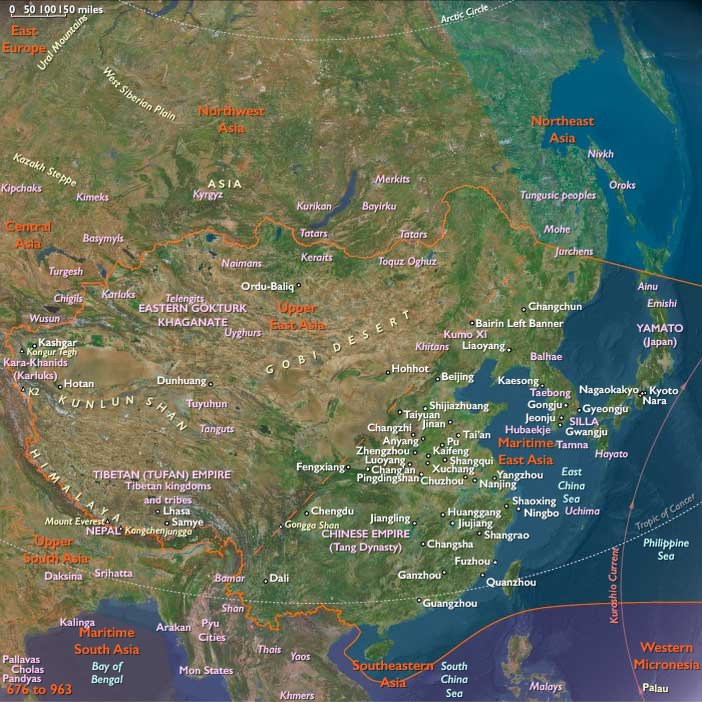
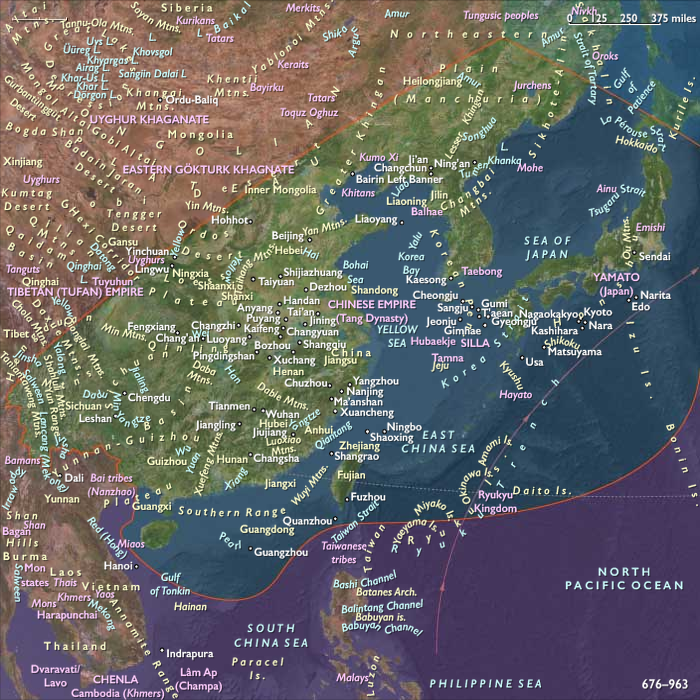
Wang Wei was residing in the capital of Chang'an when he was captured by the rebels when they took the city in 756.
Although the emperor Xuanzong and his court and most of the governmental officials had already evacuated to Sichuan, Wang Wei had come down with dysentery and at that time was an invalid and thus unable to travel, especially not on this notoriously mountainous and difficult passage.
The rebels then took their prize captive to their capital at Luoyang, where the government of the rebellion sought his collaboration.
According to some sources, he attempted to avoid actively serving the insurgents during the capital's occupation by pretending to be deaf; other sources state that, in an attempt to destroy his voice, he drank medicine that created cankers on his mouth.
In any case, at Luoyang, Wang Wei was unable to avoid becoming officially one of the rebels, with an official title.
With the ascendency of Suzong, in 757 and the Tang recapture of Luoyang from the rebel forces, Wang Wei was arrested and imprisoned by the Tang government as a suspected traitor.
The charges of disloyalty were eventually dropped, partly because of the intervention of his brother, Wang Jin, who held high government rank (as Undersecretary of the Board of Punishments) and whose loyal efforts in the defense of Taiyuan were well known.
Furthermore, the poems he had written during his captivity were produced, and accepted as evidence in favor of his loyalty.
Following his pardon, Wang Wei spent much of his time in his Buddhist practice and activities.
Then, with the further suppression of the rebellion, he again received a government position, in 758, at first in a lower position than prior to the rebellion, as a Taizi Zhongchong, in the court of the crown prince rather than that of the emperor himself.
In 759, Wang Wei was not only restored to his former position in the emperor's court, but he was eventually promoted.
Over time, he was moved to the secretarial position of Jishizhong and his last position, which he held until his death in 761, was Shangshu Youcheng, or Deputy Prime Minister.
As these positions are in the city of Chang'an, they are not too far from his private estate to prevent him from visiting and repairing it.
During all this time, he has continued his artistic endeavors.
Locations
People
Groups
Topics
Commodoties
Subjects
Regions
Subregions
Years: 761 - 761
Locations
People
Groups
Topics
Commodoties
Subjects
Regions
Subregions