Chinese bronze urns and vases, molded in …
Years: 1485BCE - 1342BCE
Chinese bronze urns and vases, molded in sections to extremely complex designs, had appeared suddenly under the Shang dynasty with no previous evidence of a metal technology other than jade carving.
Locations
Groups
Topics
Commodoties
Subjects
Regions
Subregions
Related Events
Filter results
Showing 10 events out of 67537 total
The Maritime Revolution (1485-1342 BCE): The Old Whaling Culture Emergence
The Genesis of Arctic Maritime Mastery
The age of 1485-1342 BCE marked a revolutionary transformation in Arctic subsistence strategies as the enigmatic Old Whaling culture emerged along the Eskimo-occupied coasts around 1500 BCE. The Old Whalers appeared suddenly at Cape Krusenstern, representing a mysterious people who lived there during this early period.
This 143-year span witnessed the development of humanity's first systematic whale hunting traditions in the Arctic, as coastal populations developed the sophisticated maritime technologies and social organization necessary to pursue the ocean's largest prey. Alaskan archaeologists found large whale bones in a cluster of semi-subterranean houses at Cape Krusenstern on the Bering Sea, with people quickly dubbed the Old Whaling Culture, initially thought to be the earliest whalers in the world.
Architectural Innovation and Settlement Patterns
During this age, the Old Whaling peoples established distinctive settlement patterns that would influence Arctic architecture for millennia. The site consists of five semi-subterranean winter houses roughly 100 meters away from five above-ground summer houses. The inhabitants used vertebrae within their houses, possibly as a form of furniture - a tradition that would reemerge around 800 AD in the whaling Thule people.
This architectural innovation represented more than mere shelter; it demonstrated a sophisticated understanding of seasonal cycles and the logistical demands of large-scale marine mammal hunting. The spatial organization between winter and summer structures suggests the development of complex seasonal migration patterns coordinated with whale movements.
Maritime Technology and Cultural Identity
The Old Whaling culture's emergence during 1485-1342 BCE represented a fundamental shift in human-environment relationships. Prehistoric settlements were situated and defended so that people could hunt whales, with the importance of whaling in arctic prehistory being clear. The culture developed at strategic coastal locations that provided optimal access to marine mammal migration routes.
Various whaling tools, like special harpoons and butchering tools, are found at the site, though animal remains don't indicate that whales were the main resource extracted there. This suggests the culture was developing the technological foundations and cultural practices that would later enable true systematic whaling.
The Mysterious Origins and Connections
It is unknown who the inhabitants of the site were or what caused the site to be abandoned, with J.L. Giddings stating that the Old Whalers are the mysterious people of Cape Krusenstern. The origins and cultural connections of the Old Whaling settlement at Cape Krusenstern remain a mystery.
This cultural emergence occurred within the broader context of Arctic Small Tool tradition populations, representing either an internal innovation or the arrival of new peoples with distinct maritime orientations. The sudden appearance of this culture suggests rapid technological and social adaptation to Arctic marine environments.
Trans-Beringian Networks
Evidence suggests this maritime revolution was not isolated to Alaska. Recent findings by a Russian-American research team indicate that prehistoric cultures were hunting whales at least 3,000 years ago, with researchers believing sites on Russia's Chukotka Peninsula belonged to the Old Whaling Culture tradition.
This trans-Beringian distribution implies that during 1485-1342 BCE, Arctic populations maintained sophisticated networks of communication and cultural exchange, sharing innovations in maritime technology and whale hunting strategies across the Bering Sea.
Legacy of the Maritime Transition
The age 1485-1342 BCE established foundational elements that would define Arctic cultures for thousands of years. Whaling plays a significant role in the spiritual life of Arctic peoples, who strive to live in harmony with the land and sea and show great respect for the food and other natural resources available in the arctic north.
The Old Whaling culture's emergence during this age represented more than technological innovation—it marked the beginning of the complex spiritual, social, and economic relationships between Arctic peoples and marine mammals that would become central to circumpolar cultures. This 144-year period laid the groundwork for the sophisticated whaling traditions that would later characterize Thule and modern Inuit cultures, establishing the Arctic as a region where human societies achieved remarkable adaptation to one of Earth's most challenging environments.
Groups from southeastern Asia, primarily speakers of the languages (now) classified as Malayo-Polynesian, have begun to spread out to nearby Pacific Islands.
Saipan, along with neighboring Guam, Rota/Luta, Tinian, and to a lesser extent smaller islands northward, seems to have been first inhabited around 2000 BCE.
Evidence of human habitation in Saipan, the second largest of the Mariana Islands in the western Pacific Ocean, dates from around 1500.
Maritime East Asia (1485–1342 BCE): Shang Dynasty’s Bronze Age Flourishing and Oracle Bone Divination
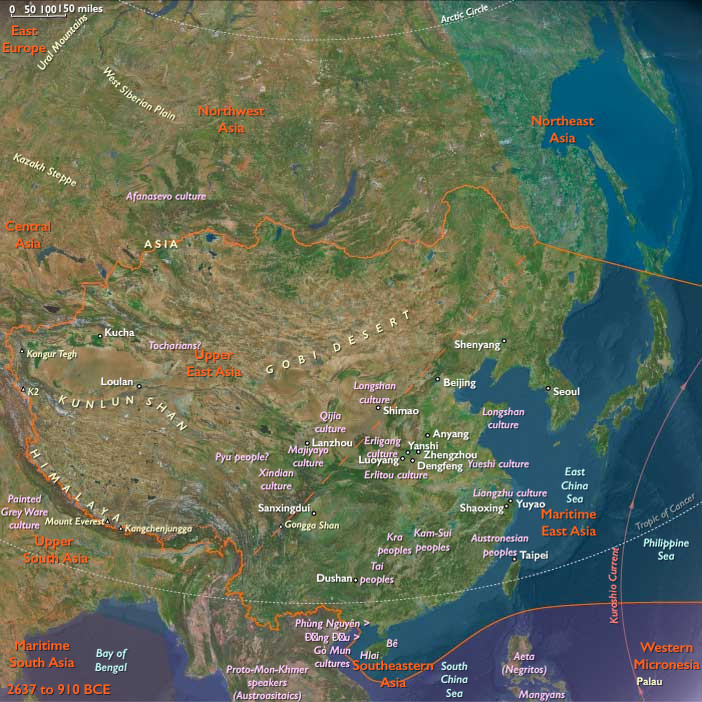
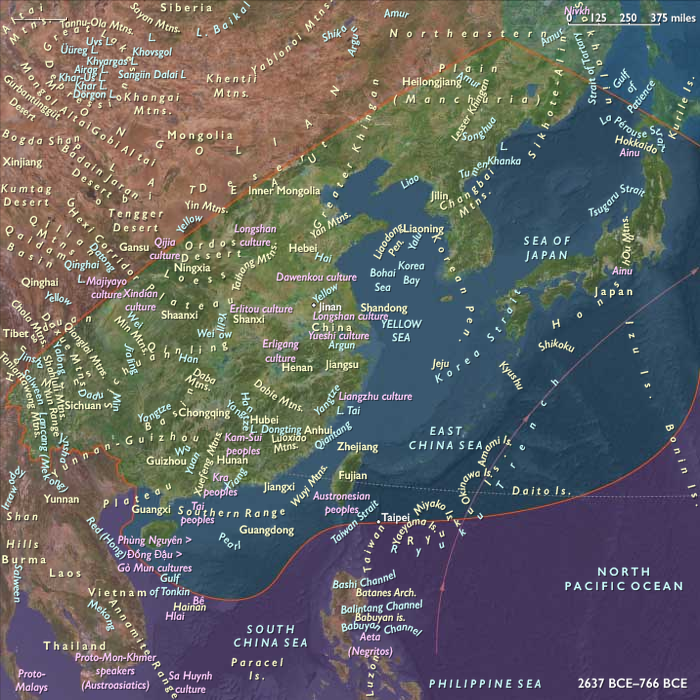
Between 1485 BCE and 1342 BCE, Maritime East Asia—comprising lower Primorsky Krai, the Korean Peninsula, the Japanese Archipelago below northern Hokkaido, Taiwan, and southern, central, and northeastern China—experiences a significant cultural and technological flowering under China’s Shang Dynasty. This era sees the dramatic expansion of sophisticated bronze craftsmanship, the consolidation and expansion of Shang political authority, advancements in construction technology, early medicinal practices, and the widespread use of oracle bone script.
Sophisticated Bronze Craftsmanship
Under the Shang Dynasty, Chinese artisans achieve remarkable advancements in bronze metallurgy, crafting highly sophisticated ceremonial vessels such as urns and vases. Molded in sections and featuring intricate decorative patterns, these bronze artifacts appear quite suddenly around the early Shang period (circa 1600 BCE) without clear prior evidence of a comparable metal technology, aside from earlier jade-carving traditions. This advanced bronze technology attests to the remarkable skill, centralized control, and artistic sophistication of Shang culture.
Political Consolidation and Capital Establishment
The Shang Dynasty, traditionally founded around 1600 BCE by the rebel leader Tang of Shang, refers to its rulers as Sons of Heaven, reinforcing their divine right to rule and legitimizing centralized political authority. Shang civilization primarily depends on agriculture, supplemented by hunting and animal husbandry, forming a stable economic base for political expansion and urban growth.
By approximately 1500 BCE, the Shang establish their early capital at Aodu (Bodu)—modern Zhengzhou (Cheng-chou), located strategically in the Yellow River Valley. Here, Chinese engineers demonstrate advanced construction techniques, including the innovative use of open caissons to stabilize and sink shallow walls in the region’s unstable soils.
The Shang court subsequently moves its capital multiple times—six relocations in total, according to the Records of the Grand Historian—culminating in its final, most significant relocation around 1350 BCE to the city of Yin (modern Anyang). This move initiates the dynasty’s "golden age," marking the peak of its political and cultural dominance.
Extent and Influence of Shang Authority
At its zenith following the move to Yin, the Shang domain expands significantly, extending from the Wei River tributaries west of the central Yellow River Valley, eastward to the Yellow Sea coast, northward toward territories occupied by nomadic peoples on the steppes, and approaching the northern boundaries of the Yangtze River basin to the south. The Shang Dynasty will endure as one of China’s longest dynasties, traditionally featuring thirty-one rulers who succeed each other through a fraternal succession pattern, from Tang to the final king, Zhou of Shang.
Early Medicinal Practices
During this period, early medical records in China document the medicinal use of fermented and moldy substances—derived from animal dung and fermented soybean curd—to treat superficial wounds and swelling. These primitive antibiotic treatments underscore early empirical medical experimentation and reflect the beginnings of China's enduring medicinal traditions.
Oracle Bone Script and Divination Practices
Around 1400 BCE, Shang priests increasingly employ the oracle bone script, a form of Chinese writing inscribed onto animal bones or turtle shells during divination rituals. The vast majority of surviving oracle bones date from the Shang capital at Yin (Anyang), ranging approximately from the fourteenth century to the mid-eleventh century BCE. Although the script’s origins likely predate this era, its widespread use from 1400 BCE onward provides China’s earliest significant corpus of recorded writing, invaluable for understanding Shang religious practices, governance, and daily concerns.
Legacy of the Era: Cultural Sophistication and Technological Innovations
Thus, the era 1485–1342 BCE represents a pivotal phase in Maritime East Asia, characterized by the Shang Dynasty's political stabilization, advanced bronze craftsmanship, early engineering achievements, formative medical practices, and innovations in literacy and divination practices. These developments collectively deepen cultural complexity, expand regional influence, and set a foundation for future historical trajectories across East Asia.

The accumulation of wealth and leisure in the world’s civilized centers has brought about the introduction of curiosity as an important contributing factor in the domain of technology by the middle of the second millennium BCE.
Theorists thus make attempts at solving a variety of numerical and algebraic equations that have no immediate practical uses and at discerning the underlying patterns of empirical calculations.
Nation-states become multinational in this age, including the Shang in China; the Mitanni, the Hittites, the Assyrians, and the Kassites in West Asia, and the Mycenaeans in the Aegean.
A rebel leader who had overthrown the last Xia ruler is believed to have founded China’s Shang dynasty around 1600 BCE.
Its civilization is based on agriculture, augmented by hunting and animal husbandry.
Shang kings call themselves Sons of Heaven.
Aodu, or Bodu, (present-day Zhengzhou, or Cheng-chou, located in the Yellow River valley), one of the earliest known Bronze Age sites in China, has served as the capital of the Shang dynasty from about 1500 BCE, by which time Chinese engineers are using open caissons to sink shallow walls in unstable soil.
Chinese medical records from this period describe the use of moldy and fermented substances from dung and soybean curd to treat wounds and superficial swellings.
The Shang dynasty moved its capital six times, as stated by the Records of the Grand Historian; the final, and most important, move being to Yin (modern Anyang) in 1350 BCE, which leads to what is to be the golden age of the dynasty.
It is to be the longest dynasty in Chinese history, featuring thirty-one kings in fraternal succession from Tang of Shang to King Zhou of Shang.
The Shang domain, now at its height, extends from the Wei River tributary area to the west of the central valley, eastward to the seacoast above the northern edge of the Yangtze River basin, and northward to the steppe country occupied by nomads.
Chinese priests are using the Oracle bone script by 1400 (although its origins probably lie in an earlier time).
Found on oracle bones, which are animal bones or turtle shells used in divination in Bronze Age China.
The vast majority record the pyromantic divinations of the royal house of the late Shang dynasty at the capital of Yin (modern Anyáng, Hénán Province); dating of the Anyáng examples of oracle bone script varies from about the fourteenth to the mid-eleventh centuries BCE.
Smiths in the eastern Balkans begin working with locally mined gold and silver after about 1450 BCE.
Horses and chariots become more common, and trade routes stretch to northern Europe and the Aegean.