Chinese chroniclers of the Ming Dynasty distinguish …
Years: 1407 - 1407
Chinese chroniclers of the Ming Dynasty distinguish three groups of Jurchens—the Wild Jurchens of northernmost Manchuria, …
Locations
Groups
Subjects
Regions
Subregions
Related Events
Filter results
Showing 10 events out of 42521 total
The Ho had tried in vain to regain China's goodwill from 1400 through 1405, having sent emissaries and diplomats with offerings to Beijing but the gifts had each time been refused or belittled.
Ho Quy Ly had realized that this stubborn attitude indicated that sooner or later the Ming would invade his country and obligate him to defend it.
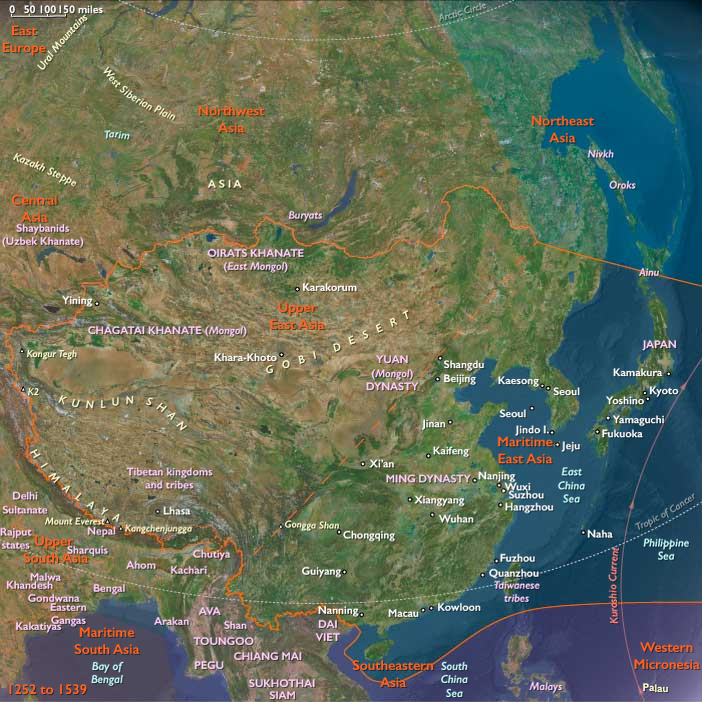
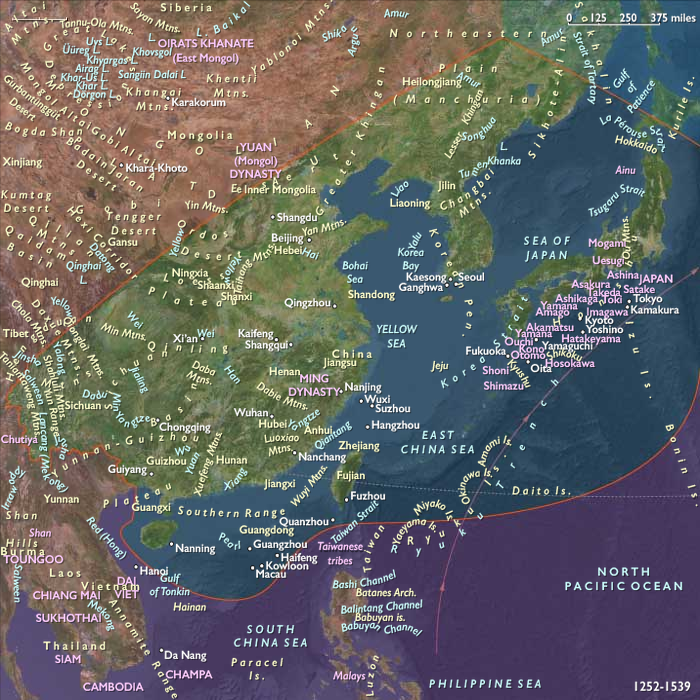
This war had begun in 1406 when Emperor Yongle, in response to several formal petitions from members of the deposed Tran family, had sent a Chinese ambassador to accompany the preeminent Tran prince to Vietnam.
On their arrival, however, their party had been ambushed and both men killed.
To avenge this insult, the Yongle Emperor dispatches a huge army of five hundred thousand south to conquer Vietnam.
the fall of Da Bang fortress, and the defeats of the Ho family at Moc Pham Giang and Ham Tu precipitate the fall dynasty’s fall.
At the Ham Tu battle, Ho Quy Ly, his sons Ho Han Thruong and Ho Nguyen Trung, and other relatives attempt escape but are captured and sent to Guangxi, where Ho Quy Ly is put to work as a Chinese soldier and security guard, a position he is to hold until the end of his life.
As the Ho monarchs had executed the royal family, Dai Viet is integrated as a Chinese province, just as it had been up until 939, and the Chinese initiate what is to be a serious and sustained effort to Sinicize the population.
Unfortunately for the Chinese rulers, their efforts to make Vietnam into a normal province will meet with a significant resistance from the local population.

The kingdom of Champa has controlled what is now southern and central Vietnam from approximately the 7th century (and will do so through 1832).
Champa had reached its apogee in the ninth and tenth centuries but thereafter began a gradual decline under pressure from the Dai Viet of what is now northern Vietnam.
An imperial fleet under the Hui eunuch admiral Zheng He attacks Dai Viet’s southern coast between 1405 and 1407, freeing Champa from the control of the Vietnamese.
About two hundred thousand Chinese troops invade Dai Viet, or Annam, in 1407, opposed by Ho Qui Ly’s troops across the Red River.
Conspirators intent on restoring the Tran dynasty undermine the defenders’ morale, enabling the Chinese invaders to easily defeat the Vietnamese army and capture the usurper and his son Ho Han Thuong, who they send to China (where they are presumably executed).
The Yongle emperor, instead of restoring the Tran family’s sovereignty after his successful invasion of Dai Viet, or Annam, annexes the Vietnamese polity to his empire in 1407, appointing a Chinese governor-general as head of the Annamese state and reorganizing the administration under Chinese officials.
…the Haixi Jurchens of modern Heilongjiang and …
…the Jianzhou Jurchens of modern Jilin province—who hunt, fish, and practice limited agriculture.
In 1388, the Hongwu Emperor had dispatched a mission to establish contact with the tribes of Odoli, Huligai and T'owen, beginning the sinicisation of the Jurchen people.
The Yongle Emperor finds allies among the various Jurchen tribes against the Mongols.
He bestows titles and surnames to various Jurchen chiefs, expecting them to send periodic tribute, and established Chinese prefectures over tribal military units under their own hereditary tribal leaders.
Bunei, ten years after succeeding his father, is formally invested by representatives of the Ming Court in his of King of Chūzan in 1406, less than a year before his own death.
Meanwhile, one aji, by the name of Hashi, had deposed his neighboring lord of Azato in 1402 and seized his territory.
Five years later, he leads a rebellion and overthrows Bunei, establishing his own father, Shishō, as King of Chūzan.
Yongle's tolerance of Chinese ideas that do not agree with his own philosophies is well-known.
Although he favors Confucianism, he treats Daoism, Confucianism, and Buddhism equally.
Strict Confucianists consider him hypocritical, but his even-handed approach helps him win the support of the people and unify China.
His love for Chinese culture is counterbalanced by a sincere hatred for Mongolian culture, which he considers decadent.
Forbidding the use of popular Mongolian names, habits, language, and clothing, the Yongle emperor goes to great lengths to eradicate Mongolian culture from China.
After several invitations by Yongle since 1403, the fifth Karmapa of the Karma Kagyu sect of Tibetan Buddhism, the lama Deshin Shekpa, finally visits the Ming Dynasty capital at Nanjing.
In his twenty-two day visit, he thrills the Ming court with alleged miracles that are recorded in a gigantic scroll translated into five different languages.
In a show of mystical prowess, Deshin Shekpa adds legitimacy to a questionable succession to the throne by Yongle, who had killed his nephew the Jianwen Emperor in the culmination of a civil war.
For his services to the Ming court, including his handling of the ceremonial rites of Yongle's deceased parents, Deshin Shekpa is awarded with the title Great Treasure Prince of Dharma.
The Timurid Emirate now rules the lands from Anatolia to Mesopotamia.
Timur’s fourth son, Shah Rokh, or Rukh, gains power over most of Persia by 1407.
Unlike his father, a man of horrific violence, he works to establish peace and prosperity and patronizes religion and the arts.
Shah Rokh’s son, Ulugh Beg, serves as his father’s viceroy in Transoxiania, where, like his father, he supports the arts.
Yury had returned to Moscow in 1406, reconciled himself with Vasily and …