
Chinese builders construct the Dujiangyan Irrigation System …
Years: 261BCE - 250BCE
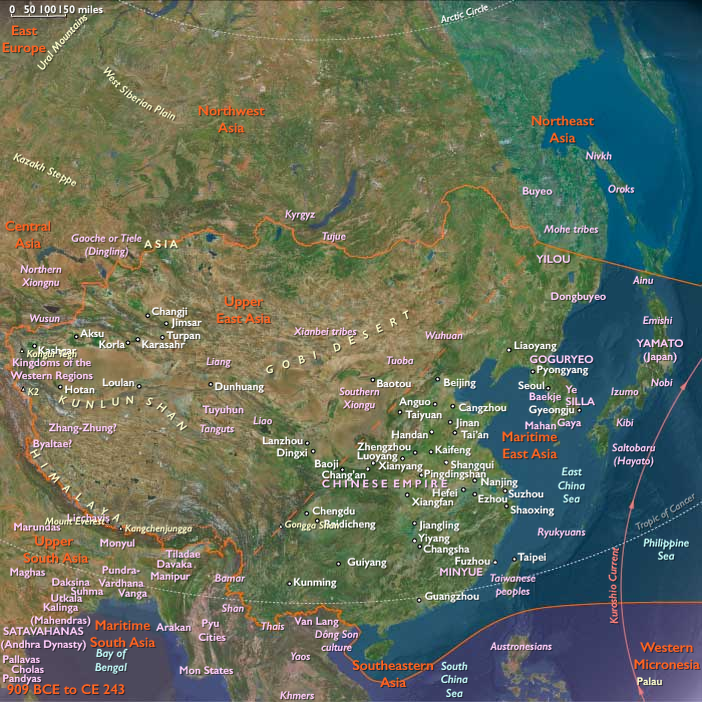
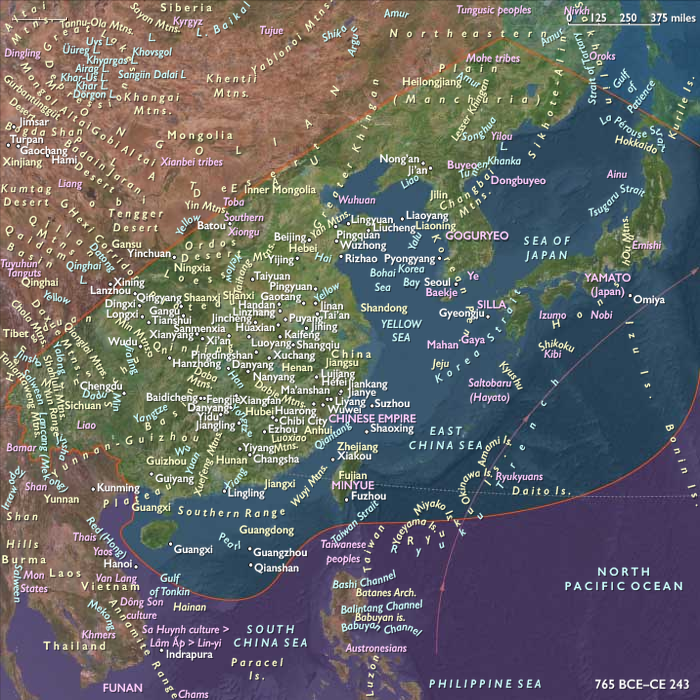
Chinese builders construct the Dujiangyan Irrigation System on the Min River.
During the Warring States period (406–221 BCE), people who live along the banks of the Min River are plagued by annual flooding.
Qin governor Li Bing investigates the problem and discovers that the river is swelled by fast flowing spring melt-water from the local mountains that bursts the banks when it reaches the slow moving and heavily silted stretch below.
One solution would have been to build a dam, but Li Bing has also been charged with keeping the waterway open for military vessels to supply troops on the frontier, so instead he proposes to construct an artificial levee to redirect a portion of the river's flow and then to cut a channel through Mount Yulei to discharge the excess water upon the dry Chengdu Plain beyond.
Li Bing receives one hundred thousand taels of silver for the project from King Zhao of Qin and sets to work with a team said to number tens of thousands.
The levee is constructed from long sausage-shaped baskets of woven bamboo filled with stones, known as Zhulong, and held in place by wooden tripods known as Macha.
The massive construction, which takes four years to complete, is finished in 256 BCE.
Cutting the channel proves to be a far greater problem as the tools available to Li Bing at the time, prior to the invention of gunpowder, are unable to penetrate the hard rock of the mountain so he uses a combination of fire and water to heat and cool the rocks until they crack and can be removed.
After eight years of work, a twenty meter (sixty-six foot) wide channel has been gouged through the mountain.
After the system is finished, no more floods occur.
The irrigation makes Sichuan the most productive agricultural place in China.
On the east side of Dujiangyan, people build a shrine in remembrance of Li Bing.
Li Bing’s construction is also credited with giving the people of the region a laid-back attitude to life.
By eliminating disaster and insuring a regular and bountiful harvest, it has left them with plenty of free time.
Still in use today to irrigate over 5,300 square kilometers (500,000 acres/202,000 hectares) of land in the region, the Dujiangyan, along with the Zhengguo Canal in Shaanxi Province and the Lingqu Canal in Guangxi Province, are known as “The three great hydraulic engineering projects of the Qin Dynasty”.
Locations
People
Groups
Topics
Commodoties
Subjects
Regions
Subregions
Years: 261BCE - 250BCE
Locations
People
Groups
Topics
Commodoties
Subjects
Regions
Subregions