
China’s Tang dynasty, under Emperor Xuanzong, controls …
Years: 735 - 735
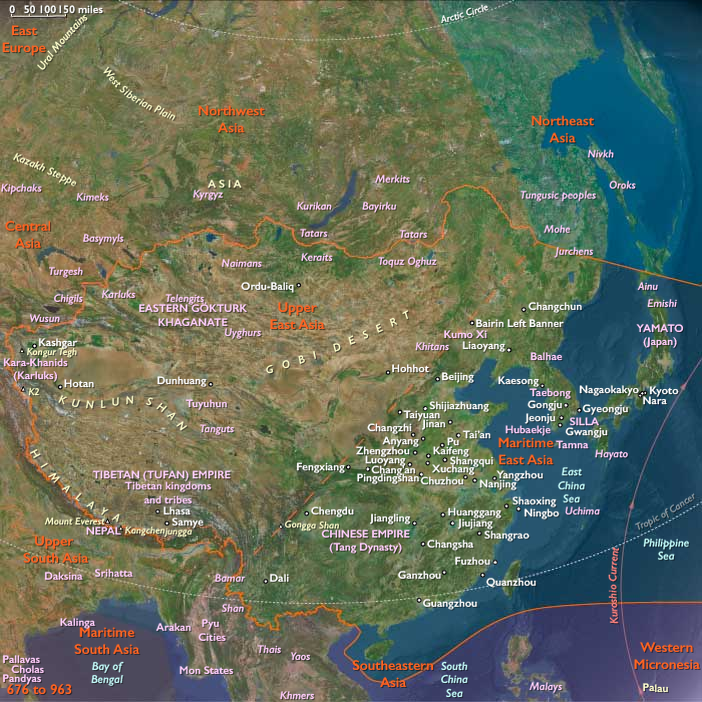
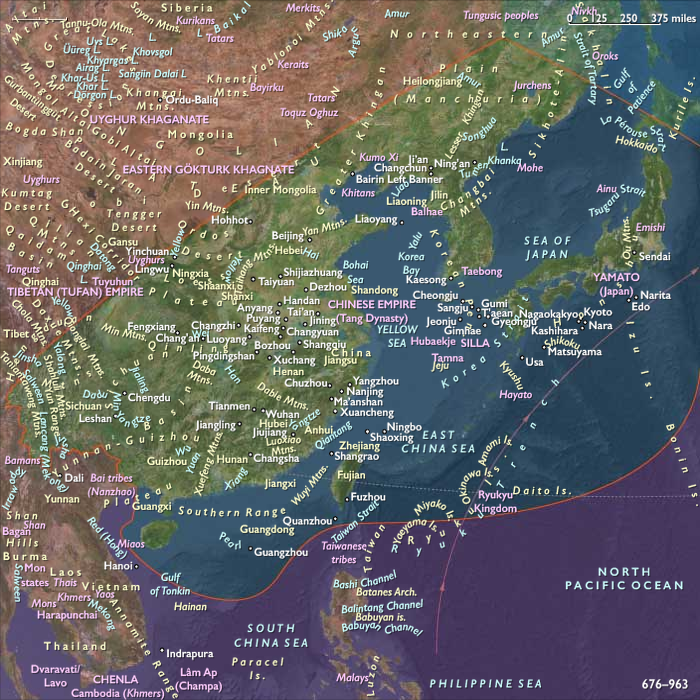
China’s Tang dynasty, under Emperor Xuanzong, controls a pan-Asian empire stretching from Korea to the borders of Persia.
During the glorious and tolerant period of the Tang dynasty at its zenith, Chinese Buddhism reaches its greatest heights and Islam, Manichaeanism, Judaism, Zoroastrianism and Nestorian Christianity all enter China.
The Tang capital, Changan, supports one million residents within its walls and another one million in its suburbs.
In 730, Xuanzong has four palace walls in the northeast sector of the capital city torn down and reassembled to construct a new Taoist abbey, the grounds of which were formerly a large garden for the governmental Bureau of Agriculture.
By the year 735, 149,685,400 kg (165,000 short tons) of grain are shipped annually along China’s Grand Canal.
The world’s first printed book sees production under the Tang dynasty.
In literature, the greatest glory of the Tang period is its poetry.
By the eighth century, poets had broken away from the artificial diction and matter of the court poetry of the southern dynasties and achieved a new directness and naturalism.
The reign of Xuanzong—known as Ming-huang, the Brilliant Emperor—is the time of the great figures of Li Po, Wang Wei, and Tu Fu.
The rebellion of An Lu-shan and Tu Fu's bitter experiences in it bring a new note of social awareness to his later poetry.
Li Bo (Li Po or Li Pai, also known by his courtesy name, Taibo), born in 701 in Central Asia, had grown up in present Sichuan (Szechwan); displaying an early taste for knight-errantry as well as poetry, he had left home about the age of twenty to roam the mountains, eventually moving into southern and central China, where he establishes various friendships.
Although not pursuing a conventional official career, Li Bo aspires to high military service.
He serves as court poet to the pleasure-loving emperor T'ang Xuandong, but the experience leaves him disappointed, and he returns to the life of a wanderer.
Locations
People
Groups
- Zoroastrians
- Jews
- Taoism
- Chinese (Han) people
- Manicheanism
- Christians, Eastern (Diophysite, or “Nestorian”) (Church of the East)
- Chinese Empire, Tang Dynasty
Commodoties
Subjects
Regions
Subregions
Years: 735 - 735
Locations
People
Groups
- Zoroastrians
- Jews
- Taoism
- Chinese (Han) people
- Manicheanism
- Christians, Eastern (Diophysite, or “Nestorian”) (Church of the East)
- Chinese Empire, Tang Dynasty
Commodoties
Subjects
Regions
Subregions