
China’s Tang dynasty faces increasing problems ruling …
Years: 677 - 677
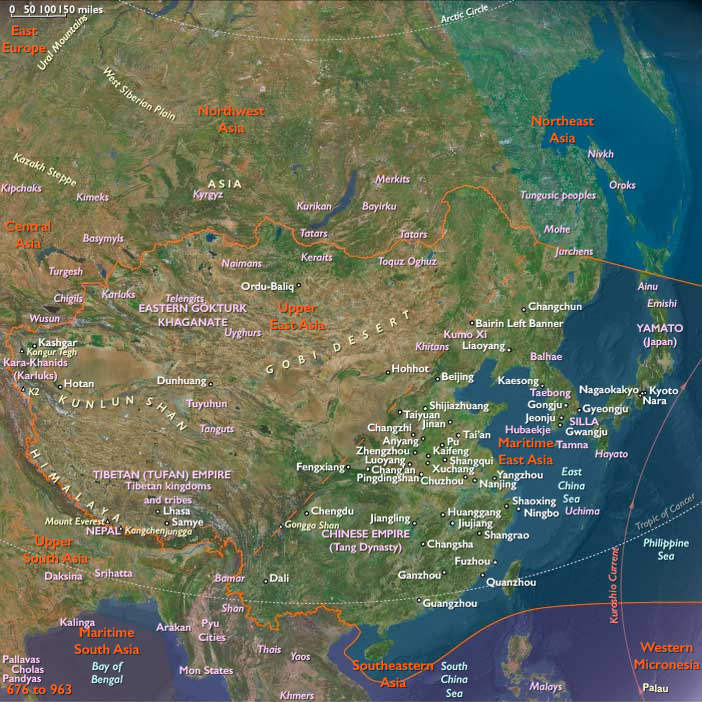
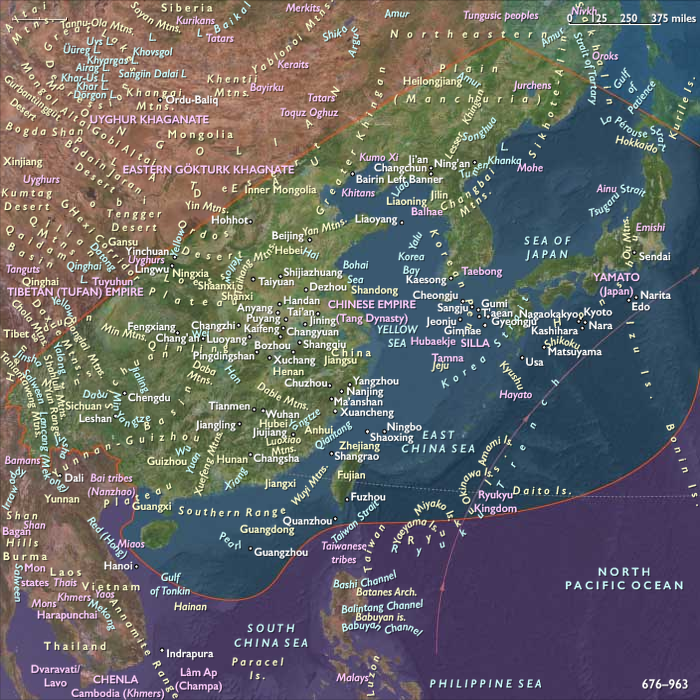
China’s Tang dynasty faces increasing problems ruling the former inhabitants of Goguryeo, as well as Silla's resistance to Tang's remaining presence on the Korean Peninsula.
In 677, Tang crowns Bojang "King of Joseon" and puts him in charge of the Liaodong commander of the Protectorate General to Pacify the East.
Locations
People
Groups
- Korean people
- Chinese (Han) people
- Chinese Empire, Tang Dynasty
- Silla, Unified or Later
- Protectorate General to Pacify the East
Topics
Subjects
Regions
Subregions
Related Events
Filter results
Showing 10 events out of 56038 total
The name Onogur is most often analyzed as On-Oğuz "ten (tribes of the) Oğuz".
In older "Oghur" Turkic languages, On~Ono means "ten" and Gar~Gurs~Gur means "tribes", so Onogurs means "People of ten tribes".
Alternative suggestions have connected the Onogurs with the polity of the Western Turkic Kaghanate as the "People of Ten Arrows" (On-oq-ar), the Utigurs, and the Adygers.
The name of Hungary and the name of the Hungarian people are also connected with the term Hunuguria/Onoguria/Unoguria, because in the western European languages the Hungarians (Magyars) are called Onogurs (e.g., Ungarn, Hongrie, Hongar, Ungherese).
The Magyars are said to have belonged to the Onogur tribal alliance.
According to the Chronicon Pictum, a medieval illustrated chronicle from the Kingdom of Hungary from the fourteenth century, the last of the Onogur tribes fleeing Khazars in the Ukraine come to Hrpad in Pannonia and the area becomes known as Hungary (but not yet Magyarorszag).
Yazid ibn Muawiya had been sent in 676 with Arab reinforcements for the Siege of Constantinople.
The Muslim Arabs attack the great walled city in 676 and 677, but are once again unable to overcome the defenders’ Greek fire-augmented defense tactics.
Greek fire, first used at Constantinople to set fire to invading Muslim Arab ships, proves so effective that its formula is kept a state secret.
Presumably a mixture of flammable materials such as sulfur and pitch, with quicklime added to react with water and ignite, the Greeks normally use hand-operated pumps to project the substance onto enemy ships.
Greek fire destroys the Arab fleet at the Battle of Syllaeum in Pamphylia, fought between the Arabs and the Empire in coordination with a series of land battles in Anatolia and Syria; retreating, the fleet is caught in a storm that sinks nearly all of its ships.
The imperial army pursues the Arabs back to Syria and defeats them there, ending the immediate Arab threat to eastern Europe.
Constantine IV, sometimes incorrectly called Pogonatos, "the Bearded", by confusion with his father, had in 654 been named a co-emperor with his father Constans II, and had become senior emperor in 668 when Constans was assassinated ion Sicily.
The fact that Constantine has led the Empire in withstanding the four-year Arab siege of Constantinople greatly enhances Roman prestige and indeed marks a turning point in European history.
The spread of Christian guerillas in Syria, Lebanon and Palestine has deepened the blow.
As a result, Muawiyah sues for peace, under the humiliating terms of which the Caliphate agrees to return all the all captured Ionian islands and to pay to the Romans annual tributes of slaves, horses and thousands pounds of gold.
The Sufyanids have generally retained the Roman and Persian administrative bureaucracies they had inherited in the provinces; politically they are organized along Arab tribal lines, in which the caliph is chosen by his peers to become, theoretically, “first among equals,” and act on the advice of a shura, or tribal council.
Muawiyah, however, in securing during his lifetime an oath of allegiance to his son Yazid, has disregarded the traditional “election” and introduced the alien concept of hereditary succession.
For this reason, the Umayyad dynasty will sometimes be referred to as the Arab kingdom, reflecting traditional Muslim disapproval of the secular nature of the Umayyad state.
The Umayyad attacks against Constantinople from 669 to 678, while ultimately unsuccessful, have offset the secular image of the state, because they have been directed against the Christians.
Adeodatus II, having reigned as pope from April 11, 672 to June 17, 676, had been succeeded by Donus, who has paved the enclosed forecourt of St. Peter's Basilica, paved the atrium or quadrangle in front of St. Peter's with great blocks of white marble, and restored other churches of Rome, notably the church of St. Euphemia on the Appian Way, and the basilica of St. Paul Outside the Walls.
During the pontificate of Donus, Reparatus, the Archbishop of Ravenna, returns to the obedience of the Holy See, thus ending the schism created by Archbishop Maurus, who had aimed at making Ravenna autocephalous.
After a colony of Nestorian monks is discovered in a Syrian monastery at Rome—the Monasterium Boetianum—Donus is reported to have dispersed them through the various religious houses of the city and to have given their monastery to Roman monks.
His successor, Agatho, a Greek born in Sicily of wealthy and devout parents, succeeds him to the papal throne in April 678.
Shortly after Agatho’s elevation, Wilfrid, Archbishop of York, arrives at Rome to invoke the authority of the Holy See in his behalf.
Wilfrid had been deposed from his see by Theodore, Archbishop of Canterbury, who had carved up Wilfrid's diocese, appointing three bishops to govern the new sees.
At a synod that Pope Agatho convoked in the Lateran to investigate the affair, it had been decided that Wilfrid's diocese should indeed be divided, but that Wilfrid himself should name the bishops.
Agatho is the first Bishop of Rome to stop paying tribute to the Emperor in Constantinople upon election.
Theodore, the Archbishop of Canterbury, had begun a substantial reorganization of the church in Mercia early in the reign of Æthelred.
He had removed Wilfred from his position as Bishop of Lichfield in 675, and over the past four years has divided the vast Mercian see into the five dioceses of Leicester, Lichfield, Worcester, Dorchester and Hereford.
Æthelred, a devout king, has made several gifts of land to the expanding church, including grants at Tetbury, Long Newton, and Somerford Keynes.
There is also a tradition that Æthelred was associated with the founding of Abingdon Abbey, in southern Oxfordshire.
The group of six Anglican kingdoms—Kent, Sussex, Wessex, East Anglia, Essex, Northumbria, and Mercia—is known to historians as the Heptarchy.
Mercia has been in conflict with Northumbria since at least 633, when Penda of Mercia defeated and killed Edwin of Northumbria at the Battle of Hatfield Chase.
However, there have been diplomatic marriages between the two kingdoms: Æthelred's sister Cyneburh had married Alhfrith, a son of Oswiu of Northumbria, and both Æthelred and his brother Peada had married daughters of Oswiu.
Cyneburh's marriage to Alhfrith had taken place in the early 650s, and Peada's marriage, to Ealhflæd, had followed shortly afterwards; Æthelred's marriage, to Osthryth, is of unknown date but must have occurred before 679, since Bede mentions it in describing the Battle of the Trent, which takes place in this year.
Bede does not mention the cause of the battle, simply saying that it occurred in the ninth year of Ecgfrith's reign.
He is more informative on the outcome.
Ælfwine, the young subking of Deira, was killed; Ælfwine was brother to Osthryth and Ecgfrith, and was well liked in both Mercia and Northumbria since Æthelred's marriage to Osthryth.
His death according to Bede threatened to cause further strife between the two kingdoms, but Theodore, the Archbishop of Canterbury, intervened.
Æthelred takes possession of Lindsey again after the battle; the change in control this time will be lasting, and Lindsey will remain part of Mercia until the Viking invasion of the ninth century remakes the map of England.
Muawiyah dies in 680, and the Islamic community is soon convulsed by civil wars.
During this time, al-Muhallab deserts the Umayyads and sides with the anti-caliph ʿAbd Allāh ibn al-Zubayr, who entrusts him with suppressing the Kharijite rebellions in Iraq by the Azariqa.
Basra will subsequently become known as Basra al-Muhallab.
Muawiyah has pacified the Arab kingdom, greatly extended its frontiers, and transformed the early Muslim patriarchy into an imperial monarchy, the Umayyad Caliphate.
Having beautified Damascus, he has developed a court to rival that of Constantinople.
At his death in 680, many of those whom Muawiyah had kept in check now rebel against his son Yazid, who is widely opposed in Syria and Mesopotamia, inaugurating what will be a series of bloody civil wars that will rend the fabric of the late Muawiyah’s Arabian Empire.
Years: 677 - 677
Locations
People
Groups
- Korean people
- Chinese (Han) people
- Chinese Empire, Tang Dynasty
- Silla, Unified or Later
- Protectorate General to Pacify the East
