
The Ming Dynasty, ruled from Beijing by …
Years: 1457 - 1457
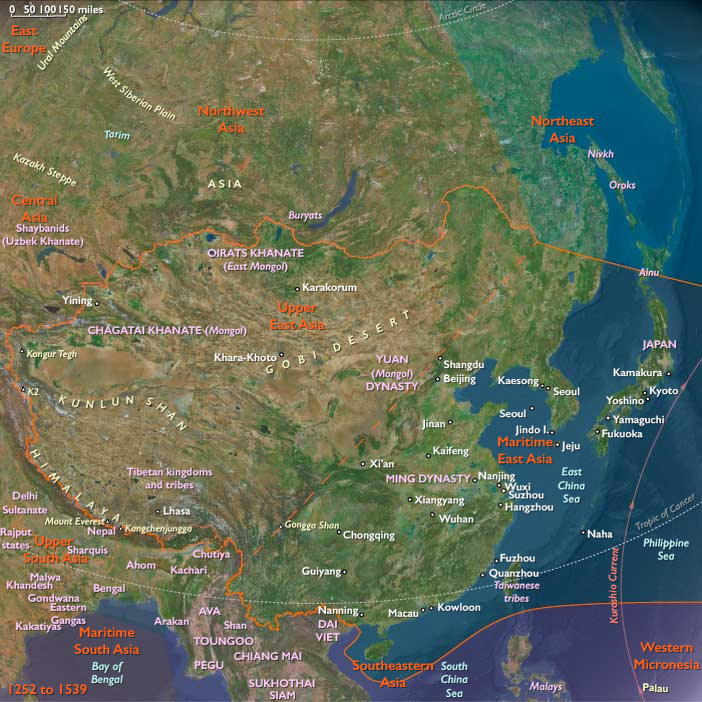
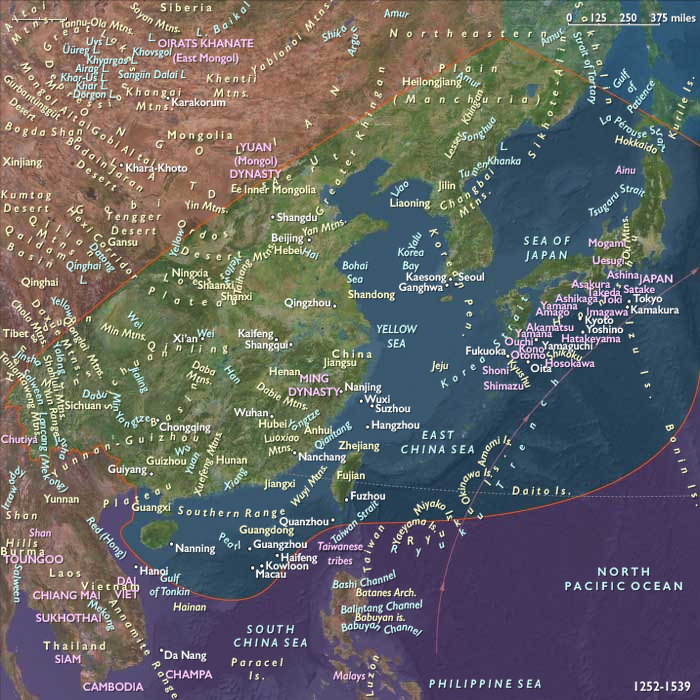
The Ming Dynasty, ruled from Beijing by ethnic Han Chinese, has constructed a vast navy and maintains a standing army of one million troops.
Enormous construction projects, including the restoration of the Grand Canal and the Great Wall and the establishment of the Forbidden City in Beijing had taken place during the first quarter of the fifteenth century.
Estimates for the late-Ming population vary from one hundred and sixty million to twio hundred million.
The founding emperor’s rebuilding of China's agricultural base and strengthening of communication routes through the militarized courier system has had the unintended effect of creating a vast agricultural surplus that can be sold at burgeoning markets located along courier routes.
Rural culture and commerce have become influenced by urban trends.
The upper echelons of society embodied in the scholarly gentry class are also affected by this new consumption-based culture.
In a departure from tradition, merchant families have begun to produce examination candidates to become scholar-officials and adopted cultural traits and practices typical of the gentry.
Parallel to this trend involving social class and commercial consumption are changes in social and political philosophy, bureaucracy and governmental institutions, and even arts and literature.
The Zhengtong Emperor had been released from a yearlong Mongol captivity in 1450 but when he returned to China had been immediately put under house arrest by his brother Zhu Qiyu, who, to calm the crisis, had been installed as the Jingtai Emperor.
For almost seven years, he has resided in the southern palace of the Forbidden city and all outside contacts are severely curtailed by the Jingtai Emperor.
Zhengtong's son (later Emperor Chenghua) had stripped of the title of crown prince and replaced by Jingtai's own son.
This act had greatly upset and devastated Zhengtong but the heir apparent had died shortly thereafter.
Overcome with grief, the Jingtai Emperor falls ill and Zhengtong decides to depose Jingtai by a palace coup which eventually reinstalls Zhu Qizhen as emperor, who renames his second reign Tianshun ("heavenly obedience"); he will go on to rule for another seven years.
Locations
People
Groups
Subjects
Regions
Subregions
Years: 1457 - 1457
Locations
People
Groups
Subjects
Regions
Subregions