
China’s Han Dynasty is notable for its …
Years: 40BCE - 40BCE
China’s Han Dynasty is notable for its military prowess.
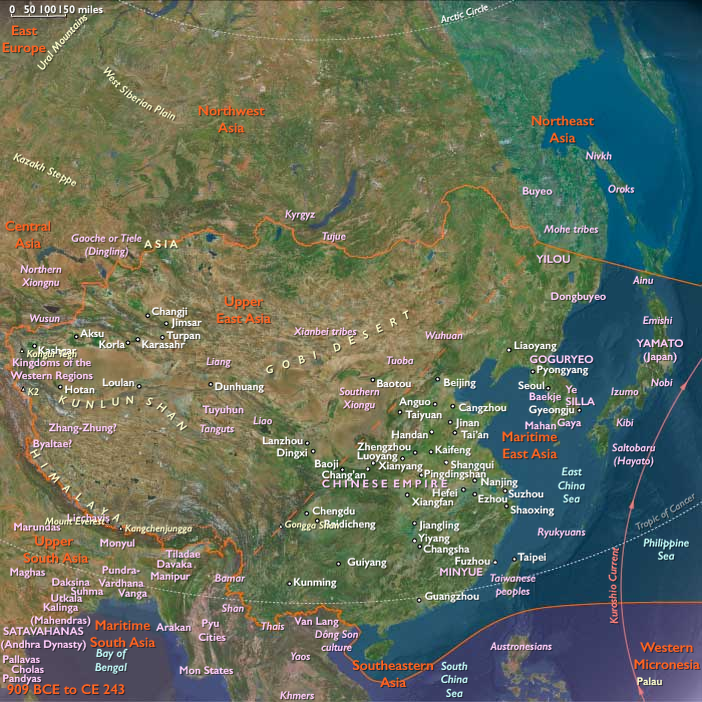
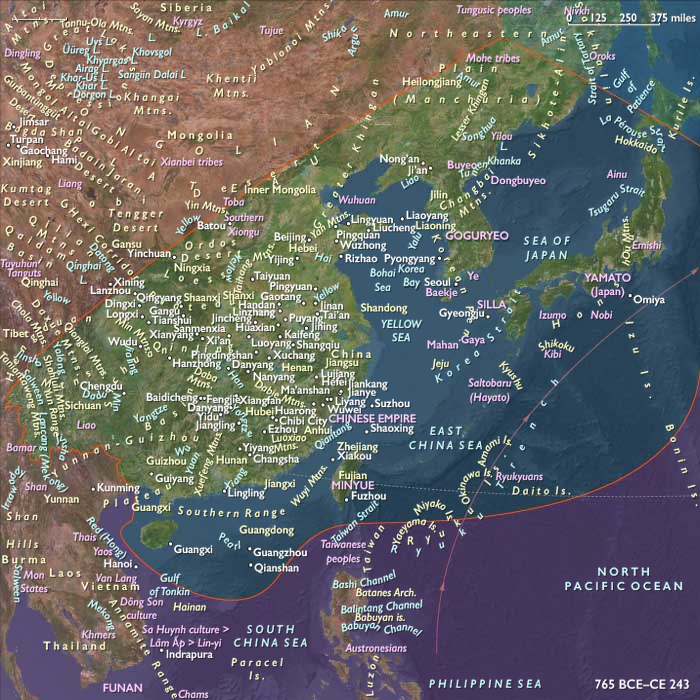
The empire has expanded westward to the Tarim Basin (in modern Xinjiang-Uyghur Autonomous Region), with military expeditions as far west as beyond the Caspian Sea, making possible a relatively safe and secure caravan and mercantile traffic across Central Asia.
The paths of caravan traffic are often called the "Silk Road" because the route is used to export Chinese silk.
Chinese armies had also invaded and annexed parts of northern Korea (Wiman Joseon) and northern Vietnam toward the end of the second century BCE.
Han Dynasty control of peripheral regions is generally insecure, however.
To ensure peace with non-Chinese local powers, the Han court has developed a mutually beneficial "tributary system" in which non-Chinese states are allowed to remain autonomous in exchange for symbolic acceptance of Han overlordship.
Tributary ties are confirmed and strengthened through intermarriages at the ruling level and periodic exchanges of gifts and goods.
In China, the trip hammer, a massive power hammer, usually raised by a cam and then released to fall under the force of gravity, has evolved out of the use of the pestle and mortar, which in turn had given rise to the treadle-operated tilt-hammer.
The latter was a simple device employing a lever and fulcrum (operated by pressure applied by the weight of one's foot to one end), which featured a series of catches or lugs on the main revolving shaft as well.
This device enabled the labor of pounding, often in the decorticating and polishing of grain, and avoided manual use of pounding with hand and arm.
Although historians assert that its origins may span as far back as the Zhou Dynasty (1050 BC–221 BCE), the earliest texts to describe the device are the Ji Jiu Pian dictionary of 40 BCE.
Locations
People
Groups
Topics
Commodoties
Subjects
Regions
Subregions
Related Events
Showing 10 events out of 62307 total
Years: 40BCE - 40BCE
Locations
People
Groups
Topics
Commodoties
Subjects
Regions
Subregions