
China imports two hundred and seventy tons …
Years: 1820 - 1820
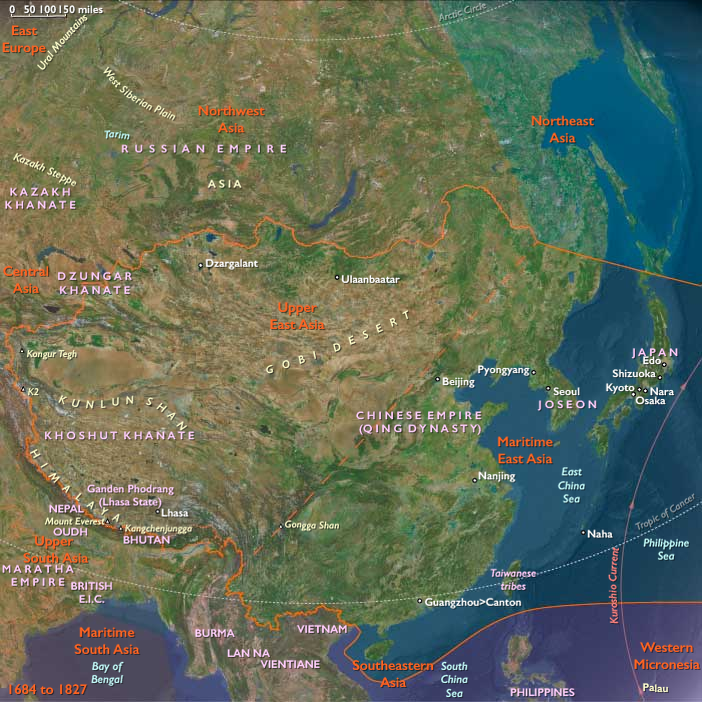
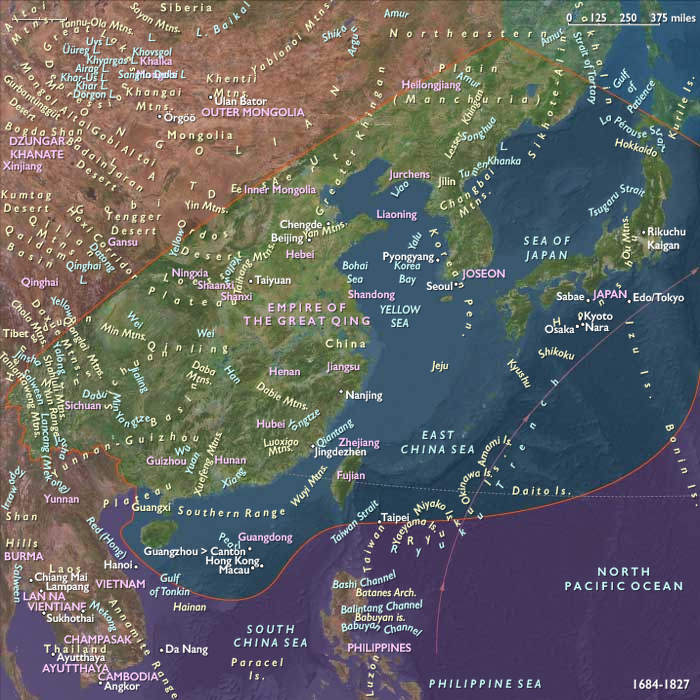
China imports two hundred and seventy tons of opium in 1820, despite the ban.
Locations
Groups
- Chinese Empire, Qing (Manchu) Dynasty
- East India Company, British (United Company of Merchants of England Trading to the East Indies)
- Britain (United Kingdom of Great Britain and Ireland)
Commodoties
Subjects
Regions
Subregions
Related Events
Filter results
Showing 10 events out of 27 total
Enough northern congressmen object to the racial provision that Henry Clay is called upon to formulate the Second Missouri Compromise.
Missouri enters the Union in 1820 as a slave state, balanced by the separation of Maine from Massachusetts, when on June 12 delegates in St. Louis, Missouri Territory approve a proposed state constitution, proclaiming that they "do mutually agree to form and establish a free and independent republic (sic), by the name of "The State of Missouri".
The cause of action that will lead to the U.S. Supreme Court case known simply as The Antelope arises, when a U.S. Treasury cutter captures a ship of the same name, which is transporting two hundred and eighty-one Africans who had been captured as slaves, in violation of the 1819 U.S. law prohibiting the slave trade.
William Henry Ashley, recently the lieutenant governor of Missouri, joins Andrew Henry—a bullet maker he had met through his gunpowder business—in posting advertisements in St. Louis newspapers seeking one hundred "enterprising young men . . . to ascend the river Missouri to its source, there to be employed for one, two, or three years."
The men who responded to this call will become known as "Ashley's Hundred."
Twenty-three year old Jedediah Strong Smith, originally of western New York, is a member of Ashley’s party.
Ashley, although born a native of Powhatan County, Virginia, had already moved to Ste. Genevieve, in what was then a part of the Louisiana Territory, when it was purchased by the United States from France in 1803.
On a portion of this land, later known as Missouri, Ashley had made his home for most of his adult life.
Ashley had moved to St. Louis around 1808 and became a Brigadier General in the Missouri Militia during the War of 1812.
Before the war, he had done some real estate speculation and earned a small fortune manufacturing gunpowder from a lode of saltpeter mined in a cave, near the headwaters of the Current river in Missouri.
When Missouri was admitted to the Union, Ashley had been elected its first Lieutenant Governor, serving, from 1820 under Governor Alexander McNair.
Catlin began his journey in 1830 when he accompanied General William Clark on a diplomatic mission up the Mississippi River into native territory.
St. Louis had become Catlin’s base of operations for the five trips he has taken took between 1830 and 1836, eventually visiting fifty tribes.
Catlin was born in Wilkes-Barre, Luzerne County, Pennsylvania
As a child growing up in Pennsylvania, Catlin had spent many hours hunting, fishing, and looking for American Indian artifacts.
His fascination with Native Americans was kindled by his mother, who told him stories of the western frontier and how she was captured by a tribe when she was a young girl.
Years later, a group of Native Americans came through Philadelphia dressed in their colorful outfits and made quite an impression on Catlin.
His early work included engravings, drawn from nature, of sites along the route of the Erie Canal in New York State.
Several of his renderings had been published in one of the first printed books to use lithography, Cadwallader D. Colden's Memoir, Prepared at the Request of a Committee of the Common Council of the City of New York, and Presented to the Mayor of the City, at the Celebration of the Completion of the New York Canals, published in 1825, with early images of the City of Buffalo.
Following a brief career as an attorney, Catlin will produce two major collections of paintings of Native Americans and publish a series of books chronicling his travels among the native peoples of North, Central, and South America.
John C. Frémont had broken camp in California and headed east across the Great Basin to the vicinity of the Great Salt Lake and finally east across the Colorado Rockies.
He returns in August 1844 to Saint Louis, having verified the existence of the Great Salt Lake and the enormous interior drainage field that is the Great Basin, proving the nonexistence of the San Buenaventura River that was thought to flow from the Rockies to California, and showing that the South Pass is the route of choice through the mountains.
George Catlin, born in Wilkes-Barre, Pennsylvania, had early abandoned a brief career as a lawyer.
Claiming his interest in America’s 'vanishing race' had been sparked by a visiting American Indian delegation in Philadelphia, he sets out to record the appearance and customs of America’s native people.
Catlin had begun his journey in 1830 when he accompanied General William Clark on a diplomatic mission up the Mississippi River into Native American territory.
St. Louis had become Catlin’s base of operations for five trips he has taken between 1830 and 1836, eventually visiting fifty tribes.
The fire destroys a significant part of the city and many of the steamboats using the Mississippi River and Missouri River.
The flames leap from the burning steamboats to buildings on the shore and is soon burning everything on the waterfront levee for four blocks.
The fire extends to Main Street westward and crossing Olive Street
It completely guts the three blocks between Olive and 2nd Street and goes as far south as Market Street
It then ignites a large copper shop three blocks away and burns out two more city blocks.
The volunteer firemen, after laboring for eight hours, are nearly completely demoralized and exhausted.
The entire business district of the city appears doomed unless something is done.
Six businesses in front of the fire are loaded with kegs of black powder and blown up in succession.
Captain Thomas B. Targee of Missouri Company No. 5 dies while he is spreading powder into Phillips Music store, the last store chosen to be blown up.
This fire is the largest and most destructive fire St. Louis has ever experienced.
When the fire is finally contained after eleven hours, four hundred and thirty buildings are destroyed, twenty-three steamboats along with over a dozen other boats are lost and three people have died including a Fire Captain.
As a result of these fires, a new building code will require new structures to be built of stone or brick and an extensive new water and sewage system will be started.
Years: 1820 - 1820
Locations
Groups
- Chinese Empire, Qing (Manchu) Dynasty
- East India Company, British (United Company of Merchants of England Trading to the East Indies)
- Britain (United Kingdom of Great Britain and Ireland)
