Chen Qian, age thirty-seven, succeeds his uncle …
Years: 559 - 559
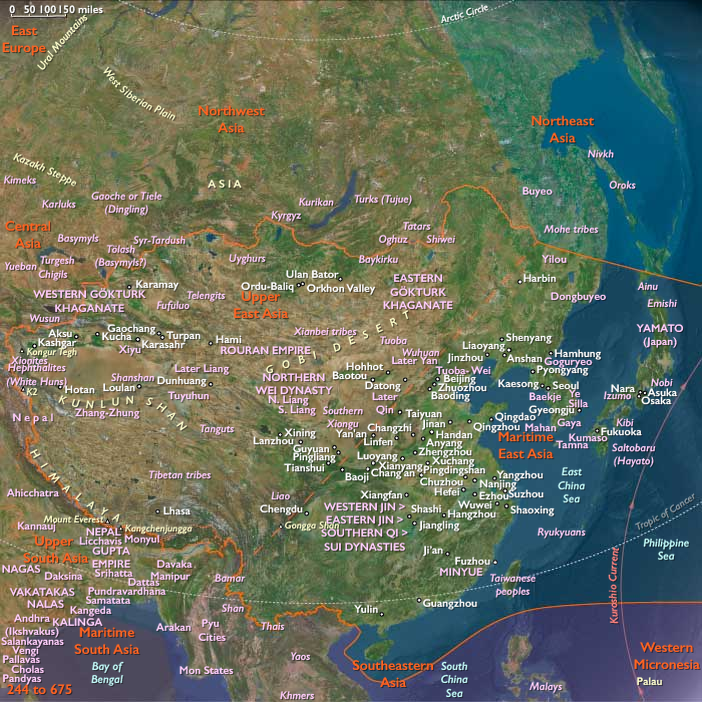
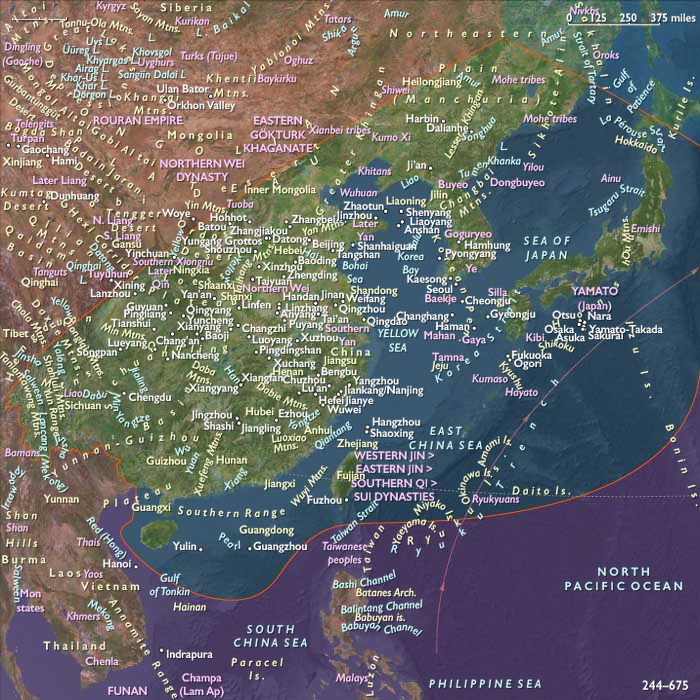
Chen Qian, age thirty-seven, succeeds his uncle Emperor Wu of Chen.
During his reign, he will consolidate the state against the rebellious warlords.
Locations
People
Groups
- Xianbei
- Chinese (Han) people
- Liang Dynasty, Western (Chinese dynasty)
- Chen Dynasty (Chinese Southern dynasty)
- Northern Zhou, Empire of
Topics
Subjects
Regions
Subregions
Related Events
Filter results
Showing 10 events out of 11 total
Yuan Huangtou of Ye, the son of the deposed Yuan Lang, the briefly reigning Emperor of Northern Wei, has been permitted to inherit his father’s title of Prince of Anding.
Northern Wei's branch successor state Eastern Wei having ended in 550 and been replaced by Northern Qi, its first emperor, Emperor Wenxuan of Northern Qi, carries out a major slaughter of Northern Wei's imperial Yuan clan in 559.
Several prisoners of Emperor Wenxuan, including Yuan Huangtou, are forced to launch themselves from a tower attached to a kite, as an experiment.
Yuan Huangtou is the sole survivor, successfully gliding over the city walls.
One Yuan Huangtou is imprisoned and starves to death, but it is not known for sure whether that Yuan Huangtou was Yuan Lang's son.
The Liang Dynasty ends in 557 as Chen Baxian, a distinguished general, becomes, as Emperor Wu, the first emperor of Southern China’s Chen Dynasty.
Taiyuan, the secondary capital of Northern Qi, is rebuilt in 562; it will become a center of Buddhism.
Li Yuan had served three terms as provincial governor during the reign of Emperor Wen of Sui.
Early in the reign of Emperor Wen's son Emperor Yang, Li Yuan had served as prefecture governor (as Emperor Yang converted provinces into prefectures), but had later been recalled to serve as a junior minister within Emperor Yang's administration.
When Emperor Yang carried out his second campaign against Goguryeo in 613, Li Yuan was in charge of part of the logistics operation.
When the general Yang Xuangan rebelled near the eastern capital Luoyang, Emperor Yang had commissioned Li Yuan as a general and placed in charge of the operations west of the Tong Pass, although Yang Xuangan's rebellion eventually did not involve that region.
Li Yuan took the opportunity to recruit talented people to his staff.
Later that year, when Emperor Yang summoned him to his presence, he had declined, citing ill health—an excuse that Emperor Yang did not believe, as he questioned Li Yuan's niece, a Consort Wang (Emperor Yang's concubine), "Will he die?".
In fear, Li Yuan took up drinking and receiving bribes to try to show Emperor Yang that he did not have great ambitions.
In 615, Emperor Yang had placed him in charge of the operations against agrarian rebels in the Hedong region (roughly modern Shanxi), but recalls him in 616.
Later this year, Emperor Yang puts him in charge of the key city of Taiyuan (in modern Taiyuan, Shanxi).
Li Yuan begins to gather forces from the region, claiming that they are necessary to defend against the Turks, which draws suspicions from his deputies Wang Wei and Gao Junya.
Li Yuan, afraid that Wang and Gao will act against him first, then uses a Turkish attack as an excuse to falsely claim that Wang and Gao are working in concert with the Turkish khagan, Shibi Khan (Ashina Duojishi), and has them executed.
He sends secret messengers to Hedong to recall his sons Li Jiancheng, Li Yuanji (both by Duchess Dou) and Li Zhiyun (by his concubine Lady Wan), whom he had left there to watch over his household, and the capital Chang'an to recall his daughter (the future Princess Pingyang) and her husband Chai Shao.
Li Jiancheng and Li Yuanji, leaving Li Zhiyun at Hedong, soon meet with Chai, and they arrive together at Taiyuan.
Li Yuan's daughter, believing it would be difficult for her to flee with Chai, chooses to hide instead.
Once Li Jiancheng, Li Yuanji, and Chai arrive at Taiyuan, Li Yuan formally declares his rebellion, but maintains the guise of a Sui loyalist and declares that his intention is simply to install on the throne Emperor Yang's grandson Yang You, the Prince of Dai, who is at this time at Chang'an, and honor Emperor Yang as Taishang Huang (retired emperor).
Li Yuan first secures his northern flank by contacting Shibi Khan, offering tribute, and receives men and horses in exchange.
He puts Li Jiancheng and Li Shimin in charge of his army and, leaving Li Yuanji in charge at Taiyuan, advances south.
Meanwhile, the Sui officials at Hedong arrest Li Zhiyun and deliver him to Chang'an, where he is executed.
His daughter Pingyang sells her possessions to raise an army for him.
She persuades several other leaders to fight under her banner.
They take several towns and her army swells until she has seventy thousand troops under her command.

Tang is meanwhile facing another serious threat—Liu Wuzhou, now determined to march south against Tang.
Emperor Gaozu sends Pei Ji against Liu's advancing army, but Pei is defeated by Liu, who then puts Taiyuan under siege.
Li Yuanji flees back to Chang'an, and much of modern Shanxi is seized by Liu.
Emperor Gaozu then sends Li Shimin against Liu, and by summer 620, Li Shimin has defeated Liu, forcing him to flee to the Eastern Turks.
Liu's territory is incorporated into Tang.
Around the same time, however, Dou Jiande the Prince of Xia makes a major offensive against the cities that had submitted to Tang in modern Hebei and Henan, north of the Yellow River, seizing nearly all of them and taking captive Emperor Gaozu's cousin Li Shentong the Prince of Huai'an, Emperor Gaozu's sister the Princess Tong'an, and Li Shiji's father Li Gai.
With Li Gai in Dou's custody, Li Shiji surrenders to Dou as well.
In 620, Li Shiji, in association with another Tang general who had surrendered to Dou, Li Shanghu, plots to ambush Dou, but the plot is discovered; Li Shanghu is killed, and Li Shiji flees back to Tang.
…Lulong (headquartered in modern Beijing, governed by Zhang Zhongwu — would side with Zhaoyi.
Emperor Wuzong had secured their cooperation by effectively promising the three circuits that he would not interfere with their independence, and had in fact secured the military cooperation of both Weibo and Chengde in the campaign against Zhaoyi by leaving the task of capturing Zhaoyi's three eastern prefectures, east of the Taihang Mountains, to Wang and He Hongjing.
The other imperial generals, including Wang Zai, Shi Xiong, and Liu Mian, concentrate on Zhaoyi's two western prefectures, including its capital Lu Prefecture.
Initially, the imperial forces make no headway against Zhaoyi forces, and the campaign is complicated by a mutiny of the officer Yang Bian at Hedong Circuit (headquartered in modern Taiyuan, Shanxi) early in 844.
Yang's mutiny is quickly put down, however, and …
The Shatuo Turks have ruled most of northern China since 923 through the Later Tang Dynasty, Later Jin Dynasty, and the Later Han Dynasty.
The short-lived Later Han Dynasty had fallen in 950.
Liu Min founds the Northern Han Kingdom, sometimes referred to as the Eastern Han, in 951 claiming that he is the legitimate heir to the imperial throne of the Later Han Dynasty.
Liu Min immediately restores the traditional relationship the Shatuo Turks had with the Khitans, who had founded the Liao Dynasty.
…northern regions of Shanxi and an annual tribute of one hundred thousand ounces of silver and around two hundred thousand rolls of silk.
After the treaty is signed, the nature of the relationship between these two states changes from one of purely political rivalry to a supposed fraternal relationship.
For the first time in Chinese history there are two Sons of Heaven, recognized by each other.
Fan Kuan's masterpiece and best known painting is his Travelers among Mountains and Streams, a large hanging scroll.
A seminal work of the Northern Song school, it establishes an ideal in monumental landscape painting to which later artists will return time and again for inspiration.
Fan Kuan based the painting on the Taoist principle of reclusion, the composition emphasizes the monumentality of nature.
A packhorse train can barely be seen emerging from a wood at the base of a huge precipice.
Despite the fact that the painting represents an ideal example of the achievements of the Northern Song landscape styles, the painting still represents several archaic conventions dating back to the Tang Dynasty.
The composition remains dominated by a central massif.
The foliage are composed of mechanically repeated and narrow texture strokes.
Ögedei distributes lands in Shanxi, China to Batu and the family of Jochi in the 1230s, but they appoint their officials under the supervision of the Imperial governor in Khorasan.
Years: 559 - 559
Locations
People
Groups
- Xianbei
- Chinese (Han) people
- Liang Dynasty, Western (Chinese dynasty)
- Chen Dynasty (Chinese Southern dynasty)
- Northern Zhou, Empire of