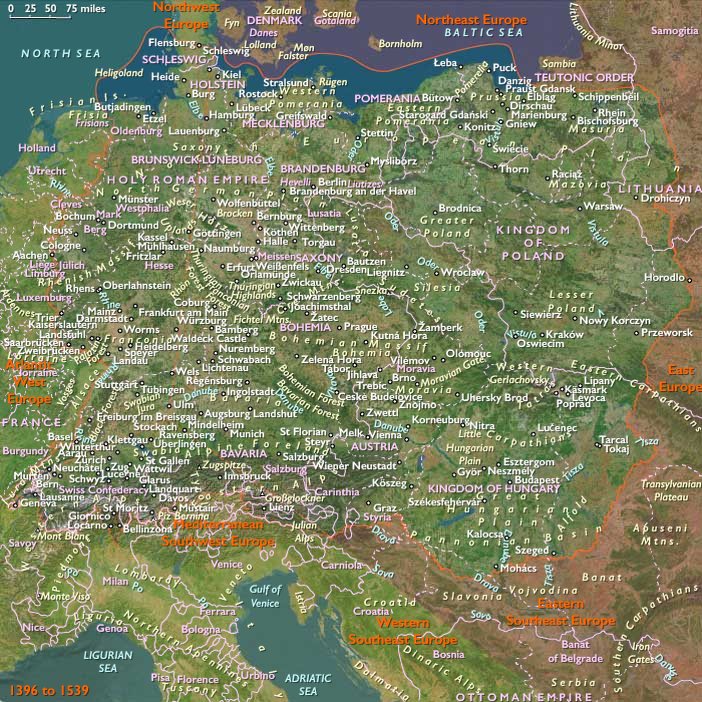
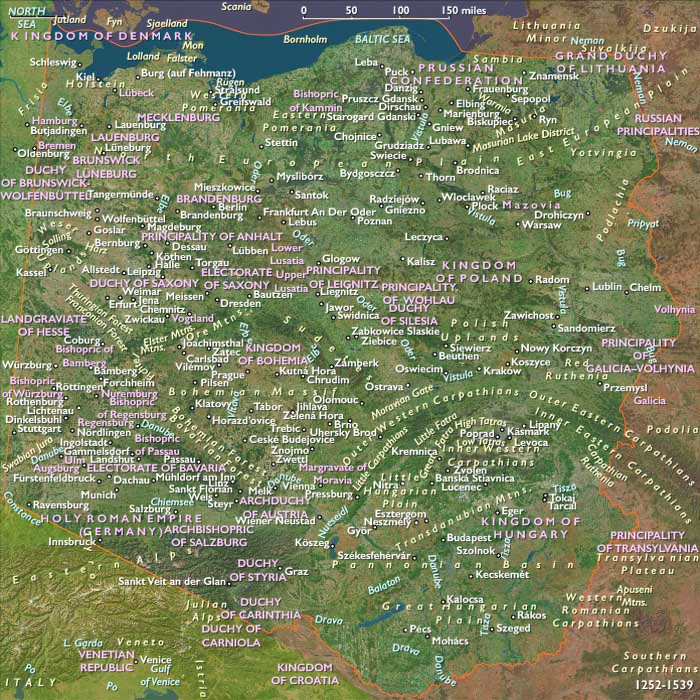
…Chemnitz, the center of the mining industry, …
Years: 1530 - 1530
…Chemnitz, the center of the mining industry, to widen the range of his observations.
Locations
People
Groups
Topics
Subjects
Regions
Subregions
Related Events
Filter results
Showing 10 events out of 38015 total
King Mingyi Nyo had in 1485 founded the First Taungoo Dynasty at Taungoo, far up the Sittaung River south of Inwa, towards the end of the Ava Kingdom in 1510.
Mingyi Nyo's forty-five-year reign has been one of the few stable regimes in Upper Burma in this age.
Toungoo's remote location (nestled between the Bago Yoma mountain range and the Karen Hill country, and cut off from the main Irrawaddy river valley) proves a vital advantage.
It takes effort to march to Toungoo.
The stability of his kingdom had attracted many refugees, and the flow of refugees had accelerated after Ava's fall.
When the Confederation of Shan States, led by Sawlom of Mohnyin, finally defeated Ava in March 1527, Nyo had deliberately devastated the countryside between Ava and Toungoo, filling the wells and breaking down the channels in the hope of making an impassable belt between Toungoo and the Confederation.
The Burmese bureaucracy and population at Ava had largely fled to Toungoo.
This increased manpower will allow Mingyi Nyo’s son Tabinshwehti and his deputy Bayinnaung to initiate an offensive war against larger kingdoms.
Tabinshwehti's improbable victory over Hanthawaddy has its beginnings in Mingyi Nyo's long stable rule.
Mingyi Nyo dies on November 24, 1530, and is succeeded by his fourteen-year-old son Tabinshweti, who rewards his childhood staff by handing out royal titles, and by marrying two of their daughters—Khin Hpone Soe, daughter of Mingyi Swe and sister of Ye Htut, and Khin Myat, daughter of Shin Nita.
He also places his young friends, including Ye Htut, as confidants.
Cardinal Albert of Brandenburg, Archbishop of Magdeburg and Elector of Mainz, needs a prestigious church that meets his expectations at a central location in his Residenz town, Halle.
Albrecht, who fears for his peace of mind in the heaven, has collected more than eighty-one hundred relics and forty-two holy skeletons that need to be stored.
These precious treasures known as "Hallesches Heilthum" and indirectly related to the sale of indulgences had triggered the Reformation a few years before.
Notably on October 31, 1517, Martin Luther had penned his famous Ninety-five Theses, in which he condemned the trade with indulgences and sent a copy to his cardinal Albrecht, who in turn sent it to Pope Leo X.
The cardinal and the Roman Catholic members of the town council had then wanted to repress the growing influence of the Reformation by holding far grander masses and services in a new church dedicated solely to Saint Mary.
On Whit Monday, May 17, 1529, representatives of the clergy, the city council and church pastors had gathered on the market square and decided, after extensive consultation, to demolish the existing parish churches, only keeping their towers, and connect the two (blue) western towers to those on the eastern side by means of a new nave It was also decided to close the two cemeteries surrounding the churches.
A new burial site had been chosen‚ the Martinsberg, a hill outside the town—and the Stadtgottesacker cemetery was laid out.
This cemetery, with ninety-four arches, designed by Nickel Hoffman, is a masterpiece of the Renaissance.
The old nave of St. Gertrude is demolished from 1529 to 1530.
What remains are the Blue Towers dating from around 1400, with their spires, which had been added in 1507 and 1513.
The Turkish invasion and its climactic siege had exacted a heavy toll upon both sides, with tens of thousands of soldiers and civilians left dead in its wake.
However, it is a milestone that marks the end of Suleiman's expansion toward the center of Europe and, arguably, the beginning of the stagnation and decline of the Ottoman Empire as the dominant power of the Renaissance world.
Suleiman's retreat, however, did not mark a complete failure.
The campaign had underlined and maintained Ottoman control of the southern Pannonian Plain and left behind a trail of collateral damage in the neighboring Habsburg Hungary and Austria that impairs Ferdinand's capacity to mount a sustained counter-attack.
Suleiman's achievement is to consolidate the gains of 1526 and further establish the puppet-kingdom of John Zápolya as a buffer-state against the Holy Roman Empire.
Ferdinand I erects a funeral monument for the German mercenary Niklas Graf Salm, head of the mercenary relief force dispatched to Vienna, as a token of appreciation to his efforts.
Niklas had survived the initial siege attempt, but had been injured during the last Ottoman assault and dies on May 4, 1530.
Holy Roman Emperor Charles V convokes the Diet of Augsburg in 1530 as part of his effort to bring religious peace to Europe.
He fails in this attempt, however, because he underestimates the fervor with which the followers of Martin Luther have already formulated a distinctive position, which they issue here as The Augsburg Confession.
One of its authors, German theologian Philipp Melanchthon, has designed it to be relatively open to the Roman Catholic church on the right and to other reformed but non-Lutheran parties on the left.
Although it affirms inherited classic Christian doctrines, its particular stress on grace, as Luther has interpreted it in the writings of St. Paul, and its rejection of any righteousness based on human works and merits renders it unacceptable to many other Western Christians.
Barthel Beham serves as court painter to Duke Wilhelm IV of Bavaria from 1530.
He employs Mannerist devices in The Testing of the True Cross, painted in this year, but remains faithful to a vigorous realism.
Lucas Cranach the Elder employs the delicate, curvilinear style derived from Gothic Mannerism in his mythological nude, “Apollo and Diana, painted in 1530.
Wenzel Jamnitzer, an accomplished goldsmith, moves at twenty-eight with his brother and partner Albrecht from Vienna to Nuremberg in about 1530.
As his style begins to evolve from High Renaissance to Mannerism, he starts to incorporate into his pieces vdirect castings of such natural objects as shells, fish, and plants, corals, and small birds' eggs in his works.
In addition to goldsmithery, Albrecht also makes jewelry and casts bronze and, with his brother, probably makes watches and scientific instruments.
Georgius Agricola (Latinized form of Georg Bauer), who studied medicine at Leipzig University, has become a devoted follower of Erasmus, who writes a foreword to Agricola's first book on mining and metallurgy, published in 1530.
In this year, Prince Maurice of Saxony appoints him historiographer with an annual allowance, and he migrates to …
The military campaigns of the Aceh Sultanate challenge both the naval dominance of the Portuguese and the holdings of the Sultanate of Johor on Sumatra.
The victories of the 1520s expand Aceh’s territory, creating a powerful kingdom that will endure until the Aceh War (1873–1903). However, its struggle with the Portuguese remains relentless.
In 1527, Portuguese captain Francisco de Mello sinks an Acehnese vessel at the roadstead outside the capital, killing the crew. The following year, Simão de Sousa Galvão, forced by a storm to seek shelter in Aceh, is attacked by local forces—most of the foreigners are killed, and the survivors taken prisoner.
Sultan Ali Mughayat Syah begins peace negotiations, which halt a planned joint expedition by Aru and the Portuguese. However, new hostilities soon follow, and the sultan orders all Portuguese prisoners executed.
In 1529, Sultan Ali devises a surprise attack on Melaka, but news of the plan leaks, and the invasion never materializes.
The date of Sultan Ali Mughayat Syah’s death is uncertain, with later chronicles offering conflicting accounts—1511, 1522, or 1530. However, his gravestone records his passing as August 7, 1530, exactly one month before the death of his abdicated father, Syamsu. Both are buried in the palace compound of Kutaraja (now Banda Aceh).
Portuguese chronicler João de Barros alleges that Sultan Ali was poisoned by his wife, Sitt Hur, a sister of the ruler of Daya, in revenge for Aceh’s conquest of her homeland. She outlives him by twenty-four years, passing away on December 6, 1554.
Sultan Ali leaves behind two sons, Salahuddin and Alauddin al-Kahar. Salahuddin, who lacks his father’s military acumen, succeeds him on the throne, while his younger brother, Alauddin, will lay the true foundations of Aceh’s power after 1539.

Crude furnaces for treating cinnabar by distillation and condensation are now meeting the growing demand for quicksilver in medicine and in the amalgamation of gold and silver ores.