
Charles’s Frankish forces war from 808 to …
Years: 810 - 810
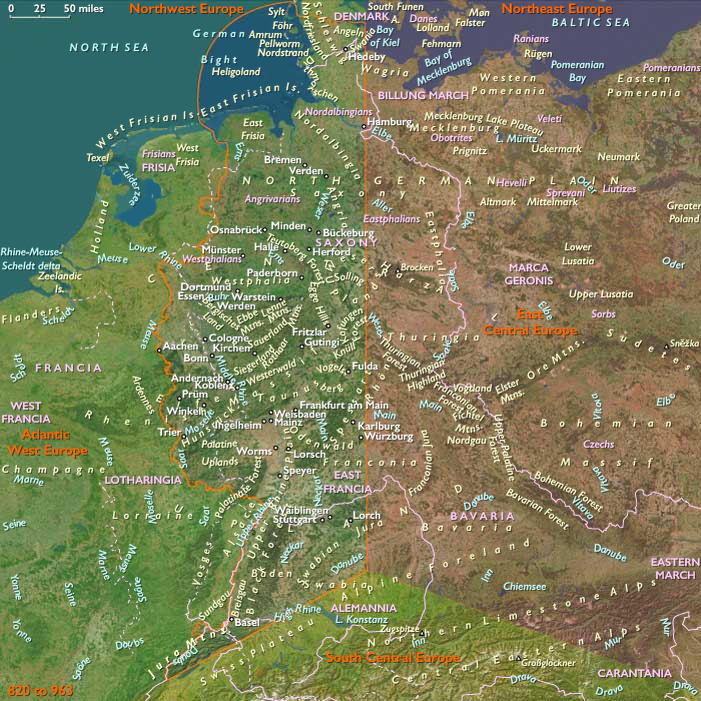
Charles’s Frankish forces war from 808 to 810 against those Saxons and Danes who had not quit in 804.
People
Groups
- Franks
- Saxons
- Denmark, Kingdom of
- Francia (Carolingians)
- Frankish, or Carolingian (Roman) Empire
- Danes (Scandinavians)
- Saxony, Duchy of
Topics
Commodoties
Subjects
Regions
Subregions
Related Events
Filter results
Showing 10 events out of 54749 total
Al-Ma'mun, open to new movements of thought and outside influences, courts the support of Iranian figures and of the eastern provinces.
Krum’s victory at Serbia has provoked Nikephoros to settle Anatolian populations along the frontier to protect it and to attempt to retake and refortify Serdica, although this enterprise ultimately fails.
Al-Amin, in contrast to his brother, emphasizes traditionalism and Arab culture.
Back in Baghdad, Fadl remains Amin's leading advisor, but his role in the governance of the state seems to have been limited.
Nevertheless, he is the leading figure among those in the Abbasid establishment who pressure Amin into reversing his father's succession plans and depriving Ma'mun of his Khurasani governorate as well as his place in the succession in favor of Amin's son Musa.
This policy increases the already existing polarization of the Abbasid elites between the two princes, with the Khurasani nobility, headed by Ma'mun's wazir al-Fadl ibn Sahl, flocking to Ma'mun, whom they see as the champion of their interests against the central government in Baghdad.
The breach between the two sides is complete in November 810, when Amin drops Ma'mun's name from the Friday prayer.
This leads to a chain of mutual acts that result in the outbreak of open civil war (the "Fourth Fitna") between the two brothers.
Dharmapala has extended Palan influence as far as Kannauj by the time of his death in 810, bringing the Palans into conflict with the expanding Rashtrakutas.
The Viking Raids Intensify: The Devastation of Frisia (810)
Since the first recorded Viking raid on the Frankish Empire in 799, Norse raiders have continued their seasonal attacks on coastal settlements, exploiting the wealth of undefended monasteries and trading centers. By 810, the Viking threat escalates dramatically as Frisia is ravaged, marking one of the most destructive early Norse incursions into Frankish territory.
Charlemagne’s Response: Strengthening the Northern Defenses
Recognizing the growing severity of the Viking raids, Charlemagne shifts his attention to fortifying the empire’s northern coastline, implementing key defensive measures:
- Naval Defenses: The Frankish fleet is expanded to counter Viking longships, particularly in Frisia and along the North Sea coast.
- Fortifications: Coastal settlements, monasteries, and riverine trade hubs begin constructing stronger defenses to deter raids.
- Garrisons and Coastal Patrols: Military forces are stationed in vulnerable areas, providing quick-response defense against Viking incursions.
The Last Years of Charlemagne and the Viking Threat
Though these initial defensive efforts slow the Viking advance, they do not eliminate the threat. By the time of Charlemagne’s death in 814, Viking raids remain a persistent menace, requiring continued military adaptation by his successors. Over the course of the 9th century, Viking incursions will intensify, culminating in major inland invasions and sieges of key Frankish cities, proving to be one of the greatest challenges to the Carolingian Empire.
The delicately carved ivory covers of the so-called Lorsch Gospels are produced around 810 in the workshop of ivory carvers established at Aachen under Charles I.
Emperor Charles, in planning the division of his lands, had decided as early as 806 that on his death Pepin should inherit Italy, Bavaria, and the territory of the Alemanni, but Pepin predeceases his father by four years, dying at Milan on July 10, 810.
Venice, Istria, and the Dalmatian coast during the reign of Nikephoros are in dispute between Constantinople and the Frankish empire of Charles.
Following Charles's son Pepin's invasion of Dalmatia as King of Italy, tension has risen between the two Empires.
Political and military instability, however, lasts only until the king's death, in July 810.
Nikephoros, embroiled from 809 in an escalating war with the Bulgarians and reluctant to fight a two-front war, begins in 810 to seek terms with the Franks.
A new treaty came under discussion between Charles, temporarily ruling over Italy, and Nikephoros.
Aigone, Count of Forlì, is a member of the delegation sent by Charles to Nikephoros.
A tentative agreement is reached, under which Charles is to surrender most of his Adriatic conquests except Istria in return for Constantinople’s recognition of him as Roman emperor of the West.
(The details will be worked out two years later during the reign of Nikephoros' successor, his son-in-law Michael.)
Michael Rangabe, the emperor’s son-in-law, is proclaimed emperor by a coup d'etat, despite the claims of Nikephoros' son Staurakios, who had been mortally wounded in Bulgaria.
Under the influence of the abbot and theologian Theodore Studites, Michael supports the proponents of the use of religious images, or icons.
The first emperor to bear a family name, Michael's use of the patronymic, Rangabe, bears witness to the emergence of the empire’s great families, whose accumulation of landed properties will soon threaten the integrity of those smallholders upon whom the empire depends for its taxes and its military service.
The name Rangabe seems to be a Hellenized form of a Slav original (rokavu), and, if so, Michael's ethnic origin and that of his successor, Leo V the Armenian, provide evidence enough of the degree to which the empire in the ninth century has become not only a melting-pot society but, further, a society in which even the highest office lays open to the man with the wits and stamina to seize it.
Krum mobilizes as many soldiers as possible, giving weapons even to peasants and women.
This army is assembled in the mountain passes to intercept the imperial troops as they return to Constantinople.
At dawn on July 26, the Bulgarians manage to trap the retreating Nikephoros in the Vărbica pass.
The imperial army is wiped out in the ensuing battle and Nikephoros was killed, the second Eastern Emperor to suffer this fate since Valens in the Battle of Adrianople (August 9, 378).
His son Staurakios is carried to safety by the imperial bodyguard after receiving a paralyzing wound to the neck.
Fleeing with him are his brother-in-law, the curopalates Michael Rangabe, the Domestic of the Schools Stephen, and the magistros Theoktistos.
Gathered around Staurakios’s bedside, they debate the succession.
Because of his uncertain condition, he is hastily proclaimed Emperor by Stephen, who has the backing of the army.
This is the first time an Emperor of the Eastern Empire has been crowned outside Constantinople.
It is said that Krum had the Emperor's skull lined with silver (or gold) and used it as a drinking cup.
Years: 810 - 810
People
Groups
- Franks
- Saxons
- Denmark, Kingdom of
- Francia (Carolingians)
- Frankish, or Carolingian (Roman) Empire
- Danes (Scandinavians)
- Saxony, Duchy of
