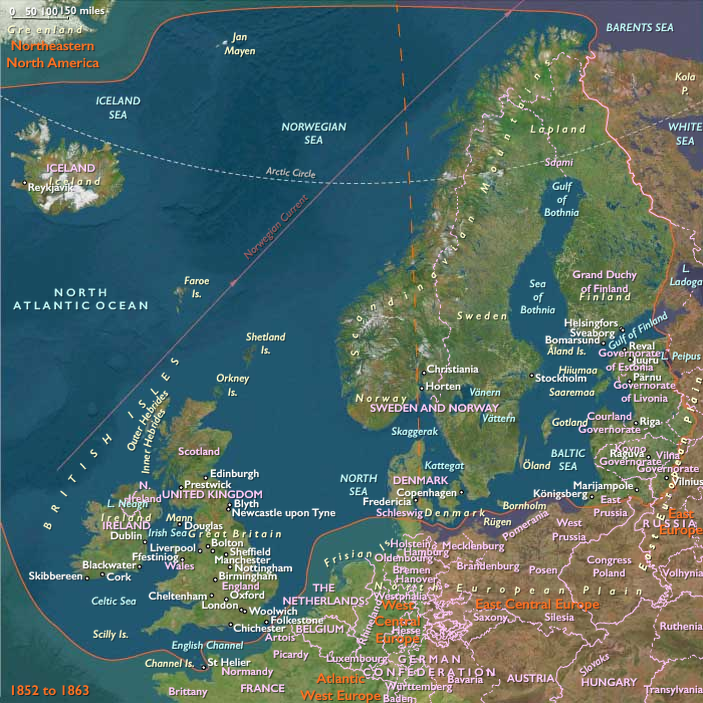
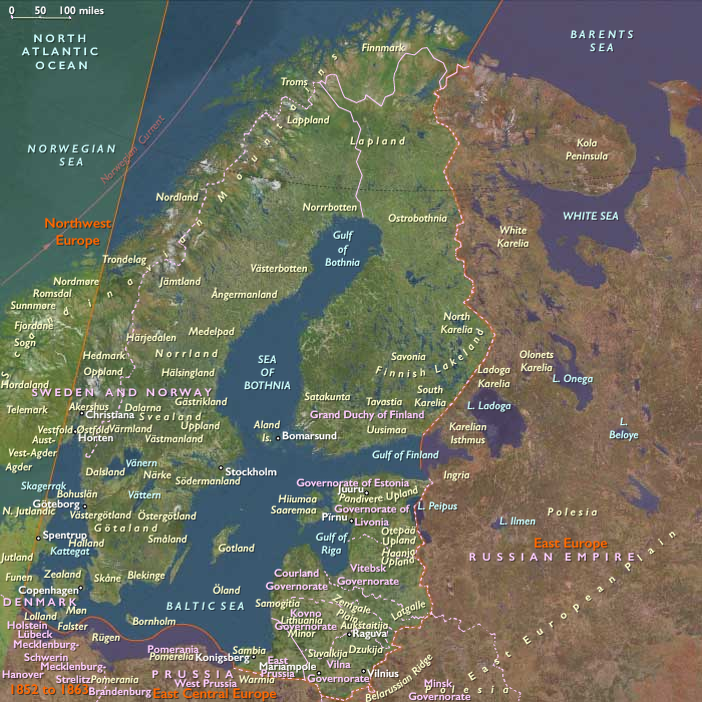
The first women's magazine in the Nordic …
Years: 1859 - 1859
The first women's magazine in the Nordic countries, Tidskrift för hemmet, begins publication in Sweden in 1859
Locations
Groups
Topics
Commodoties
Subjects
Regions
Subregions
Related Events
Filter results
Showing 10 events out of 15120 total
The island of Timor is divided between Portugal and the Netherlands in 1859.
The island has been politically divided in two parts for centuries.
The Dutch and Portuguese had fought for control of the island until dividing it by treaty in 1859, but they still will not formally resolve the matter of the boundary until 1912.
West Timor, will be known as Dutch Timor until 1949 when it will become Indonesian Timor, a part of the nation of Indonesia formed from the old Netherlands East Indies, while East Timor will be known as Portuguese Timor, a Portuguese colony until 1975.
It includes the exclave of Oecussi-Ambeno in West Timor.
China's legalization of opium consumption in 1858 has encouraged a sharp rise in both production and consumption.
With legalization, domestic opium supersedes imports, making speed less important in the shipping of opium and allowing steamships to replace the clippers formerly crucial to the India-China opium trade, thereby assuring the East India Company of a de facto monopoly over this fast growing market.
Hong Rengan, a cousin and neighbor of Hong Xiuquan, had fled at the outbreak of the Taiping rebellion in 1850 to the British settlement of Hong Kong, where he had been baptized and educated by a Protestant missionary.
He finally makes his way to the Taiping camp in 1859 with the intention of teaching the Taipings the correct version of Protestant Christianity and helping them improve their relations with the Western countries.
The British emissary Lord Elgin, in further negotiations in Shanghai later in the year, had forced China to legalize the so-called coolie trade (unskilled contract laborers shipped from China, particularly the southern ports of Amoy and Macau, to developing European colonial areas, such as Hawaii, Ceylon, Malaya, and the Caribbean) and the importation of opium and fixes a small tariff rate for opium importation.
The Chinese, however, refuse to ratify the treaties, and ...
...refuse entry to foreign diplomats at Peking.
The allies resume hostilities and an invading British force is slaughtered in 1859 by the Chinese near Beijing.
An Anglo-French expedition seizes the Taku forts, moves upriver and takes Tianjin, then defeats a Chinese army outside of Peking and burns the emperor's summer palace.
The emperor flees, and his commissioners conclude four new treaties.
Russia meanwhile expands at Chinese expense.
The Nien leaders consolidate their bases north of the Huai River from 1856 to 1859 by winning over the masters of the earth-wall communities, consolidated villages that have been fortified for self-defense against the Taiping.
The Nien strategy is to use their powerful cavalry to plunder the outlying areas and carry the loot to their home bases.
Germany has experienced a period of unmitigated reaction in the 1850s.
Those who had dared to defy royal authority are forced to pay the penalty of harassment, exile, imprisonment, or even death.
Many of the political concessions made earlier, under the pressure of popular turmoil, are now restricted or abrogated.
Austria, for example, has revoked the constitution that had been promulgated in 1849, and legitimacy, centralization, and clericalism have become the guiding principles of government.
While in Prussia the constitution granted by the king remains in force, its effectiveness is reduced through the introduction of a complicated system of election by which the ballots are weighted in accordance with the income of the voters.
This results in the control of the legislature by well-to-do conservatives.
The restoration of the confederal system also serves the interests of the Habsburgs, who stand at the pinnacle of their prestige as the saviors of the established order.
In Berlin, on the other hand, the prevailing mood is one of confusion and discouragement.
The king, increasingly gloomy and withdrawn, comes under the influence of ultraconservative advisers who preach legitimism in politics and orthodoxy in religion.
The government, smarting under the humiliation suffered at the hands of Austria, is as timid in foreign as it is oppressive in domestic affairs.
The people, tired of insurrection and cowed by repression, are politically apathetic.
The German Confederation as a whole, rigid and unyielding, remains blind to the need for reform that the revolution had made clear.
As wealth continues to shift from farming to manufacturing, from the country to the city, and from the aristocracy to the bourgeoisie, the pressure for a redistribution of political power also gains strength.
While the reactionaries solemnly proclaim the sanctity of traditional institutions, economic change undermines the foundation of those institutions.
By the end of the decade, a new struggle between the forces of liberalism and conservatism is brewing.

A rising Hindu middle class begins to assume dominant positions in industry, education, the professions, and the civil service following the Indian Mutiny.
Muslim leaders have been discredited in the eyes of British rulers.
As a consequence, the landed Muslim upper classes in the north Indian heartland retreat into cultural and political isolation, while fellow Muslims in Punjab are rewarded for assisting the British.
The former group fails to reemerge economically and produces no large group comparable to the upwardly mobile British-educated Hindu middle class.
They do not revise the doctrines of Islam to meet the challenges posed by alien rule, Christian missionaries, and revivalist Hindu sects, such as the Arya Samaj, attempting reconversion to Hinduism.
George Grey has dealt firmly with the natives in South Africa, but has endeavored to protect them from the white colonists by setting apart tracts of land for their exclusive use.
He more than once has acted as arbitrator between the government of the Orange Free State and the natives, and had eventually come to the conclusion that a federated South Africa would be a good thing for everyone.
The Orange Free State would have been willing to join the federation, and it is probable that the Transvaal would also have agreed.
However, Grey is fifty years before his time and the colonial office will not agree to his proposals.
In spite of their instructions, Grey continues to advocate union, and, in connection with other matters, such as the attempt to settle soldiers in South Africa after the Crimean War, he several times disregards his instructions.
When all the circumstances are considered, it is not surprising that he is recalled in 1859.
Martinus Pretorius, the President of Transvaal, is elected president of the Orange Free State in 1859, but will fail in his effort to unite the two Boer republics.