
Charles VIII, in order to have a …
Years: 1494 - 1494
September
Charles VIII, in order to have a free hand in Italy, has made ruinous pacts with all his neighbors, so they will not interfere.
Henry VII has been given cash, Ferdinand II of Aragon has been given Roussillon and Maximillian has been given Artois and Franche-Comté.
This handing out of territory is symptomatic of Charles' lack of foresight.
Charles is willing to do this, however, in his attempt to establish his Neapolitan base for his crusade.
The fighting between the many independent towns of Italy has been done by establishing a contract, condotta in Italian, between the town leaders and the leaders of mercenary bands, who had come to be called condottieri.
This had led to the developing of fighting tactics destined to establish field supremacy, gaining wealthy prisoners to be ransomed, and minimizing casualties, as it is basically a business.
These tactics will be put to shame when the motivated armies of France and Spain descend upon the Italian peninsula.
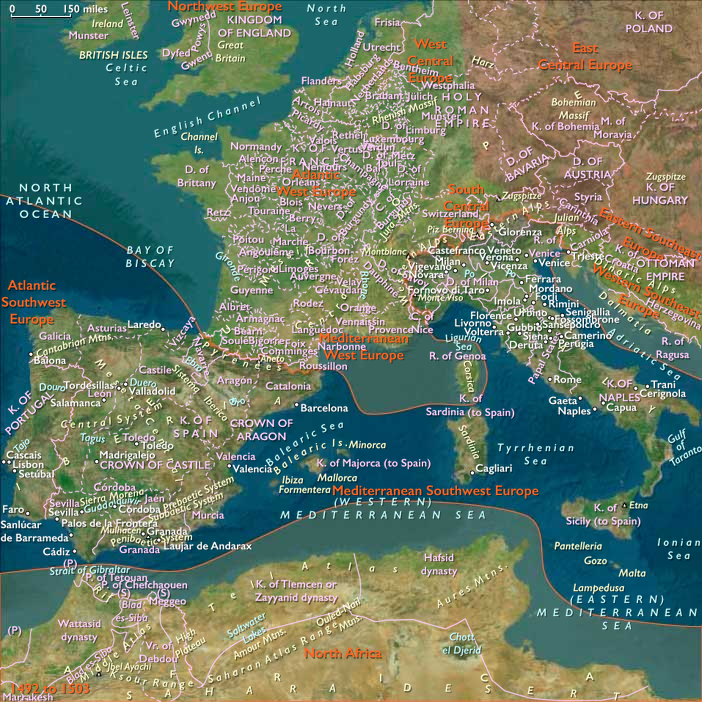
Rapallo is occupied by four thousand Neapolitan troops on September 3, 1494, with Giulio Orsini, Obietto Fieschi and Fregosino Campofregoso in command, their plan being to force a rebellion in Genoa; however, the Neapolitan fleet is soon forced away by bad weather.
Louis d'Orleans lands on September 5 with one thousand Swiss mercenary infantry, later reinforced overland by two thousand more Swiss mercenaries and a contingent of Genoese-Milanese infantry.
A skirmish breaks out between the Swiss mercenaries and Neapolitan forces, though the terrain does not allow for the Swiss to form up their pike squares.
The battle is mainly fought, however, between the Genoese-Milanese and Neapolitan infantry.
Following concentrated artillery fire from the French fleet, the Neapolitans are routed.
The Swiss massacre Neapolitans trying to surrender, although Orsini and Campofregoso are captured in the retreat.
After the battle the Swiss mercenaries kill the enemy wounded and sack the town of Rapallo.
Though this had been a small battle, it is seen as a significant victory that halts Neapolitan-Aragonese attempts to incite a rebellion in Genoa against the French.
Locations
People
- Alfonso II of Naples
- Charles VIII of France
- Ferdinand I of Naples
- Ferdinand II of Aragon
- Francesco II Gonzaga
- Gilbert
- Girolamo Savonarola
- Louis XII of France
- Ludovico Sforza
- Maximilian I of
- Piero the Unfortunate
- Pope Alexander VI
- Pope Julius II
- Étienne de Vesc
Groups
- Jews
- Papal States (Republic of St. Peter)
- Genoa, (Most Serene) Republic of
- Christians, Roman Catholic
- Mantua, free commune of
- Aragón, Kingdom of
- Venice, (Most Serene) Republic of
- Aragon, Crown of
- Castile, Crown of
- Swiss mercenaries
- France, (Valois) Kingdom of
- Florence, Medici-ruled
- Holy Roman Empire
- Milan, Duchy of
- England, (Tudor) Kingdom of
- Florence, Republic of
Topics
Commodoties
Subjects
Regions
Subregions
Related Events
Showing 10 events out of 40220 total
Years: 1494 - 1494
September
Locations
People
- Alfonso II of Naples
- Charles VIII of France
- Ferdinand I of Naples
- Ferdinand II of Aragon
- Francesco II Gonzaga
- Gilbert
- Girolamo Savonarola
- Louis XII of France
- Ludovico Sforza
- Maximilian I of
- Piero the Unfortunate
- Pope Alexander VI
- Pope Julius II
- Étienne de Vesc
Groups
- Jews
- Papal States (Republic of St. Peter)
- Genoa, (Most Serene) Republic of
- Christians, Roman Catholic
- Mantua, free commune of
- Aragón, Kingdom of
- Venice, (Most Serene) Republic of
- Aragon, Crown of
- Castile, Crown of
- Swiss mercenaries
- France, (Valois) Kingdom of
- Florence, Medici-ruled
- Holy Roman Empire
- Milan, Duchy of
- England, (Tudor) Kingdom of
- Florence, Republic of
Topics
Commodoties
Subjects
Regions
Subregions