
Vienna's Karlskirche is completed in 1737. …
Years: 1737 - 1737
Vienna's Karlskirche is completed in 1737.
Charles VI, Holy Roman Emperor, had in 1713, one year after the last great plague epidemic, pledged to build a church for his namesake patron saint, Charles Borromeo, who was revered as a healer for plague sufferers.
An architectural competition was announced, in which Johann Bernhard Fischer von Erlach had prevailed over, among others, Ferdinando Galli-Bibiena and Johann Lukas von Hildebrandt.
Construction begun in 1716 under the supervision of Anton Erhard Martinelli.
After J.B. Fischer's death in 1723, his son, Joseph Emanuel Fischer von Erlach, completes the construction in 1737 using partially altered plans.
The church originally possesses a direct line of sight to the Hofburg and is also, until 1918, the imperial patron parish church.
As a creator of historic architecture, J.B. Fischer has united the most diverse of elements.
The façade in the center, which leads to the porch, corresponds to a Greek temple portico.
The neighboring two columns, crafted by Lorenzo Mattielli, find a model in Trajan's Column in Rome.
Next to those, two tower pavilions extend out and show the influence of the Roman baroque (Bernini and Borromini).
Above the entrance, a dome rises up above a high drum, which the younger J. E. Fischer has shortened and partly altered.
The iconographical program of the church originates from the imperial official Carl Gustav Heraeus and connects St. Charles Borromeo with his imperial benefactor.
The relief on the pediment above the entrance with the cardinal virtues and the figure of the patron on its apex point to the motivation of the donation.
This sculpture group continues onto the attic story as well.
The attic is also one of the elements which the younger Fischer has introduced.
The columns display scenes from the life of Charles Borromeo in a spiral relief and are intended to recall the two columns, Boaz and Jachim, that stood in front of the Temple at Jerusalem.
They also recall the Pillars of Hercules and act as symbols of imperial power.
The entrance is flanked by angels from the Old and New Testaments.
This program continues in the interior as well, above all in the dome fresco by Johann Michael Rottmayr of Salzburg and Gaetano Fanti (pseudoarchitecture) which displays an intercession of Charles Borromeo, supported by the Virgin Mary.
Surrounding this scene are the cardinal virtues.
The frescos in a number of side chapels are attributed to Daniel Gran.
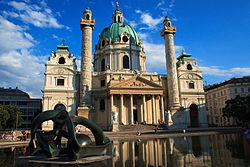
Karlskirche, Vienna (Taken by John Menard from Phoenix, USA, 2 August 2006)
Locations
People
Groups
Topics
Subjects
Regions
Subregions
Years: 1737 - 1737
Karlskirche, Vienna (Taken by John Menard from Phoenix, USA, 2 August 2006)
Locations
People
Groups
Topics
Subjects
Regions
Subregions