
Charles-Joseph Natoire's father Florent Natoire, a sculptor, …
Years: 1734 - 1734
Charles-Joseph Natoire's father Florent Natoire, a sculptor, had given him his fundamental training in drawing, then sent him to Paris in 1717 to complete his training, first in the atelier of Louis Galloche (1670–1761), peintre du Roi and professor at the Académie royale de peinture et de sculpture, and then in the atelier of François Lemoyne, whose training had shaped Natoire's style.
He obtained the Prix de Rome in 1721 with a Sacrifice of Manoah to obtain a son.
On June 30, 1723 he had been appointed a pensionnaire at the French Academy in Rome, at the time lodged in the Palazzo Mancini, where he arrived in October.
During his stay, he executed a copy of Pietro da Cortona's Rape of the Sabine Women.
He won a first prize in December 1725 from the Accademia di San Luca with a Moses Returning from Sinai.
He painted for the French ambassador, the prince de Polignac, an Expulsion of the Money-Changers from the Temple in 1728.
Returning to Paris via Venice in the early part of 1729, Natoire had on September 30, 1730, been received into the Académie royale de peinture et de sculpture.
His reputation quickly established, he has received major commissions.
From 1731, he has provided several suites of canvasses for Philibert Orry, contrôleur général des finances, who is to succeed the duc d'Antin as general director of the Bâtiments du Roi in 1736.
For Orry's Château de La Chapelle-Godefroy at Saint-Aubin (Aube), Natoire provides a series of nine canvasses of Histories of the Gods, six more of the History of Clovis, six of a History of Telemachus and four Seasons.
During the same period, in 1732 he had provided three overdoors on Old Testament subjects for the duc d'Antin in Paris.
Natoire submits on June 1734 to an Exposition de la Jeunesse in place Dauphine a Galatea.
In the same year, his first royal commission arrives, for the Chambre de la Reine at Versailles.
He is made a full member of the Académie on December 31 with a Venus Commanding from Vulcan the Arms of Aeneas.
Henceforth, numerous royal commissions will come his way for the petits appartements at the Château de Fontainebleau, for the Cabinet du Roi and the royal dining-room at Versailles, decorations for Marly, for the Cabinet des Médailles in the royal library in Paris, and others.
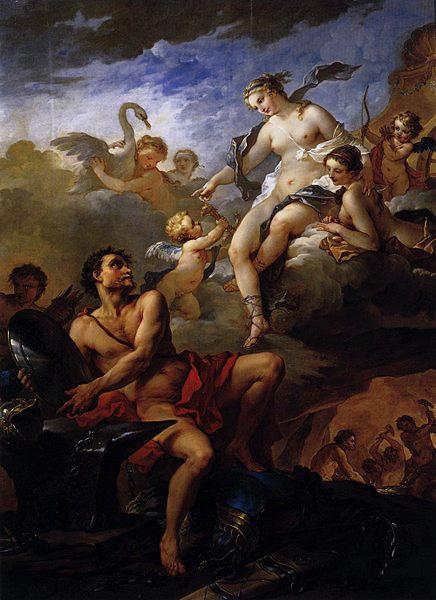
Charles-Joseph Natoire, Venus Demanding Arms from Vulcan for Aeneas (after 1732). Oil on canvas, 194 cm (76.4 in). Width: 140 cm (55.1 in); Musée Fabre, Montpellier, France
Locations
People
Groups
Topics
Subjects
Regions
Subregions
Related Events
Showing 10 events out of 27545 total
Years: 1734 - 1734
Charles-Joseph Natoire, Venus Demanding Arms from Vulcan for Aeneas (after 1732). Oil on canvas, 194 cm (76.4 in). Width: 140 cm (55.1 in); Musée Fabre, Montpellier, France
Locations
People
Groups
Topics
Subjects
Regions
Subregions