Paul Cézanne had exhibited Portrait of M.L.A …
Years: 1882 - 1882
October
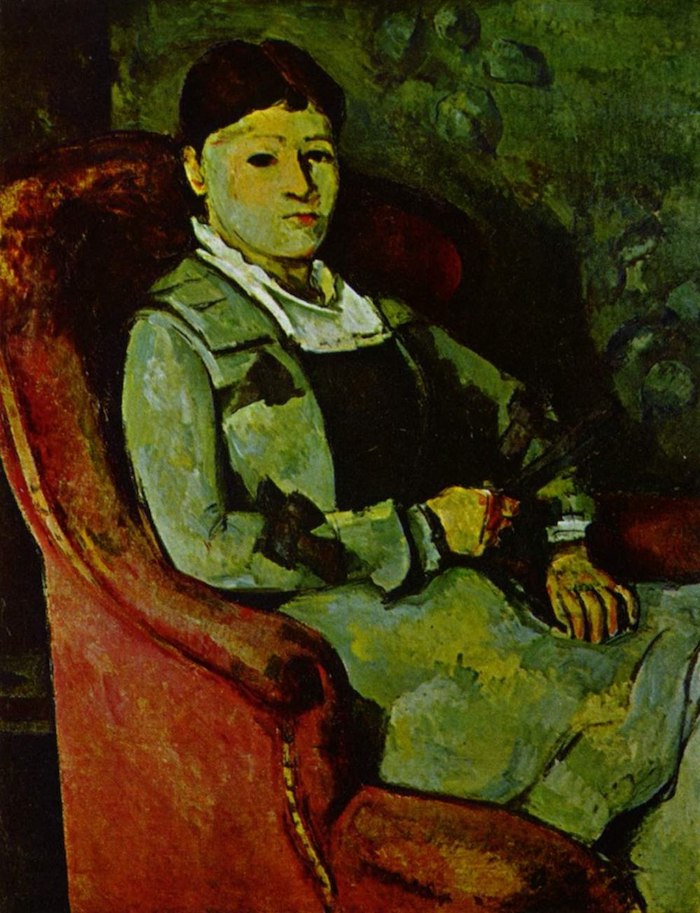
Paul Cézanne had exhibited Portrait of M.L.A. at the Salon as a “pupil of Guillemet.”
He has spent most of the year in Paris, but had visited Émile Zola at Médan, and returns to Aix in October where he works at the Jas de Bouffan.
Related Events
Filter results
Showing 10 events out of 11301 total
Levuka had remained the Fijian the capital until 1877, when the administration had been moved to Suva, prompted by concerns that the six hundred-meter high cliffs surrounding Levuka give it no room for expansion.
The move is made official in 1882.
The England-bound voyage of the first refrigerated cargo ship in 1882 creates a booming export industry for New Zealand lamb and mutton.
The first attempt to ship refrigerated meat had been made when the Northam sailed from Australia to the UK in 1876; however, the refrigeration machinery had broken down en route and the cargo was lost.
In 1877, the steamers Le Frigorifique and Paraguay had carried frozen mutton from Argentina to France, proving the concept of refrigerated ships, if not the economics.
In 1879, the Strathleven, equipped with compression refrigeration, had sailed successfully from Sydney to the UK with forty tons of frozen beef and mutton as a small part of her cargo.
The clipper sailing ship Dunedin, owned by the New Zealand and Australian Land Company (NZALC), had been refitted in 1881 with a Bell-Coleman compression refrigeration machine—this steam powered freezer unit works by compressing air, then releasing it into the hold of the ship.
The expanding air gets cooler as it expands, cooling the cargo in the hold.
Using three tons of coal a day, this steam-powered machine can chill the hold to 40°F (22°C) below surrounding air temperature, freezing the cargo in the temperate climate of southern New Zealand, and then maintaining it below freezing (32°F (0°C)) through the tropics.
The Dunedin's most visible sign of being an unusual ship is the funnel for the refrigeration plant placed between her fore and main masts, (sometimes leading her to be mistaken for a steamship, which have been common since the 1840s).
The Dunedin sails from Port Chalmers, New Zealand in February 1882 with 4331 mutton, 598 lamb and 22 pig carcasses, 246 kegs of butter, as well as hare, pheasant, turkey, chicken and 2226 sheep tongues and arrives in London UK after ninety-eight days sailing with its cargo still frozen.
After meeting all costs, The NZALC company makes a £4700 profit from the voyage.
France intervenes militarily in Tonkin, creating a French Protectorate in 1882.
The Hong Kong Observatory, built in Tsim Sha Tsui, Kowloon Peninsula, is established in 1883 as Hong Kong Observatory by the ninth Governor of Hong Kong, George Bowen, with Dr. William Doberck as the first director of the Observatory.
Early operations include meteorological and magnetic observations, a time service based on astronomical observations and a tropical cyclone warning service.
The reclusive Korea, having signed a trade treaty with Japan in 1876, signs a commercial treaty with the United State in 1882, ending centuries of isolationism and opening its doors to Western trading nations.
Leon Pinsker, his assimilationist beliefs shattered, turns to Jewish nationalism, no longer believing that mere humanism and enlightenment would defeat anti-Jewish sentiments.
His visit to Western Europe leads to his famous pamphlet Auto-Emanzipation, subtitled Mahnruf an seine Stammgenossen, von einem russischen Juden (Warning to His Fellow People, from a Russian Jew), which he publishes anonymously in German on January 1, 1882, and in which he urges the Jewish people to strive for independence and national consciousness.
The book raises strong responses, both for and against.
An incisive, embittered, and impassioned pamphlet, Auto-Emanzipation provokes strong reactions, both critical and commendatory, from Jewish leaders.
In the pamphlet, he contends that Judeophobia is a modern phenomenon, beyond the reach of any future triumphs of” humanity and enlightenment,” and that the only restorative for Jewish dignity and spiritual health lies in a Jewish homeland, not necessarily in their ancestral home in the Holy Land.
As a professional physician, Pinsker prefers the medical term "Judeophobia" to the recently introduced misnomer "antisemitism".
Pinsker knows that a combination of mutually exclusive assertions is a characteristic of a psychological disorder and is convinced that pathological, irrational phobia may explain this millennia-old hatred: "... to the living the Jew is a corpse, to the native a foreigner, to the homesteader a vagrant, to the proprietary a beggar, to the poor an exploiter and a millionaire, to the patriot a man without a country, for all a hated rival."
His analysis of the roots of this ancient hatred lead him to call for the establishment of a Jewish National Homeland, either in Palestine or elsewhere.
Eventually Pinsker will come to agree with Moses Lilienblum that hatred of Jews is rooted in the fact that they are foreigners everywhere except their original homeland, the Land of Israel, or Eretz Israel.
Leon Pinsker had inherited a strong sense of Jewish identity from his father, Simchah Pinsker, a Hebrew language writer, scholar and teacher.
Leon had attended his father's private school in Odessa and was one of the first Jews to attend Odessa University, where he studied law.
Later he realized that, being a Jew, he had no chance of becoming a lawyer due to strict quotas on Jewish professionals and chose the career of a physician.
Pinsker believes that the Jewish problem could be resolved if the Jews could attain equal rights.
In his early years, Pinsker had favored the assimilation path and had been one of the founders of a Russian language Jewish weekly.
The Odessa pogrom of 1871 had moved Pinsker to become an active public figure.
In 1881, a bigger wave of anti-Jewish hostilities, some allegedly state-sponsored, had swept southern Russia; the pogroms will continue until 1884.

Alexander III initiates a period of political counterreform.
He strengthens the security police, reorganizing it into an agency known as the Okhrana, gives it extraordinary powers, and places it under the Ministry of Internal Affairs.
The new Russian tsar assigns his former tutor, conservative Konstantin Pobedonostsev, to be the procurator of the Holy Synod of the Orthodox Church and Ivan Delyanov to be the minister of education.
Dmitriy Tolstoy, Alexander's minister of internal affairs and Chief of Gendarmerie, institutes the use of land captains, who are noble overseers of districts, and he restricts the power of the zemstvos and the dumas.
Labor legislation is first introduced in Russia 1882 with the creation of the inspectorate of factories (in charge of health and life saving regulations), the regulation of working hours and the limitation of female and juvenile labor.
Tolstoy is considered one of the pillars of the political reaction in the 1880s and supporter of the strong authority.
Tolstoy's activities are aimed at backing the nobility, regulating peasantry's modus vivendi and spreading his administration's influence over local authorities.
On Tolstoy's initiative, the government issues the so called "Temporary regulations" in 1882, which limit the freedom of press to an even greater extent.
Together with A. Pazukhin, Tolstoy outlines and prepared the so-called "counterreforms", which will become very unpopular in Russia.
As one of the great counter reformers of the post Crimean period, Tolstoy will use his position as minister of education to promote study at university and secondary levels that will bolster Russia as a nation with honest people in power looking to maintain Orthodoxy and Autocracy: something in danger during Tolstoy's rule as the post Crimean period of reform amounts also to increasing rebellion and student dissent.
Tolstoy does his best to educate Russia, and moreover a Russian elite that will maintain Orthodoxy and Autocracy while being in mountable competition with the West.
His focus is on consolidating his power over education while suppressing revolutionary attitudes by just censorship, etc.
The author of a number of books on Russian history, Tolstoy is elected President of the St. Petersburg Academy of Sciences in 1882.
Per Teodor Cleve concludes in 1882 that Mosander's didymia (from which are eventually isolated praseodymium and neodymium) is a complex earth, i.e., a mixture of several rare-earth oxides.
Leon Pinsker's authorship is soon discovered, and the newly formed Zionist group Hibbat Ziyyon (”Love of Zion”), ignoring Pinsker's indifference toward the Holy Land and taking up his call for a territorial solution to the Jewish problem, makes him one of its leaders.
Pinsker organizes an international conference in 1884 in Katowice (Upper Silesia, part of the Kingdom of Prussia).
Tuberculosis is the cause of one in seven deaths in the mid-nineteenth century; the death rate from tuberculosis at this time stands at 370:100,000.