Cerialis is appointed governor of Britain in …
Years: 71 - 71
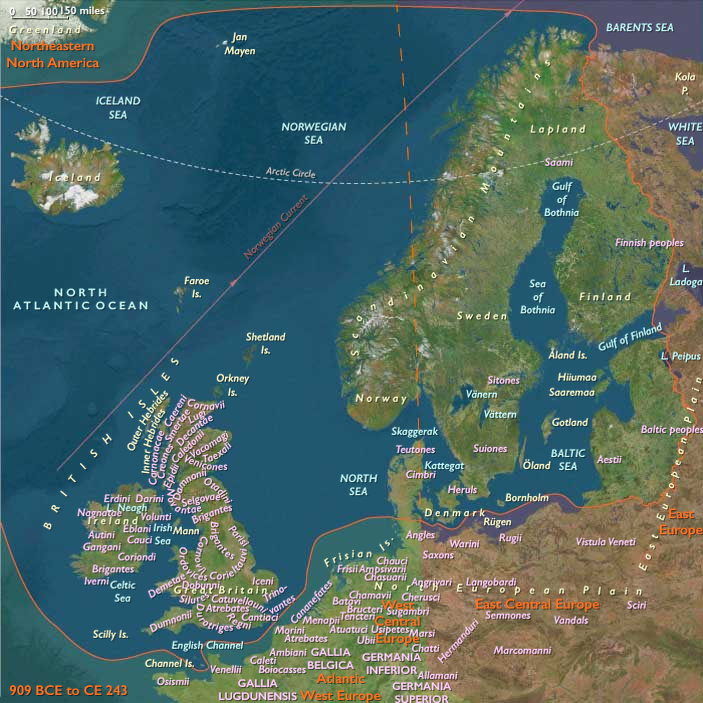
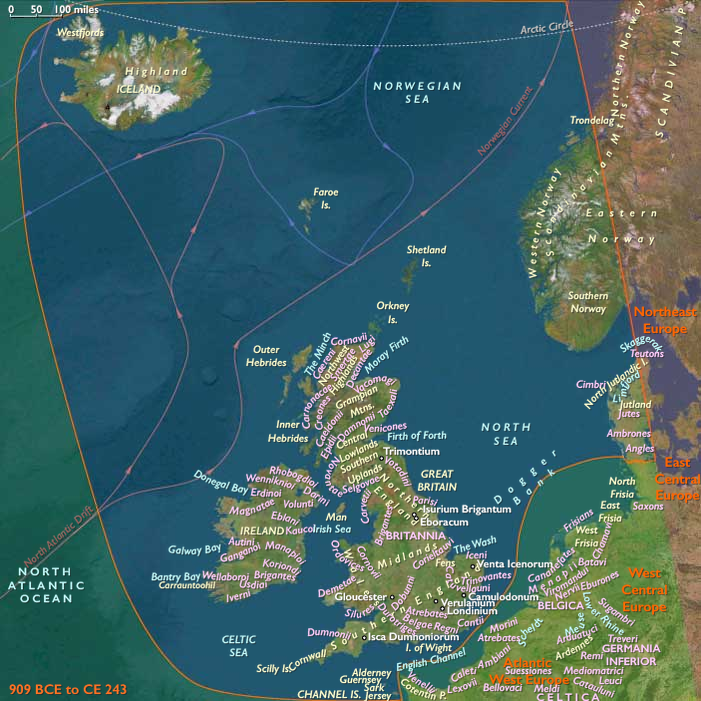
Cerialis is appointed governor of Britain in 71, bringing the II Adiutrix with him to the province.
He is supported by Gnaeus Julius Agricola, commander of XX Valeria Victrix.
As governor, Cerialis campaigns against the Brigantes of northern England.
Locations
People
Groups
Topics
- Classical antiquity
- Roman colonization
- Pre-Roman Iron Age of Northern Europe
- Roman Age Optimum
- Pax Romana
- Roman Conquest of Britain
Commodoties
Subjects
Regions
Subregions
Related Events
Filter results
Showing 10 events out of 61587 total
Prince Ying commits suicide in exile in 71.
The investigation does not end, however.
By Emperor Ming's orders, Prince Ying's associates (but not his family) are harshly tortured and interrogated, and anyone that they name as a coconspirator is arrested and further tortured and interrogated.
The interrogators themselves use this opportunity to falsely accuse many others of conspiracy.
Tens of thousands of people die, either of torture or execution, during the investigation.
Only after Empress Ma's intercession and persuasive petitions by one of the interrogators, Han Lang, do the interrogations taper off.
Johanan ben Zakkai, head of the Sanhedrin during the years leading up to the Jewish Revolt, had acted as a leading representative of the Pharisees in debate with priestly and Sadducean authorities.
One in search of learning would go to extremes, if need be, to be admitted to Johanan's famous school in Jerusalem.
Furthermore, Johanan had opposed the policy of those who were determined on war with Rome at all costs.
By quitting beleaguered Jerusalem according to most accounts in 70 (though it is possible that he left as early as 68) and being brought to the Roman camp, he somehow succeeds in getting permission to set up an academy in …
…Jamnia (Jabneh, modern Yibna, about twenty-four kilometers southwest of present-day Tel Aviv), near the Judaean coast, and here he is joined by a number of his favorite disciples, including Eliezer ben Hyrcanus and Joshua ben Hananiah.
The two are credited with having smuggled their master out of Jerusalem in a coffin for burial, after pretending that he was dead.
Titus, unable to sail to Italy during the winter, celebrates elaborate games at Caesarea Maritima and Berytus, then travels to Zeugma on the Euphrates, where he is presented with a crown by Vologases I of Parthia.
While visiting Antioch he confirms the traditional rights of the Jews in that city.
Ben-Matityahu adopts the name Flavius Josephus after the emperor’s family name, accompanies his patron to Alexandria, and there marries for the third time. (Josephus' first wife had been lost at the siege of Jotapata, and his second had deserted him in Judaea.)
Titus on his way to Alexandria had stopped in Memphis to consecrate the sacred bull Apis.
According to Suetonius, this caused consternation; the ceremony required Titus to wear a diadem, which the Romans associated with kingship, and the partisanship of Titus's legions had already led to fears that he might rebel against his father.
Titus returns quickly to Rome—hoping, says Suetonius, to allay any suspicions about his conduct.
Agrippa II goes to Rome after the destruction of Jerusalem; his sister Berenice also goes to Rome, where she is reportedly courted by Titus.
Josephus, too, takes up residence in the city.
Upon Titus’ arrival in Rome in 71, he is awarded a triumph.
Accompanied by Vespasian and Domitian, he rides into the city, enthusiastically saluted by the Roman populace and preceded by a lavish parade containing treasures and captives from the war.
Josephus describes a procession with large amounts of gold and silver carried along the route, followed by elaborate reenactments of the war, Jewish prisoners, and finally the treasures taken from the Temple of Jerusalem, including the Menorah (the seven-branched golden candelabrum used during the eight-day festival of Hanukkah, and which signifies, among other things, the seven days of creation) and the Pentateuch.
Simon Bar Giora is executed in the Forum, after which the procession closes with religious sacrifices at the Temple of Jupiter.
(The triumphal Arch of Titus, which stands at one entrance to the Forum, memorializes the victory of Titus.)
Where Domitian’s political and military career had ended in disappointment, his private affairs are more successful at this time.
Vespasian has attempted to arrange a dynastic marriage between his youngest son and the daughter of Titus, Julia Flavia, but Domitian is adamant in his love for Domitia Longina, going so far as to persuade her husband, Lucius Aelius Lamia, to divorce her so that Domitian himself can marry her, which he does in 71.
Despite its initial recklessness, the alliance is very prestigious for both families.
Domitia Longina is the younger daughter of Gnaeus Domitius Corbulo, the respected general and honored politician, who, following the failed Pisonian conspiracy against Nero in 65, had been forced to commit suicide.
The new marriage not only reestablishes ties to senatorial opposition, but also serves the broader Flavian propaganda of the time, which seeks to diminish Vespasian's political success under Nero.
Instead connections to Claudius and Britannicus are emphasized, and Nero's victims, or those otherwise disadvantaged by him, rehabilitated.

The Roman conquest of Britain had begun in CE 43, but advance beyond the Humber does not take place until the early 70s CE.
This is because the people in the area known as the Brigantes by the Romans, who had became a Roman client state, had become more hostile to Rome when their leadership changed.
Cerialis leads the Ninth Legion north from Lincoln across the Humber.
The fortress of Eboracum is founded in 71 CE when Cerialis and the Ninth Legion construct a military fortress (castra) on flat ground above the River Ouse near its junction with the River Foss.
In the same year Cerialis is appointed Governor of Britain.
Vespasian joins Cappadocia with the provinces of Galatia and Lesser Armenia in 72 to form a large new Roman administrative unit.
Aretaeus of Cappadocia writes in Ionic Greek a general treatise on diseases, which is still extant, and is certainly one of the most valuable relics of antiquity.
The book displays great accuracy in the detail of symptoms, and in seizing the diagnostic character of diseases.
In his practice he follows for the most part the method of Hippocrates, but he pays less attention to what have been styled "the natural actions" of the system; and, contrary to the practice of the Father of Medicine, he does not hesitate to attempt to counteract them, when they appear to him to be injurious.
One disease he describes is later known as Celiac Disease and is common in the world today.
The account which he gives of his treatment of various diseases indicates a simple and sagacious system, and one of more energy than that of the professed Methodici.
Thus he freely administers active purgatives; he does not object to narcotics; he is much less averse to bleeding; and upon the whole his Materia Medica is both ample and efficient.
It may be asserted generally that there are few of the ancient physicians, since the time of Hippocrates, who appear to have been less biased by attachment to any peculiar set of opinions, and whose account of the phenomena and treatment of disease has better stood the test of subsequent experience.
Aretaeus is placed by some writers among the Pneumatici because he maintained the doctrines which are peculiar to this sect; other systematic writers, however, think that he is better entitled to be placed with the Eclectics.
Aretaeus' work consists of eight books, two De causis et signis acutorum morborum, two De causis et signis diuturnorum morborum, two De curatione acutorum morborum, and two De curatione diuturnorum morborum.
They are in a tolerably complete state of preservation, though a few chapters are lost. (See Aretaeus' complete works in Greek and English (edition of Francis Adams, 1856) at the Digital Hippocrates project.)
Vespasian establishes a new pagan city, Flavia Neapolis ("new city of the emperor Flavius"), as a reward for the loyalty of the Greeks in the revolt.
Founded in 72 over an older Samaritan village, Mabartha ("the passage"), and located between Mount Ebal and Mount Gerizim, the new city lies two kilometers (1.2 mi) west of the Biblical city of Shechem, which has been destroyed by the Romans this same year during the war.
Insofar as the hilly topography of the site allows, the city is built on a Roman grid plan and settled with veterans who have fought in the victorious legions and other foreign colonists.
Holy places at the site of the city's founding include Joseph's Tomb and Jacob's Well.
Due to the city's strategic geographic position and the abundance of water from nearby springs, Neapolis will prosper, accumulating extensive territory, including the former Judean toparchy of Acraba.
Known today as Nablus, the city is the capital of the Nablus Governorate and a Palestinian commercial and cultural center.
Titus had set sail for Rome in the spring of 71.
A new military governor he has appointed from Rome, Lucilius Bassus, prefect of the fleet stationed at Ravenna, had betrayed Vitellius by siding with Vespasian during the Year of the Four Emperors.
Bassus’s assigned task being the "mopping-up" operations in Judea, he uses X Fretensis to besiege and capture the few remaining fortresses that still resist.
Bassus takes Herodium, then …
Years: 71 - 71
Locations
People
Groups
Topics
- Classical antiquity
- Roman colonization
- Pre-Roman Iron Age of Northern Europe
- Roman Age Optimum
- Pax Romana
- Roman Conquest of Britain