
Central Vietnam has become the French protectorate …
Years: 1881 - 1881
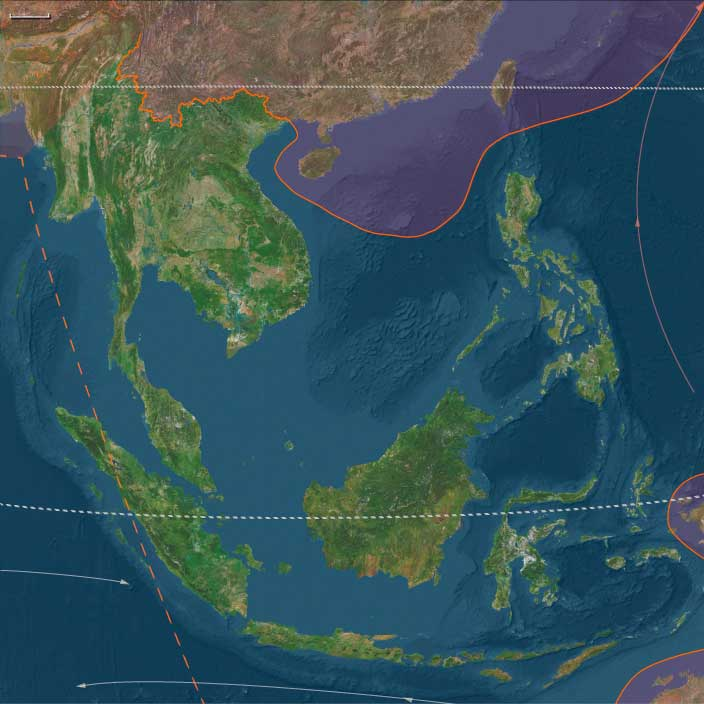
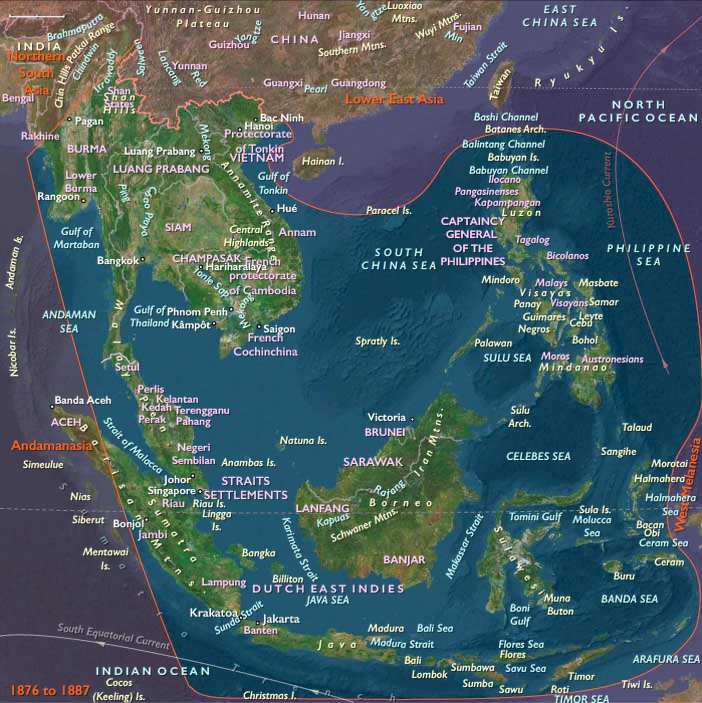
Central Vietnam has become the French protectorate of Annam and French influence in the Indochina Peninsula has strengthened.
Locations
Groups
- Chinese Empire, Qing (Manchu) Dynasty
- Vietnam, Kingdom of
- French Cochinchina
- France (French republic); the Third Republic
- Annam (French protectorate)
Topics
Commodoties
Subjects
Regions
Subregions
Related Events
Filter results
Showing 10 events out of 11414 total
King Kalākaua leaves Hawaiʻi on a trip around the world in 1881 to study the matter of immigration and to improve foreign relations.
He also wants to study how other monarchs rule.
In his absence, his sister and heir, Princess Liliʻuokalani, rules as regent (Prince Leleiohoku, the former heir, had died in 1877).
The King had first traveled to San Francisco, where he had received a royal welcome, then sailed to the Empire of Japan, where he had met with the Meiji Emperor.
He had continued through Qing Dynasty China, Siam under King Chulalongkorn (Rama V), Burma, British Raj India, Egypt, Italy, Belgium, the German Empire, Austria-Hungary, the French Third Republic, Spain, Portugal, the United Kingdom of Great Britain and Ireland, and back through the United States before returning to Hawaiʻi.
During this trip, he had met with many other crowned heads of state, including Pope Leo XIII, Umberto I of Italy, Tewfik, Viceroy of Egypt, William II of Germany, Rama V of Siam, U.S. President Chester A. Arthur, and Queen Victoria.
In this, he has become the first king to travel around the world.
Kalākaua also builds ʻIolani Palace (the only royal palace that exists on American soil today) at a cost of three hundred thousand dollars—a sum unheard of at this time.
Many of the furnishings in the palace had been ordered by Kalākaua while he was in Europe.
Support for Christianity had increased rapidly throughout the Southern Group of the Cook Islands after the early conversion of a number of important ariki (high chiefs) in the Kingdom of Raratonga.
Working through the ariki, the missionaries had drawn up draft legal codes, which, together with the abolition of violence as a means of dispute settlement, has led to unprecedented political stability.
The British Colonial Office decides in 1881 that New Zealand interests in the area need some form of protection against foreign powers and the British Government grants a petition by local European traders and planters for the appointment of an unpaid British Consul for the Hervey Islands, as the Southern Group is at this time known.
A squadron of the British Royal Navy anchors off the coast of Nauru on September 21, 1881, and the squadron's flagship approaches the island to appraise the local situation.
An acculturated local beachcomber, William Harris, boards the British ship, which summons the rest of the squadron by semaphore that evening, saying that a tribal war is raging, an escaped convict had become king, that all of the islanders are drunk, that the actual king of the island, Aweida, wishes to have missionaries come to the island to help stop the war.
Some Māori had begun a strategy of passive resistance after the wars, most famously at Parihaka in Taranaki.
Others continued co-operating with Pākehā.
For example, tourism ventures had been established by Te Arawa around Rotorua.
Resisting and co-operating iwi both find that the Pākehā desire for land remains.
In the last decades of the century, most iwi lose substantial amounts of land through the activities of the Native Land Court.
This had been set up to give Māori land European-style titles and to establish exactly who owned it.
Due to its Eurocentric rules, the high fees, its location remote from the lands in question, and unfair practices by many Pākehā land agents, its main effect is to directly or indirectly separate Māori from their land.
The European population of New Zealand has grown explosively, from fewer than one thousand in 1831 to five hundred thousand by 1881.
Some four hundred thousand settlers had come from Britain, of whom three hundred thousand stay permanently.
Most are young people and two hundred and fifty thousand babies have been born.
The colonial government had paid for the passage of one hundred and twenty thousand.
Immigration slackens after 1880, and future growth will be due chiefly to the excess of births over deaths.
The Marine Biological Station, as the Linnaean Society’s new zoological center proposed by Miklouho-Maclay is known, is constructed by John Kirkpatrick, a prominent Sydney architect.
Located in Watsons Bay on the east side of the Greater Sydney, this facility is the first marine biological research institute in Australia.
Miklouho-Maclay marries Margaret-Emma Robertson, daughter of the Premier of New South Wales, John Robertson.
Miklouho-Maclay from 1879 onward has written a number of letters to Australian papers, and corresponds with Sir Arthur Gordon, High Commissioner for the Western Pacific, on protecting the land rights of his friends on what will come to be known as New Guinea’s Maclay Coast, and ending the traffic in arms and intoxicants in the South Pacific.
The South Island, with its low Māori population, had been generally peaceful while the the Land Wars convulsed the North Island.
Gold had been discovered at Gabriel's Gully in Central Otago, sparking a gold rush, n 1861.
Dunedin had become the wealthiest city in the country and many in the South Island resented financing the North Island’s wars.
Parliament had defeated a proposal in 1865, to make the South Island independent by seventeen to thirty-one.
The French administration in Saigon establishes the Opium Regie in 1881, a direct state marketing monopoly that shows greater profitability than the licensed opium dens.
The French Navy had begun a heavy presence in the Mekong Delta after helping to unify Vietnam under the Nguyen Dynasty, and had later colonized the southern third of Vietnam, including Saigon in 1867.
The first Japanese political parties are established in 1881.
Indian opium imports, having peaked in 1880, decline slowly as cheaper, China-grown opium begins to supplant the high-grade Bengal brands.
Years: 1881 - 1881
Locations
Groups
- Chinese Empire, Qing (Manchu) Dynasty
- Vietnam, Kingdom of
- French Cochinchina
- France (French republic); the Third Republic
- Annam (French protectorate)
