
Central Asia (45 BCE–CE 99): Crossroads of …
Years: 45BCE - 99
Central Asia (45 BCE–CE 99): Crossroads of Empires and the Rise of Kushan Influence
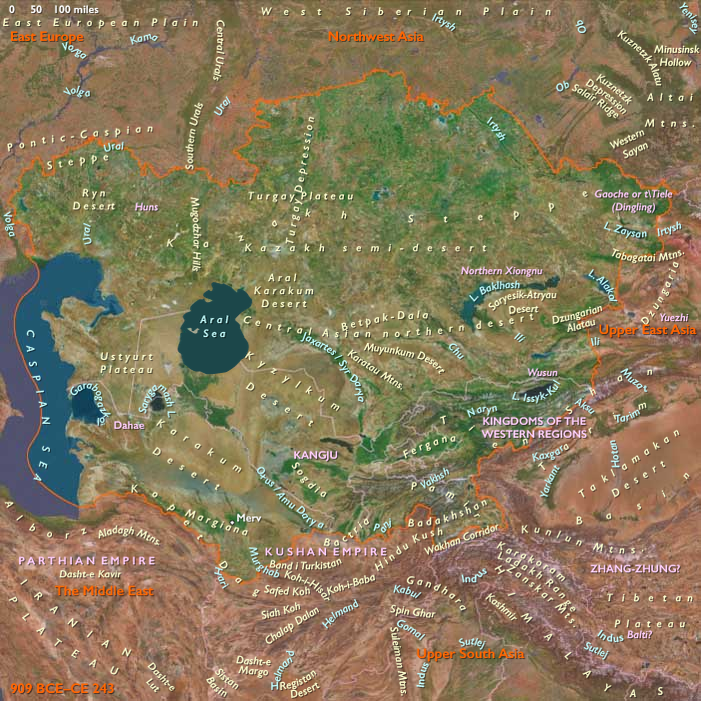
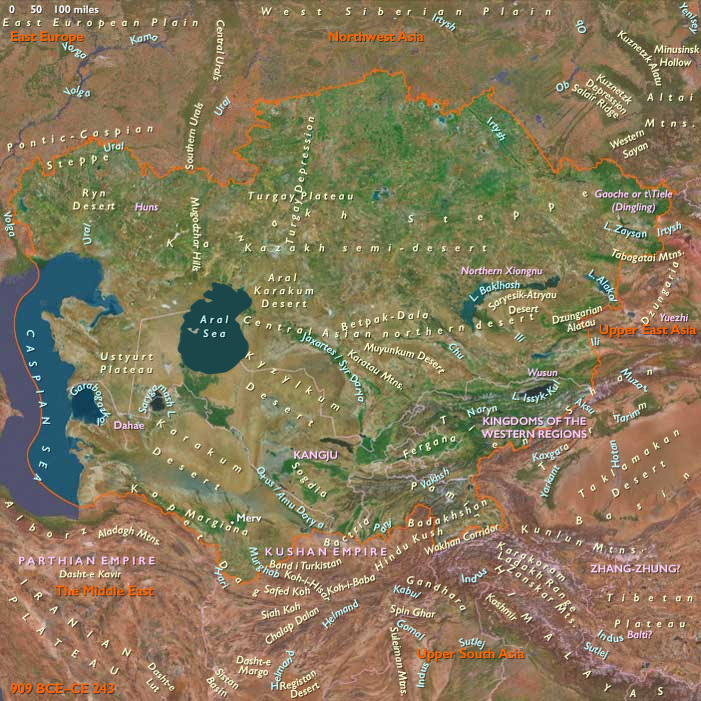
From 45 BCE to CE 99, Central Asia—encompassing modern-day Kazakhstan, Uzbekistan, Turkmenistan, Tajikistan, and Kyrgyzstan—served as a critical crossroads for cultural, economic, and political interaction. This transformative era was defined by the decline of Greco-Bactrian and Scythian states, the ascendancy of the Kushan Empire, flourishing Silk Road commerce, and increasingly intricate interactions with neighboring powers, notably Han China and Parthia.
Political and Military Developments
Decline of Hellenistic and Scythian Influence (45 BCE–25 CE)
-
The fragmented Greco-Bactrian kingdoms, remnants of Alexander’s empire, had largely dissolved by the start of this era. Small, Hellenistic-influenced principalities in Bactria, Sogdia, and Margiana gradually gave way to nomadic groups, especially the Yuezhi and other Indo-Iranian and Turkic peoples.
-
To the north, the Indo-Scythian kingdoms steadily weakened, paving the way for stronger, centralized empires emerging from the Yuezhi confederation in Bactria and the Tarim Basin.
Rise and Consolidation of the Kushan Empire (25–99 CE)
-
Around 25 CE, Kujula Kadphises, leader of the Yuezhi confederation, unified various tribes and city-states, laying the foundation for the powerful Kushan Empire. Although Kujula’s precise reign dates remain uncertain, his effective rule began around this time, consolidating territories in northern Afghanistan, Tajikistan, southern Uzbekistan, and parts of Turkmenistan.
-
Under Kujula’s successors, particularly Vima Takto (Soter Megas) from about 80 CE, the Kushan Empire expanded dramatically, controlling strategic points along the Silk Road, fostering vibrant commercial and cultural exchange between East and West.
Interaction with Han China and Parthia
-
The Kushans became influential intermediaries between the Han Dynasty in China and the Parthian Empire to the west. Diplomatic missions and alliances were frequent, as each empire sought advantageous trade terms and territorial security.
-
Central Asian states skillfully navigated these relationships, often balancing diplomatic, commercial, and occasionally military pressures exerted by both eastern and western neighbors.
Economic Developments and the Silk Road
Central Asia as Silk Road Nexus
-
Central Asian cities—Samarkand, Bukhara, Termez, and Maracanda—became increasingly wealthy through trade, benefiting from their strategic positions along the Silk Road. These cities served as pivotal commercial hubs, handling silk from China, spices and textiles from India, and precious metals, glassware, and wine from Rome and Parthia.
-
Sogdian merchants, particularly based in Samarkand and Bukhara, established expansive trade networks, dominating long-distance caravan trade across deserts and mountain passes.
Economic Prosperity under the Kushans
-
Kushan rulers fostered economic stability by issuing standardized coinage featuring imagery from diverse cultures, symbolizing the cosmopolitan nature of their empire and facilitating commercial interactions along the Silk Road.
-
Agriculture thrived in oasis settlements, enhancing regional prosperity. Innovations in irrigation and water management boosted agricultural output, enabling cities to grow and sustain large populations.
Cultural and Religious Developments
Cultural Syncretism and Kushan Patronage
-
The Kushan Empire promoted remarkable cultural syncretism. Their coins, monuments, and artifacts combined Hellenistic, Indian, Persian, and nomadic artistic traditions, reflecting Central Asia’s unique position as a cultural crossroads.
-
Artistic and architectural developments flourished, blending styles from Greco-Roman, Parthian, and Indian traditions, particularly visible in sculpture, coinage, and the monumental architecture of urban centers.
Spread of Buddhism into Central Asia
-
Under Kushan patronage, Buddhism spread rapidly throughout the region. Buddhist monasteries and stupas emerged in Uzbekistan (particularly in Termez), Tajikistan, and Turkmenistan, acting as centers of learning, art, and spiritual practice.
-
The Kushan rulers supported Buddhist missionary activities, facilitating the religion’s transmission into East Asia, notably influencing its arrival in China.
Persistence of Local Religions and Zoroastrian Influence
-
While Buddhism expanded, local religious traditions—including Zoroastrianism, local Iranian cults, and various animistic practices—remained robust and continued to coexist with Buddhism, contributing to Central Asia’s religious diversity.
-
Zoroastrian temples and fire worship persisted prominently in Sogdiana (especially around Samarkand and Bukhara), reflecting continued Iranian cultural influence.
Social and Urban Developments
Growth of Cosmopolitan Urban Centers
-
Central Asian urban centers flourished during this period, characterized by vibrant marketplaces, cosmopolitan communities, and complex social structures influenced by interactions among nomadic tribes, sedentary populations, and foreign traders.
-
Samarkand and Bukhara emerged as significant cultural and economic hubs, attracting merchants, scholars, and artisans from across Eurasia, facilitating cultural exchange.
Tribal and Nomadic Influence
-
Nomadic tribes continued to impact the region profoundly. Various Turkic and Iranian-speaking nomads regularly interacted with settled populations, influencing urban culture, political structures, and military dynamics throughout Central Asia.
Long-term Consequences and Historical Significance
The era from 45 BCE to CE 99 positioned Central Asia decisively as an essential hub of economic exchange, cultural fusion, and political power. The emergence and expansion of the Kushan Empire provided political stability and economic growth, fostering cultural syncretism and religious diffusion. Central Asia became deeply embedded in the Silk Road networks, profoundly shaping global history by enabling sustained cultural and commercial exchange between East and West.
The foundations established in this era—including vibrant cosmopolitan cities, integrated trade networks, diverse cultural traditions, and religious pluralism—defined Central Asia’s identity for centuries, securing its legacy as a pivotal crossroads of Eurasian history.
People
Groups
- Tajik people
- Iranian peoples
- Tocharians
- Yuezhi
- Persian people
- Scythians, or Sakas
- Zoroastrians
- Margiana
- Buddhism
- Sogdia
- Xiongnu (Hsiung-nu)
- Greco-Bactrian Kingdom
- Parthian Empire
- Indo-Greeks, Kingdom of the
- Indo-Scythians
- Indo-Parthians, Kingdom of the
- Chinese Empire, Tung (Eastern) Han Dynasty
- Kushan Empire
- Tokharistan (Kushan Bactria)
Topics
Commodoties
- Weapons
- Hides and feathers
- Domestic animals
- Grains and produce
- Textiles
- Ceramics
- Strategic metals
- Manufactured goods
- Spices
Subjects
Regions
Subregions
Related Events
Showing 10 events out of 62463 total
Years: 45BCE - 99
People
Groups
- Tajik people
- Iranian peoples
- Tocharians
- Yuezhi
- Persian people
- Scythians, or Sakas
- Zoroastrians
- Margiana
- Buddhism
- Sogdia
- Xiongnu (Hsiung-nu)
- Greco-Bactrian Kingdom
- Parthian Empire
- Indo-Greeks, Kingdom of the
- Indo-Scythians
- Indo-Parthians, Kingdom of the
- Chinese Empire, Tung (Eastern) Han Dynasty
- Kushan Empire
- Tokharistan (Kushan Bactria)
Topics
Commodoties
- Weapons
- Hides and feathers
- Domestic animals
- Grains and produce
- Textiles
- Ceramics
- Strategic metals
- Manufactured goods
- Spices
Subjects
Regions
Subregions