
Catholics in the Vandal kingdom of North …
Years: 532 - 532
July
Catholics in the Vandal kingdom of North Africa have been subject to frequent persecution.
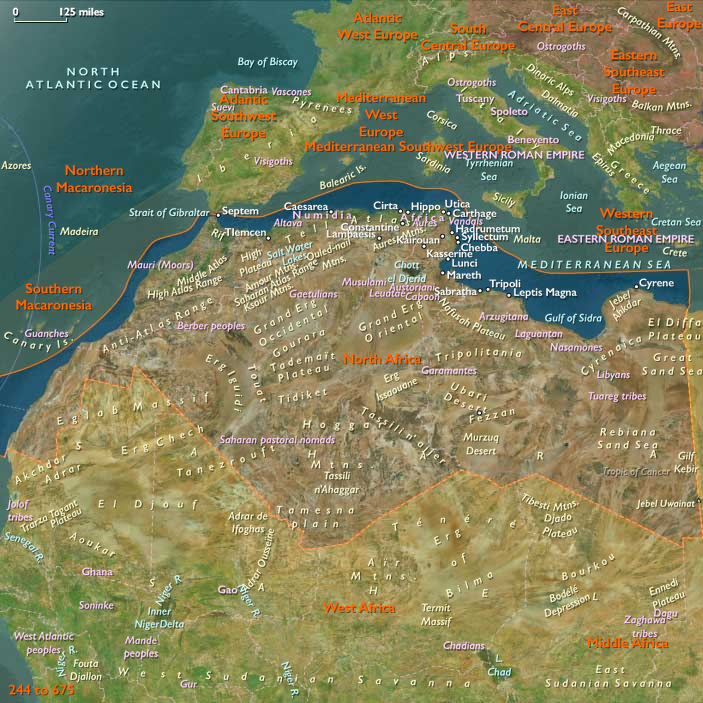
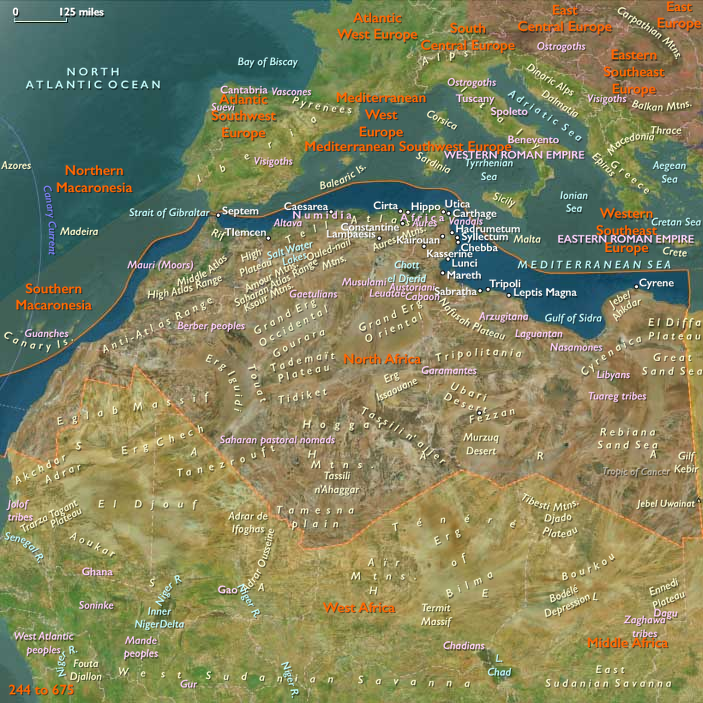
The aged Vandal king Hilderic, who had been in alliance with Constantinople and had ceased persecution of the Catholics, had been deposed in favor of Gelimer in 530, but Hilderic’s faction disputes the succession at the same time the Moorish tribes of Mauretania and southern Numidia threaten the kingdom.
Soon after Gelimer's seizure of power, his domestic position had began to deteriorate, as he has persecuted his political enemies among the Vandal nobility, confiscating their property and executing many of them.
These actions had undermined his already doubtful legitimacy in the eyes of many, and have contributed to the outbreak of two revolts in remote provinces of the Vandal kingdom: in Sardinia, where the local governor, Godas, has declared himself an independent ruler, and shortly after in Tripolitania, where the native population, led by a certain Pudentius, has rebelled against Vandal rule.
Although Procopius' narrative makes both uprisings seem coincidental, Ian Hughes points out the fact that both rebellions broke out shortly before the commencement of the Roman expedition against the Vandals, and that both Godas and Pudentius immediately asked for assistance from Justinian, as evidence of an active diplomatic involvement by the Emperor in their preparation.
(Hughes, Ian (2009).
Belisarius: The Last Roman General.
Yardley, PA: Westholme Publishing, LLC) In response to Godas' emissaries, Justinian details Cyril, one of the officers of the foederati, with four hundred men, to accompany the invasion fleet and then sail on to Sardinia.
Gelimer reacts to Godas' rebellion by sending the bulk of his fleet, one hundred and twenty of his best vessels, and five thousand men under his own brother Tzazon, to suppress it.
The Vandal king's decision plays a crucial role in the outcome of the war, for it removes from the scene the Vandal navy, the main obstacle to a Roman landing in Africa, as well as a large part of his army.
Gelimer also chooses to ignore the revolt in Tripolitania for the moment, as it is both a lesser threat and more remote, while his lack of manpower constrains him to await Tzazon's return from Sardinia before undertaking further campaigns.
At the same time, both rulers try to win over allies: Gelimer contacts the new Visigoth king Theudis and proposes an alliance, while Justinian secures the benevolent neutrality and support of the Ostrogothic Kingdom of Italy, which has strained relations with the Vandals over the ill treatment of the Ostrogoth princess Amalafrida, the wife of Thrasamund.
The Ostrogoth court readily agrees to allow the Roman invasion fleet to use the harbor of Syracuse in Sicily and establish a market for the provisioning of the Roman troops there.
Locations
People
Groups
- Berber people (also called Amazigh people or Imazighen, "free men", singular Amazigh)
- Goths (East Germanic tribe)
- Christianity, Arian
- Moors
- Vandals and the Alans, Kingdom of the
- Sicily, Germanic
- Christianity, Chalcedonian
- Italy, Praetorian prefecture of
- Ostrogoths, Italian Kingdom of the
- Visigothic Kingdom of Spain
- Roman Empire, Eastern: Justinian dynasty
Topics
Commodoties
Subjects
- Commerce
- Watercraft
- Environment
- Labor and Service
- Conflict
- Faith
- Government
- Custom and Law
- Technology
- Movements
- Theology
- Christology
Regions
Subregions
Years: 532 - 532
July
Locations
People
Groups
- Berber people (also called Amazigh people or Imazighen, "free men", singular Amazigh)
- Goths (East Germanic tribe)
- Christianity, Arian
- Moors
- Vandals and the Alans, Kingdom of the
- Sicily, Germanic
- Christianity, Chalcedonian
- Italy, Praetorian prefecture of
- Ostrogoths, Italian Kingdom of the
- Visigothic Kingdom of Spain
- Roman Empire, Eastern: Justinian dynasty
Topics
Commodoties
Subjects
- Commerce
- Watercraft
- Environment
- Labor and Service
- Conflict
- Faith
- Government
- Custom and Law
- Technology
- Movements
- Theology
- Christology
Regions
Subregions