
Catholic land ownership in Ireland is less …
Years: 1703 - 1703
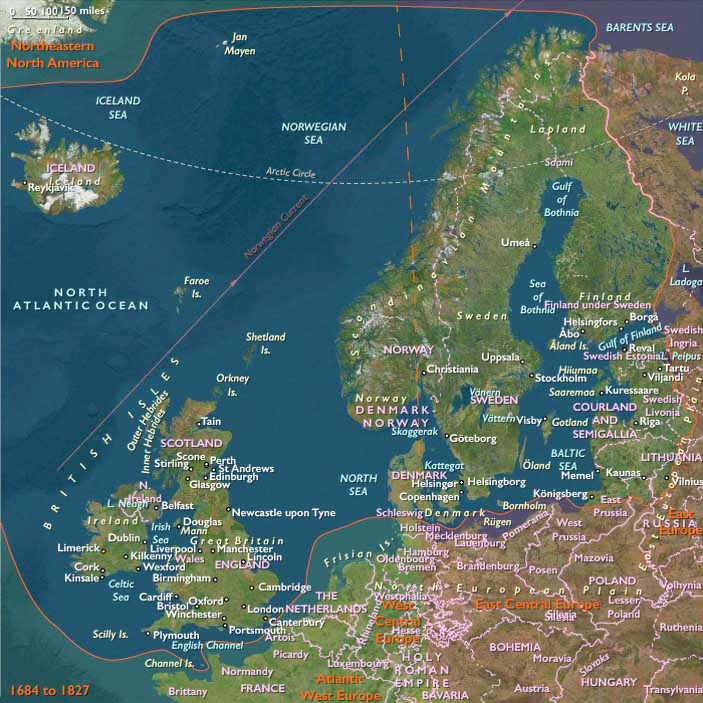
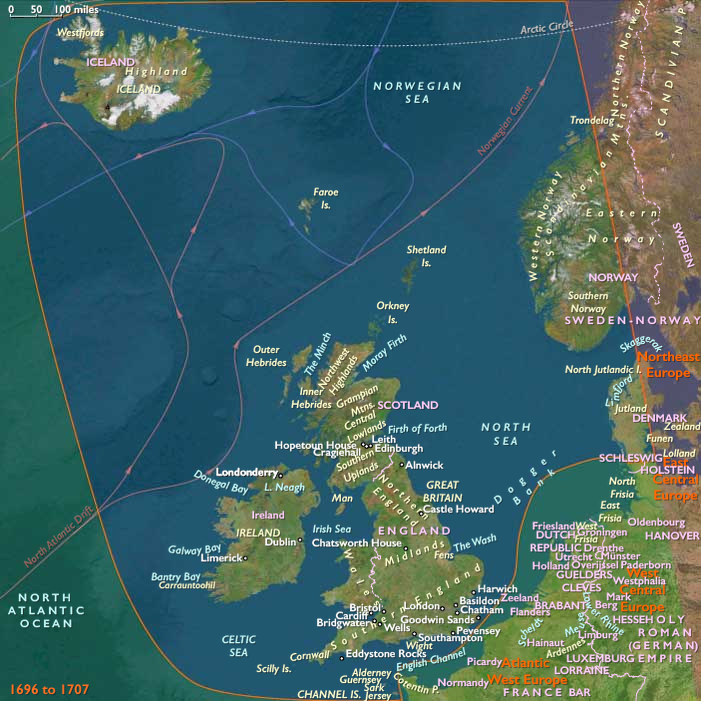
Catholic land ownership in Ireland is less than fifteen percent by 1703.
On this foundation is established the Protestant Ascendancy.
Locations
Groups
- Christians, Roman Catholic
- Protestantism
- Anglicans (Episcopal Church of England)
- Ireland, (English) Kingdom of
- England, (Stewart, Restored) Kingdom of
Subjects
Regions
Subregions
Related Events
Filter results
Showing 10 events out of 28814 total
Asano's retainers break into Kira's mansion on January 30, 1703, and kill him in revenge.
They then surrender themselves to the shogunate authorities and on March 20 are ordered to commit seppuku for the murder.
The Tokugawa shogunate condemns the grandson of Yoshinaka to death for being incapable of protecting his family like a samurai; the Kira are also dispossessed and loss the rank of koke.
After the death of Uesugi Tsunakatsu, the revenues of the Uesugi are reduced from three hundred thousand koku to one hundred and fifty thousand koku.
On the other hand, the brother of Asano Naganori is reestablished, receiving a revenue of five thousand koku and the rank of hatamoto.
One noted Japanese scholar described the tale of the Forty-seven Ronin as the country's "national legend." ("Kanadehon"; Columbia University.)
It recounts the most famous case involving the samurai code of honor, bushidō.
With much embellishment, this true story will be popularized in Japanese culture as emblematic of the loyalty, sacrifice, persistence, and honor that all good people should preserve in their daily lives.
Fictionalized accounts of these events, written some fifty years after the actual event, are known as Chūshingura.
The popularity of the almost mythical tale will only be enhanced by rapid modernization during the Meiji era of Japanese history, when it is suggested many people in Japan longed for a return to their cultural roots.
Peter the Great has meanwhile recovered and gained ground in Sweden's Baltic provinces.
Nyenskans, a Swedish fortress, had been founded at the mouth of the Neva River in 1611, in a land then called Ingermanland.
A small town called "Nyen" has grown up around it.
Peter is interested in seafaring and maritime affairs, and he aims to have Russia gain the ability to take to the seas in order to trade with other maritime nations, for which he needs a better seaport than Arkhangelsk, located on the White Sea to the north.
Peter captures Nyenskans on May 12 [O.S. 1] 1703, during the Great Northern War, and soon sets about replacing that fortress.
He cements Russia's access to the Baltic Sea by founding Saint Petersburg on May 27 [O.S. 16] 1703, closer to the estuary (five kilometers/three miles inland from the gulf).
On Zayachy (Hare) Island, he constructs the Peter and Paul Fortress, which becomes the first brick and stone building of the new city.
The city is built by conscripted peasants from all over Russia; a number of Swedish prisoners of war will also be involved in some years under the supervision of Alexander Menshikov.
Tens of thousands of serfs will die building the city.
Francis II Rákóczi, deciding to invest his energies in a war of national liberation, he has accepted the request by kuruc forces to head a new uprising in Munkács begun by them.
Another group of about three thousand armed men headed by Tamás Esze had joined him on June 15, 1703, near the Polish city of Lawoczne.
Count Miklós Bercsényi had also arrived, with French funds and six hundred Polish mercenaries.
Most of the Hungarian nobility does not support Rákóczi’s uprising, because they consider it to be no more than a jacquerie, a peasant rebellion.
Rákóczi’s famous call to the nobility of Szabolcs county seems to be in vain.
He does manage to persuade the Hajdús (emancipated peasant warriors) to join his forces, so his forces by late September 1703 control most of Kingdom of Hungary to the east and north of the Danube.
He continues soon after by conquering Transdanubia.
The son of an old noble family and one of the richest landlords in the Kingdom of Hungary, Francis II Rákóczi, was born in 1676 to Francis I Rákóczi, elected ruling prince of Transylvania, and Ilona Zrínyi.
His father had died when Rákóczi was a mere baby, and his mother had married Imre Thököly in 1682.
After Thököly was defeated, Zrínyi had held the castle of Munkács (today Mukacheve in Ukraine) for three years, but was eventually forced to surrender.
Rákóczi has held the title of count (comes perpetuus) of the Comitatus Sarossiensis (in Hungarian Sáros) from 1694.
After the Treaty of Karlowitz, when his stepfather and mother had been sent into exile, Rákóczi had stayed in Vienna under Habsburg supervision.
Remnants of Thököly’s peasant army had started a new uprising in the Hegyalja region of northeastern present-day Hungary, which was part of the property of the Rákóczi family.
After capturing the castles of Tokaj, Sárospatak and Sátoraljaújhely, they had asked Rákóczi to become their leader, but, not being eager to head what had appeared to be a minor peasant rebellion, he had quickly returned to Vienna, where he tried his best to clear his name.
Rákóczi had then befriended Bercsényi, whose property at Ungvár (today Uzhhorod), in Ukraine), lies next to his own.
Bercsényi is a highly educated man, the third richest man in the kingdom (after Rákóczi and Simon Forgách), and is related to most of the Hungarian aristocracy.
As the House of Habsburg is on the verge of dying out, France is looking for allies in its fight against Austrian hegemony.
Consequently, they have established contact with Francis Rákóczi and promised support if he will take up the cause of Hungarian independence.
An Austrian spy had seized this correspondence and brought it to the attention of the Emperor.
As a direct result of this, Rákóczi had been arrested on April 18, 1700, and imprisoned in the fortress of Wiener Neustadt (south of Vienna).
It had become obvious during the preliminary hearings that, just as in the case of his grandfather Péter Zrínyi, the only possible sentence for Francis was death.
With the aid of his pregnant wife Amelia and the prison commander, Rákóczi had managed to escape and flee to Poland.
Here he had met with Bercsényi again, and together they resumed contact with the French court.
Three years later, the War of the Spanish Succession has used a large part of the Austrian forces in the Kingdom of Hungary to temporarily leave the country.
The continued warfare has caused internal social and economic dislocations in the Ottoman empire.
Heavy taxes have driven many cultivators off the land; and the government's exclusive preoccupation with Europe has resulted in local revolts in eastern Anatolia and among the Arab tribes of Syria and Iraq.
Mustafa, disillusioned by the defeat at Senta, now leaves most matters of state to the leader of the Muslim hierarchy, Feyzullah, while he himself devotes his last years to hunting.
The failure of the Porte to pay the Janissaries in 1703 causes a six-week revolt that almost becomes a civil war.
Mustafa hides in Adrianople, gathering a rival army and refusing to come to the Turkish capital as demanded.
The Janissaries, possessing the Prophet's sacred standard, come to him, achieve the defection of the rival army, and on August 22 force his abdication in favor of his thirty-year-old brother, who ascends the throne as Ahmed III.
The Methuen Treaty (1703): Portugal’s Perpetual Dependence on English Textiles
The Methuen Treaty, signed in 1703 between Portugal and England during the War of the Spanish Succession (1701–1714), was an offensive military and commercial alliance that had long-term economic consequences for Portugal. Under this treaty, Portugal agreed to import exclusively English-manufactured textiles “in perpetuity”, while England granted preferential duties on Portuguese wine exports.
The Military and Economic Context of the Methuen Treaty
- Portugal, initially allied with France, switched sides in 1703, joining England and the Grand Alliance against Bourbon Spain.
- England needed Portugal’s ports (Lisbon and Oporto) as strategic naval bases for military operations against France and Spain.
- Portugal, in return, sought economic and military support from England.
- The treaty, negotiated by John Methuen (English envoy) and Manuel Teles da Silva, 1st Marquis of Alegrete (Portuguese representative), tied Portugal’s economy to England’s industrial and commercial dominance.
Key Terms of the Methuen Treaty (1703)
-
Exclusive Importation of English Textiles
- Portugal obligated itself “in perpetuity” to import only English-manufactured textiles, eliminating domestic competition.
- This stifled Portugal’s own textile industry, preventing industrial development.
-
Preferential Tariffs for Portuguese Wine in England
- In exchange, English consumers enjoyed lower duties on Portuguese wines (particularly Port wine).
- This significantly boosted Portuguese wine exports to England.
-
Military Alliance Against Spain and France
- Portugal agreed to support England militarily during the War of the Spanish Succession.
Consequences of the Methuen Treaty
✔ Portugal’s Wine Industry Thrived
- The treaty increased Portuguese wine exports, making England its largest customer.
- It secured a stable demand for Port wine, shaping Portugal’s economy for centuries.
❌ Portugal’s Industry Declined
- Portugal became dependent on English-manufactured goods, particularly textiles, stifling domestic industrialization.
- Portuguese wealth, especially gold from Brazil, was used to pay for English imports, enriching England at Portugal’s expense.
❌ Long-Term Economic Dependence on Britain
- The treaty cemented Portugal’s economic reliance on England, leading to a trade imbalance that persisted into the 19th century.
Conclusion: A Short-Term Gain, A Long-Term Disadvantage
While the Methuen Treaty (1703) secured an English military alliance and boosted Portuguese wine exports, it also permanently weakened Portugal’s textile industry. The treaty benefited England far more than Portugal, reinforcing Portugal’s economic dependence on British trade policies, a situation that persisted for over a century.
Possibly the first house erected within the site of Buckingham Palace was that of a Sir William Blake, around 1624.
The next owner was Lord Goring, who from 1633 extended Blake's house and developed much of today's garden, then known as Goring Great Garden.
He did not, however, manage to obtain freehold interest in the mulberry garden.
Unbeknown to Goring, in 1640 the document "failed to pass the Great Seal before King Charles I fled London, which it needed to do for legal execution". (Wright, Patricia (1999; first published 1996). The Strange History of Buckingham Palace.Stroud, Gloucs.: Sutton Publishing Ltd) (It was this critical omission that will help the British royal family regain the freehold under King George III.)
The improvident Goring had defaulted on his rents; Henry Bennet, 1st Earl of Arlington, had obtained the mansion and was occupying it, now known as Goring House, when it burned down in 1674.
Arlington House rose on the site—the southern wing of today's palace—the next year, and its freehold was bought in 1702.
The house which forms the architectural core of the present palace had been built for the first Duke of Buckingham and Normanby in 1703 to the design of William Winde.
The style chosen was of a large, three-floored central block with two smaller flanking service wings.
The 1703 Treaty of Methuen gives England a monopoly on the import of manufactured textiles into Portuguese colonies in exchange for Brazilian gold.
Father Kino opposes the slavery and compulsory hard labor in the silver mines that the Spaniards force on native people.
This stance causes great controversy among his fellow missionaries, many of whom act according to the laws imposed by Spain on their territory.
Kino is also a writer, authoring books on religion, astronomy and cartography.
He has built missions extending from present day states of Mexican Sonora, northeast for one hundred and fifty miles (two hundred and forty kilometers), into present-day Arizona, where the San Xavier del Bac mission, near Tucson, a popular National Historic Landmark, is still a functioning Franciscan parish church.
He has constructed nineteen rancherías (villages), which supply cattle to new settlements.
Kino practices other crafts and is reportedly an expert astronomer, mathematician and cartographer, who draws the first accurate maps of Pimería Alta, the Gulf of California and Baja California.
He enjoys making model ships out of wood.
His knowledge of maps and ships lead him to believe that Mexican Indians can easily access California by sea, a position viewed with skepticism by missionaries in Mexico City.
When Kino proposes and begins making a boat that will be pushed across the Sonoran Desert and to the Mexican west coast, a controversy arises, as many of his fellow missionaries begin to question Kino's faculties.
Kino possesses an unusual amount of wealth for his vocation, which he uses primarily to fund his missionary activities.
His contemporaries report on his wealth with suspicion.
Creeks attack San Francisco de Potano and ...
...San José de Ocuya in early 1703, also raiding either Patali or Piritiba; it is possible that as many as five hundred natives are enslaved as a result of these raids.
Years: 1703 - 1703
Locations
Groups
- Christians, Roman Catholic
- Protestantism
- Anglicans (Episcopal Church of England)
- Ireland, (English) Kingdom of
- England, (Stewart, Restored) Kingdom of
Subjects
Regions
Subregions