
Cassius had in 48 BCE sailed his …
Years: 47BCE - 47BCE
Cassius had in 48 BCE sailed his ships to Sicily, where he had attacked and burned a large part of Caesar's navy.
He then proceeded to harass ships off the Italian coast.
News of Pompey's defeat at the Battle of Pharsalus had caused Cassius to head for Hellespont, with hopes of allying with the king of Pontus, Pharnaces II.
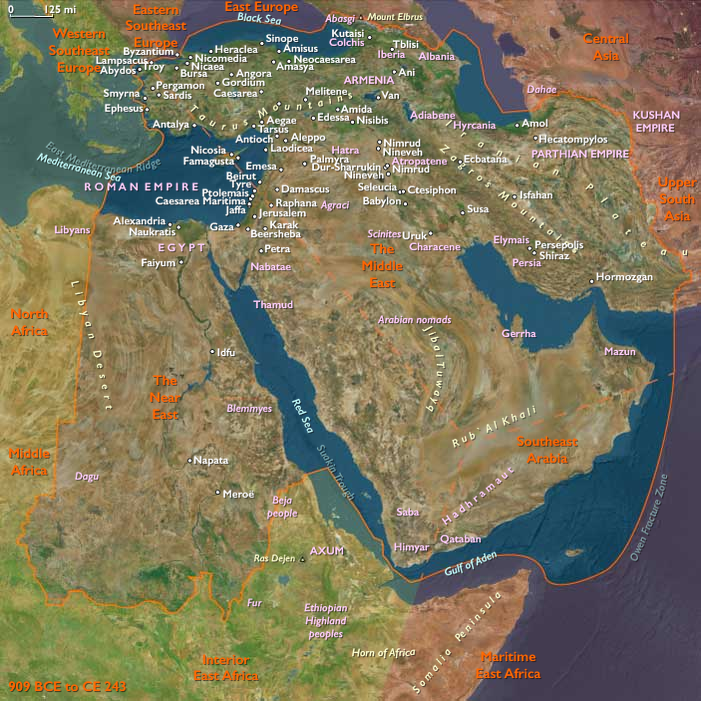
Caesar, having established Cleopatra as ruler of Egypt, meanwhile marches his army north through Syria into Asia Minor.
Cassius is overtaken by Caesar en route, and is forced to surrender unconditionally.
Caesar makes Cassius a legate, employing him in the war against the very same Pharnaces whom Cassius had hoped to join after Pompey's defeat at Pharsalus. (However, Cassius will refuse to join in the fight against Cato and Scipio in Africa, choosing instead to retire to Rome.)
Caesar’s superior troops, meeting Pharnace II and his army at the Battle of Zela in Pontus in May, 47, easily defeat those of Pharnaces.
Caesar promptly sends a message back to Rome: “Vini, vidi, vici” (“I came, I saw, I conquered”).
Pharnaces, escaping the rout with just a small detachment of cavalry, flees quickly back to the Bosporan kingdom.
Caesar demolishes the mountain strongholds of the Pontic territory and divides the region among minor kings.
Locations
People
Groups
Topics
- Classical antiquity
- Roman Republic, Crisis of the
- Roman Civil War, Great, or Caesar's Civil War
- Zela, Battle of
- Caesar's War in Pontus
Commodoties
Subjects
Regions
Subregions
Related Events
Filter results
Showing 10 events out of 19 total
East Central Europe (1192–1203 CE): Přemyslid Restoration under Ottokar I, Emergence of Andrew II in Hungary, Continued Polish Decentralization, and Austria’s Ascendant Babenberg Dynasty
Between 1192 and 1203 CE, East Central Europe—including modern-day Poland, Czechia, Slovakia, Hungary, and eastern regions of Germany and Austria east of 10°E and north of the defined southeastern boundary—experienced critical political transitions, dynastic realignments, and continued territorial consolidation. Bohemia saw renewed Přemyslid strength under Ottokar I, Hungary navigated succession struggles leading toward the ascendancy of Andrew II, Poland remained politically fragmented with strong regional principalities, and Austria continued its growth and stabilization under the prominent Babenberg dynasty. This era was pivotal in establishing lasting political frameworks, economic prosperity, and enduring cultural traditions across the region.
Political and Military Developments
Přemyslid Restoration under Ottokar I in Bohemia
-
In 1197, Ottokar I Přemysl (r. 1197–1230) secured power, bringing renewed stability and reinvigorating Přemyslid authority after prolonged dynastic strife. His effective governance restored Bohemia’s regional influence and solidified its alliance with the Holy Roman Empire.
-
Ottokar’s political acumen laid foundations for future Bohemian royal autonomy, leading eventually to his hereditary royal title recognition in 1198 by Philip of Swabia, bolstering the Přemyslid dynasty’s long-term prominence.
Hungarian Succession Struggles and Rise of Andrew II
-
Hungary entered a period of complex succession disputes after Béla III’s death (1196). His sons, Emeric (1196–1204) and Andrew II (1205–1235), contended for power, causing brief internal instability.
-
Emeric, ruling from 1196, attempted to stabilize royal power but faced challenges from his ambitious younger brother Andrew, whose eventual ascendancy in the following era (1205) would profoundly impact Hungarian politics.
Persistent Polish Decentralization and Regional Autonomy
-
Poland continued its fragmented political landscape, divided among powerful Piast principalities such as Silesia under Duke Henry I the Bearded, Greater Poland, Masovia, and Lesser Poland. Rivalry among these territories persisted, further decentralizing political authority and strengthening local aristocratic rule.
Austria’s Stability and Expansion under Leopold V and Frederick I
-
Under Duke Leopold V (r. 1177–1194) and his successor, Frederick I (r. 1195–1198), the Austrian Babenberg dynasty further solidified territorial cohesion, political stability, and regional influence within the Holy Roman Empire.
-
Austria’s expansion and strengthening of ducal authority prepared the foundation for greater autonomy and influence throughout the medieval period.
Imperial Transition after Frederick Barbarossa’s Death
-
The death of Emperor Frederick Barbarossa (1190) during the Third Crusade shifted imperial dynamics, temporarily affecting the political balance in East Central Europe. His successor, Henry VI (r. 1190–1197), and the subsequent imperial interregnum significantly influenced regional politics, alliances, and dynastic stability.
Economic and Technological Developments
Continued Economic Expansion and Urban Prosperity
-
Economic growth remained robust, supported by vibrant trade networks connecting regional economies with Baltic, Byzantine, Western European, and Mediterranean markets. Major urban centers like Prague, Vienna, Esztergom, Kraków, and Wrocław expanded as prosperous commercial hubs.
Agricultural Productivity and Technological Advancements
-
Continued adoption of advanced agricultural practices, including improved plowing techniques and systematic crop rotation, increased agricultural productivity. These innovations supported urban growth, population expansion, and regional prosperity.
Cultural and Artistic Developments
Bohemian Cultural Revival under Ottokar I
-
Ottokar I strongly supported ecclesiastical institutions, architectural projects, and manuscript production, significantly contributing to Bohemia’s cultural flourishing and reestablishing Prague as an influential intellectual and artistic center.
Hungarian Ecclesiastical and Cultural Continuity
-
Despite internal succession disputes, Hungary maintained robust cultural and religious activities. Ecclesiastical institutions, monasteries, and scholarly communities flourished, ensuring continuity and resilience in Hungarian cultural life.
Cultural Stability in Fragmented Poland
-
Polish cultural continuity remained resilient amid political fragmentation. Monasteries and ecclesiastical institutions continued scholarly and artistic traditions, preserving regional cultural and religious identities.
Settlement and Urban Development
Urban Consolidation and Expansion in Bohemia
-
Under Ottokar I, Bohemian towns such as Prague significantly expanded, enhancing fortifications, administrative structures, and economic infrastructure. This urban growth supported Přemyslid centralization and regional prominence.
Hungarian Urban Development Despite Instability
-
Hungarian urban centers, notably Esztergom and Székesfehérvár, maintained growth and infrastructure development, despite succession disputes, reflecting continued economic prosperity and strong local governance structures.
Austrian Territorial Cohesion and Urban Growth
-
Austria’s urban centers, especially Vienna, flourished under Babenberg rule, consolidating territorial cohesion, economic vitality, and regional administrative authority, reinforcing Austria’s long-term significance within East Central Europe.
Social and Religious Developments
Strengthened Ecclesiastical Structures and Religious Identity
-
Ecclesiastical institutions expanded and strengthened throughout the region, shaping governance, education, and cultural identities. Monasteries, bishoprics, and religious orders played vital roles in societal cohesion, education, and cultural preservation.
Aristocratic Dominance and Dynastic Stability
-
Aristocratic governance and dynastic authority continued to shape regional politics significantly. Bohemia’s Přemyslid restoration under Ottokar I, Austria’s Babenberg stability, and Hungary’s aristocratic power structures highlighted the pivotal role of nobility. Poland’s regional aristocratic autonomy deepened amid persistent fragmentation.
Long-Term Consequences and Historical Significance
The era 1192–1203 CE critically shaped East Central Europe’s political landscape, economic vitality, and cultural identity. The restoration of Přemyslid authority in Bohemia under Ottokar I, Hungary’s succession struggles leading toward Andrew II’s significant future rule, Austria’s territorial and political strengthening, and Poland’s persistent decentralization deeply influenced regional trajectories. These developments laid enduring foundations for the distinct political structures, economic patterns, and cultural identities characterizing East Central Europe throughout the medieval period and beyond.
Philip, the fifth and youngest son of Emperor Frederick I and Beatrice I, Countess of Burgundy, daughter of Renaud III, count of Burgundy, and brother of the emperor Henry VI, had entered the clergy, had been made provost of Aix-la-Chapelle, and in 1190 or 1191 had been chosen bishop of Würzburg.
Having accompanied his brother Henry to Italy in 1191, Philip had forsaken his ecclesiastical calling, and, traveling again to Italy, had been made duke of Tuscany in 1195 and received an extensive grant of lands.
In his retinue in Italy was the Minnesinger Bernger von Horheim.
Philip had become duke of Swabia on the death of his brother Conrad in 1196; in May 1197, he marries the Dowager Queen of Sicily, Irene Angelina, daughter of the Greek emperor Isaac II and widow of King Roger III of Sicily.
Irene had been captured on December 29, 1194, in the German invasion of Sicily.
In Germany, she is renamed Maria.
Her father, who had been deposed in 1195, urges her to get Philip's support for his reinstatement; her brother, Alexios, will subsequently spend some time at Philip's court during the preparations for the Fourth Crusade.
The early years of Ottokar, a younger son of King Vladislav II of Bohemia, had passed amid the anarchy which prevailed everywhere in the country.
After several struggles in which he had taken part, he had been recognized as ruler of Bohemia by Holy Roman Emperor Henry VI in 1192.
He was, however, soon overthrown for joining a conspiracy of German princes to bring down the Hohenstaufen monarchy.
In 1197, Ottokar had forced his brother, Duke Vladislaus III Henry, to abandon Bohemia to him and to content himself with Moravia.
Taking advantage of the German civil war between the Hohenstaufen claimant Philip of Swabia and the Welf candidate Otto IV, Ottokar declares himself hereditary King of Bohemia in 1198.
This title is supported by Philip of Swabia, who needs Czech military support against Otto.
The Holy Roman Empire has become a patchwork of petty principalities.
The various city-states of northern Italy are, by this time, in no way subject to their ostensible Emperor.
The German princes and the pope had together in 1196 rejected Henry’s proposed plan to make the imperial crown a hereditary office, but following Henry’s death, the pro-Hohenstaufen princely majority, with the backing of Henry’s brother Duke Philip of Swabia, recognizes Henry’s three-year-old son, Frederick II, as their future king;.
Preferring, however, an adult ruler, they choose Philip on March 6, 1198, and later—irregularly—crown him king.
The anti-Hohenstaufen minority on June 9 elects Henry the Lion’s son, Otto of Brunswick, as king of Germany, in opposition to Philip.
Civil war between the two factions ensues.
Theobald III of Champagne and the Origins of the Fourth Crusade (1197–1199 CE)
Theobald III, Count of Champagne, was the younger son of Henry I of Champagne and Marie of France(daughter of Louis VII and Eleanor of Aquitaine). He became Count of Champagne in 1197, following the death of his older brother, Henry II, in Palestine. During his brief rule, Theobald was closely involved in both political and financial dealings with Philip II of France and in the early stages of the Fourth Crusade.
Theobald III and Philip II’s Jewish Charters (1198–1231)
- In September 1198, Theobald and Philip Augustus issued charters dictating the rights of the Jews in their respective lands, particularly in relation to debts.
- These agreements ensured that debts owed to Philip were repaid to Champagne for the use of its Jewish moneylenders.
- These laws were later reinforced in additional charters between 1198 and 1231, shaping the legal framework of Jewish financial interactions in medieval France.
The Tournament at Écry and the Launch of the Fourth Crusade (November 28, 1199)
- Innocent III had called for the Fourth Crusade in 1198, but enthusiasm was initially limited.
- On November 28, 1199, Theobald hosted a grand tournament at his castle in Écry-sur-Aisne, attended by many prominent French nobles.
- The preacher Fulk of Neuilly used the occasion to preach the Crusade, successfully inspiring many nobles to take the cross.
- The crusaders elected Theobald as their leader, marking the formal beginning of the Fourth Crusade.
- Among those present was Geoffrey de Villehardouin, Marshal of Champagne, who would later write one of the principal chronicles of the Crusade.
Legacy of Theobald III
- He would not live to lead the Crusade, as he died in 1201, shortly before its departure.
- His death left the leadership uncertain, leading to the election of Boniface of Montferrat as the new commander.
- The Fourth Crusade would infamously divert its forces to Constantinople, leading to the sack of the Byzantine capital in 1204 rather than a campaign in the Holy Land.
Despite his short rule, Theobald III played a crucial role in the financial and political negotiations of Champagne, and his tournament at Écry was the turning point that officially launched the Fourth Crusade.
Markward von Annweiler is a ministerialist—that is, he comes not from the free nobility, but from a class of unfree knights and administrators whose purpose is to serve loyally the Imperial administration in any capacity.
During the reign of the Emperor Frederick Barbarossa, Markward had become one of the most important figures in the administration.
Markward had served Barbarossa's son Henry VI in Italy from 1184.
Henry had appointed him Margrave of Ancona and Count of Abruzzo, placing him in a highly strategic position in north-central Italy.
After Henry’s death, Markward had at first supported his widow Constance of Sicily, but later found himself her enemy.
He had been excommunicated by Popes Celestine III and Innocent III, during their attempts to take over lands in central Italy.
Markward had stayed in Italy, and become a supporter of Philip of Swabia, the brother of Henry.
Markward's political and military activities cause great problems for the Popes, whose control of Sicily gradually weakens.
Two years after Constance's death, Philip gives Markward the lordship of Palermo, where the underage heir, the future Emperor Frederick II, is resident.
Despite the opposition of Innocent III, Markward becomes Guardian of Frederick II and Regent of Sicily.
Frederick's tutor during this period is Cencio Savelli, who will become Pope Honorius III.
Philip of Swabia, assisted in the German civil war that began in 1198 by southern Germans and by France, clashes with the Welf Otto of Brunswick, aided by northern Germans, the archbishop of Cologne, and the English.
Philip’s pro-Hohenstaufen, anti-Welf faction becomes known as the Waiblingens, from the name of the Hohenstaufen castle.
The new pope, Innocent III, maneuvers behind the scenes, pretending neutrality until Otto in 1201 agrees—insincerely—to donate Italian lands to the papacy.
Alexios Angelos, the son of the deposed and blinded Emperor Isaac II Angelos, makes his way in 1201 to Germany, where he works to bring about the diversion of the Fourth Crusade to Constantinople in order to restore his father to power.
The brother-in-law of the Hohenstaufen lord Philip of Swabia, Alexios entreats the crusaders to help him remove from the throne his uncle Alexios III in exchange for promises of funds, supplies, and troops to conquer Egypt, the maintenance of five hundred Western knights in the Holy Land, and submission of the Greek church to Rome.
The leadership of the coalescent Fourth Crusade passes after the death of Theobald of Champagne to Boniface of Montferrat, cousin to Philip of Swabia, who, like Philip, has married into the Greek imperial family, and brother to Conrad, the momentarily reigning King of Jerusalem, who had been the brother-in-law of Emperor Isaac.
Innocent is informed of the plan, but his veto is disregarded.
Reluctant to jeopardize the Crusade, Innocent gives conditional absolution to the crusaders—not, however, to the Venetians.
To finance the siege of Zara, the Doge grants the benefits of the revenue from the salt tax to a consortium of creditors.
Pledging the income from the Salt Office will become a staple of the city's finance.
Boniface of Montferrat had been chosen in 1201 as the new leader of the Fourth Crusade at the death of the original leader, Count Theobald III of Champagne.
Boniface is an experienced soldier, and the position is an opportunity to reassert his dynasty's reputation after defeat at home.
Boniface's family is well known in the east: his nephew Baldwin and brother Conrad had been Kings of Jerusalem, and his niece Maria is heiress of the kingdom.
Boniface's cousin Philip of Swabia is married to Irene Angelina, a daughter of the deposed emperor Isaac II Angelos and niece of Conrad's second wife Theodora.
Boniface in the winter of 1201, had spent Christmas with Phillip in Hagenau, and while there also met with Alexios Angelos, Isaac II's son, who had escaped from the custody of his uncle Alexios III Angelos.
The three had discussed the possibility of using the crusading army to restore Alexios' right to the throne.
Alexios entreats the crusaders to help him in exchange for promises of funds, supplies, and troops to conquer Egypt, the maintenance of five hundred Western knights in the Holy Land, and submission of the Constantinopolitan church to Rome.
Both Boniface and Alexios had traveled separately to Rome to ask for Pope Innocent III's blessing for the endeavor; however, Boniface had been specifically told by Innocent not to attack any Christians, including the Imperial Greeks.
The Crusader army is in debt to the Venetian Doge Enrico Dandolo, who had provided their fleet.
He has instructed them to attack the rebellious cities of Trieste, Moglia, and Zara and beat them into submission before sailing for Cairo.
The strategic Dalmatian city of Zara had been repeatedly invaded by Venice between 1111 and 1154, then once more between 1160 and 1183, when it finally rebelled, appealing to the Pope and to the Croato-Hungarian throne for protection.
Emeric, king of Croatia and Hungary, has condemned the crusade, because of an argument about the possible heresy committed by God's army in attacking a Christian city.
Zadar is devastated and captured, nonetheless, with the population—who, like the crusaders, are Roman Catholic Christians—escaping into the surrounding countryside.
Years: 47BCE - 47BCE
Locations
People
Groups
Topics
- Classical antiquity
- Roman Republic, Crisis of the
- Roman Civil War, Great, or Caesar's Civil War
- Zela, Battle of
- Caesar's War in Pontus
