
Cardinal Alessandro Farnese, the future Pope Paul …
Years: 1559 - 1559
Cardinal Alessandro Farnese, the future Pope Paul III, had acquired an estate at Caprarola in 1504 and had commissioned the architects Antonio da Sangallo the Younger and Baldassare Peruzz to design a fortified castle or rocca.
Surviving plan drawings by Peruzzi show a pentagonal arrangement with each face of the pentagon canted inwards towards its center, to permit raking fire upon a would-be scaling force, both from the center and from the projecting bastions that advance from each corner angle of the fortress.
Peruzzi's plan also shows a central pentagonal courtyard and it is likely that the later development of the circular central court was also determined by the necessities of the pentagonal plan.
The pentagonal fortress foundations, constructed probably between 1515 and 1530, becomes the base upon which the present villa sits; so the overall form of the villa had been predetermined by the rocca foundations.
Cardinal Alessandro Farnese, a grandson of Pope Paul III, and a man who is known for promoting his family's interests, plans to turn this partly constructed fortified edifice into a villa or country house.
He had commissioned Vignola as his architect for this difficult and inhospitable site in 1556; building work commences in 1559.
Vignola had recently proved his mettle in designing Villa Giulia on the outskirts of Rome for the preceding pope, Julius III.
Vignola in his youth had been heavily influenced by Michelangelo.
For the villa at Caprarola, his plans as built are for a pentagon constructed around a circular colonnaded courtyard.
In the galleried court, paired Ionic columns flank niches containing busts of the Roman Emperors, above a rusticated arcade, a reworking of Bramante's scheme for the "House of Raphael", in Via Giulia, Rome.
A further Bramantesque detail is the entablature that breaks forward over the columns, linking them above, while they stand on separate bases.
The interior loggia formed by the arcade is frescoed with Raphaelesque grotesques, in the manner of the Vatican Logge.
The gallery and upper floors are reached by five spiral staircases around the courtyard: the most important of these is the Scala Regia ("Royal Stairs") rising through the principal floors.
Fountains have by the mid-sixteenth century become a crucial element in Italian landscape architecture, whose practitioners often exploit natural undulations in the land to create water pressure, as in Vignola's Villa Farnese.
One of the finest examples of Renaissance architecture, the Villa Farnese reflects Vignola’s ability to formulate inventive and graceful designs using classical elements.
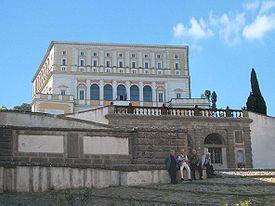
Side view of the main Southeastern front of Villa Farnese (Photo by Pippo-b, 2007)
Locations
People
Groups
Topics
Subjects
Regions
Subregions
Years: 1559 - 1559
Side view of the main Southeastern front of Villa Farnese (Photo by Pippo-b, 2007)
Locations
People
Groups
Topics
Subjects
Regions
Subregions