
Cardinal Albert of Brandenburg, Archbishop of Magdeburg …
Years: 1530 - 1530
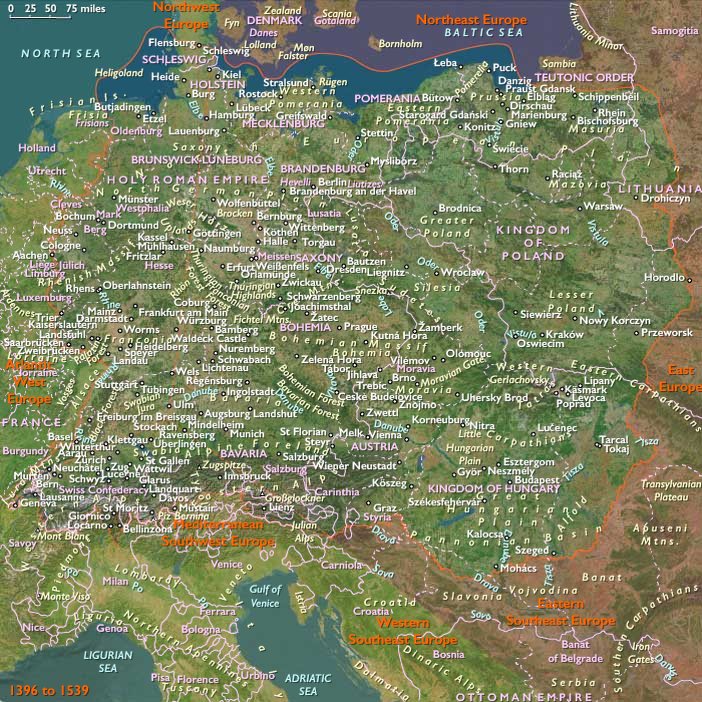
Cardinal Albert of Brandenburg, Archbishop of Magdeburg and Elector of Mainz, needs a prestigious church that meets his expectations at a central location in his Residenz town, Halle.
Albrecht, who fears for his peace of mind in the heaven, has collected more than eighty-one hundred relics and forty-two holy skeletons that need to be stored.
These precious treasures known as "Hallesches Heilthum" and indirectly related to the sale of indulgences had triggered the Reformation a few years before.
Notably on October 31, 1517, Martin Luther had penned his famous Ninety-five Theses, in which he condemned the trade with indulgences and sent a copy to his cardinal Albrecht, who in turn sent it to Pope Leo X.
The cardinal and the Roman Catholic members of the town council had then wanted to repress the growing influence of the Reformation by holding far grander masses and services in a new church dedicated solely to Saint Mary.
On Whit Monday, May 17, 1529, representatives of the clergy, the city council and church pastors had gathered on the market square and decided, after extensive consultation, to demolish the existing parish churches, only keeping their towers, and connect the two (blue) western towers to those on the eastern side by means of a new nave It was also decided to close the two cemeteries surrounding the churches.
A new burial site had been chosen‚ the Martinsberg, a hill outside the town—and the Stadtgottesacker cemetery was laid out.
This cemetery, with ninety-four arches, designed by Nickel Hoffman, is a masterpiece of the Renaissance.
The old nave of St. Gertrude is demolished from 1529 to 1530.
What remains are the Blue Towers dating from around 1400, with their spires, which had been added in 1507 and 1513.
Locations
People
Groups
Topics
Subjects
Regions
Subregions
Related Events
Showing 10 events out of 38015 total
Years: 1530 - 1530
Locations
People
Groups
Topics
Subjects
Regions
Subregions