
Caravaggio’s last picture is The Martyrdom of …
Years: 1610 - 1610
Caravaggio’s last picture is The Martyrdom of Saint Ursula.
His style has continued to evolve — Saint Ursula is caught in a moment of highest action and drama, as the arrow fired by the king of the Huns strikes her in the breast, unlike earlier paintings which had all the immobility of the posed models.
The brushwork is much freer and more impressionistic.
Had Caravaggio lived, something new would have come.
In the chiaroscuro, a woman points two fingers at Peter while a soldier points a third.
Caravaggio tells the story of Peter denying Christ three times with this symbolism.
Chiaroscuro had been practiced long before Caravaggio came on the scene, but it is he who has made the technique definitive, darkening the shadows and transfixing the subject in a blinding shaft of light.
With this comes the acute observation of physical and psychological reality which forms the ground both for his immense popularity and for his frequent problems with his religious commissions.
He works at great speed, from live models, scoring basic guides directly onto the canvas with the end of the brush handle; very few of Caravaggio's drawings appear to have survived, and it is likely that he preferred to work directly on the canvas.
The approach is anathema to the skilled artists of his day, who decry his refusal to work from drawings and to idealize his figures.
Yet the models are basic to his realism.
Some have been identified, including Mario Minniti and Francesco Boneri, both fellow artists, Mario appearing as various figures in the early secular works, the young Francesco as a succession of angels, Baptists and Davids in the later canvasses.
His female models include Fillide Melandroni, Anna Bianchini, and Maddalena Antognetti (the "Lena" mentioned in court documents of the "artichoke" case as Caravaggio's concubine), all well-known prostitutes, who appear as female religious figures including the Virgin and various saints.
Caravaggio himself appears in several paintings, his final self-portrait being as the witness on the far right to the Martyrdom of Saint Ursula.
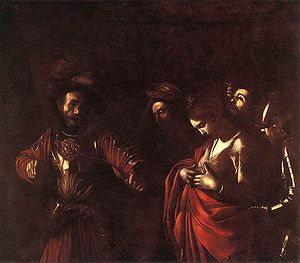
Caravaggio: The Martyrdom of Saint Ursula (1610) Oil on canvas, 154 cm × 178 cm (61 in × 70 in), Galleria di Palazzo Zevallos Stigliano, Naples
Locations
People
Groups
Topics
Subjects
Regions
Subregions
Related Events
Showing 10 events out of 33443 total
Years: 1610 - 1610
Caravaggio: The Martyrdom of Saint Ursula (1610) Oil on canvas, 154 cm × 178 cm (61 in × 70 in), Galleria di Palazzo Zevallos Stigliano, Naples
Locations
People
Groups
Topics
Subjects
Regions
Subregions