
Caravaggio goes on to secure a string …
Years: 1601 - 1601
Caravaggio goes on to secure a string of prestigious commissions for religious works featuring violent struggles, grotesque decapitations, torture and death.
For the most part each new painting increases his fame, but a few are rejected by the various bodies for whom they are intended, at least in their original forms, and have to be repainted or find new buyers.
The essence of the problem is that while Caravaggio's dramatic intensity is appreciated, his realism is seen by some as unacceptably vulgar.
His first version of Saint Matthew and the Angel, which featured the saint as a bald peasant with dirty legs attended by a lightly clad over-familiar boy-angel, had been rejected and a second version had to be painted as The Inspiration of Saint Matthew.
Similarly, The Conversion of Saint Paul had been rejected, and while another version of the same subject, the Conversion on the Way to Damascus, is accepted, it features the saint's horse's haunches far more prominently than the saint himself, prompting this exchange between the artist and an exasperated official of Santa Maria del Popolo: "Why have you put a horse in the middle, and Saint Paul on the ground?"
"Because!"
"Is the horse God?"
"No, but he stands in God's light!"
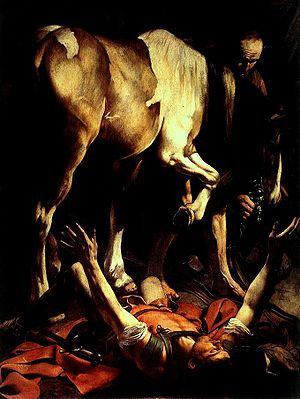
Caravaggio: Conversion on the Way to Damascus (1601) Oil on canvas, 230 cm × 175 cm (91 in × 69 in), Santa Maria del Popolo, Rome
Locations
People
Groups
Topics
Commodoties
Subjects
Regions
Subregions
Related Events
Showing 10 events out of 33897 total
Years: 1601 - 1601
Caravaggio: Conversion on the Way to Damascus (1601) Oil on canvas, 230 cm × 175 cm (91 in × 69 in), Santa Maria del Popolo, Rome
Locations
People
Groups
Topics
Commodoties
Subjects
Regions
Subregions