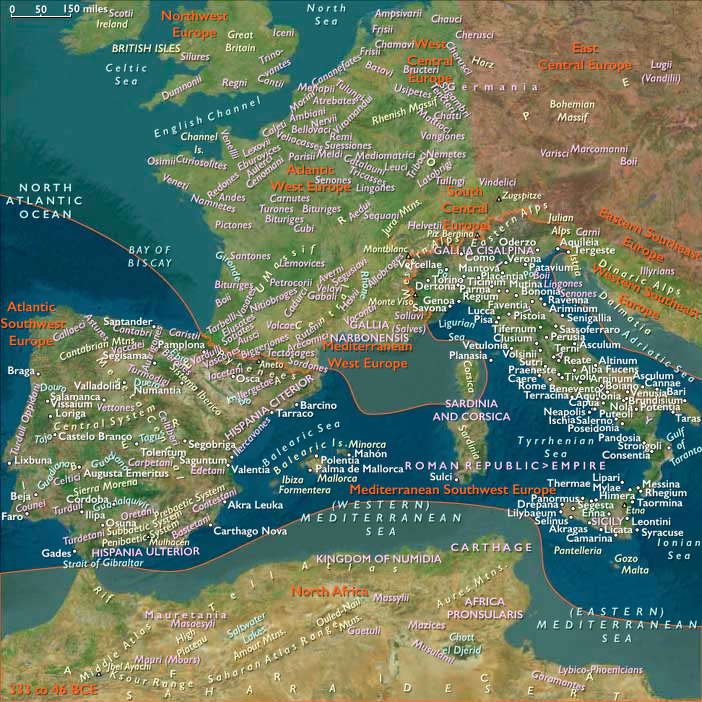
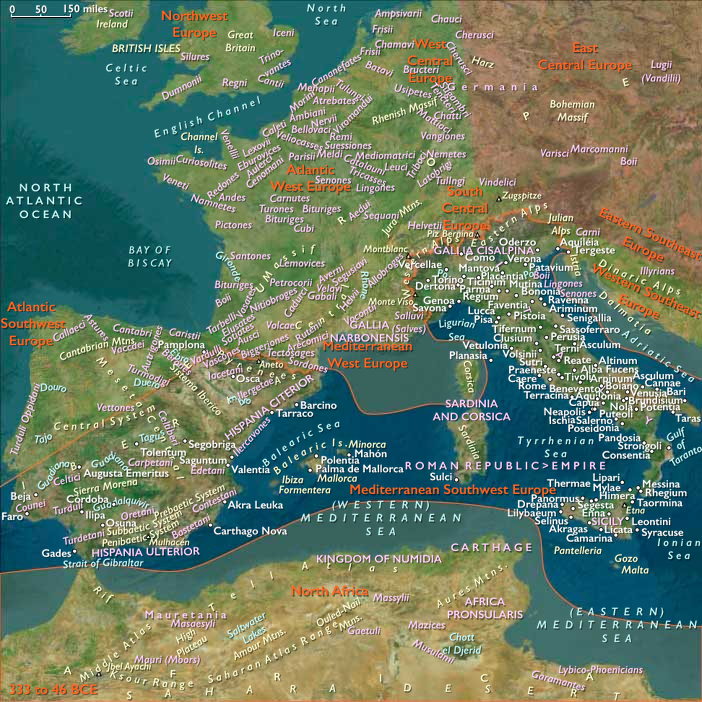
…captures Consentia and …
Years: 332BCE - 332BCE
…captures Consentia and …
Locations
People
Groups
- Italy, classical
- Taras (Dorian Greek) city-state of
- Roman Republic
- Lucani
- Samnium
- Epirus, Kingdom of
- Greece, Hellenistic
Topics
Commodoties
Subjects
Regions
Subregions
Related Events
Filter results
Showing 10 events out of 64394 total
Alexander's forces in the Levant, as a part of the Macedonian conquest of Syria, occupy Baalbek, the ancient center for the worship of the Phoenician god Baal, in 332.
The Greeks, who identify Baal with Helios, call the city Heliopolis (“City of the Sun”).
The Persians counterattack during the winter of 333-332 BCE by land in Asia Minor—where they are defeated by Antigonus, the Macedonian satrap of Greater Phrygia—and by sea, recapturing a number of cities and islands.
Darius sends a new offer while the siege of Tyre is in progress: he will pay a huge ransom of ten thousand talents for his family, cede all his lands west of the Euphrates, and offer the hand of his daughter in return for an alliance.
“I would accept,” Parmenio is reported to have said, “were I Alexander”; “I too,” was the famous retort, “were I Parmenio.”
His causeway to join the besieged island city of Tyre to the mainland incomplete in early 332, Alexander bolsters his troops’ morale by reminding them that the fall of the city means an end to the Cyprus-based Persian fleet, which, fortunately for the Macedonians, now surrenders, enabling Alexander to attack Tyre from the sea with two hundred and twenty ships, tying some of them in pairs to hold rams and allow siege towers to draw up against the city's walls.
The storming of Tyre in July 332, attended with great carnage, is Alexander's greatest military achievement.
When the city at last surrenders, Alexander dishonors the corpse of Batis, its commander, in the way that Achilles in the Iliad had treated the corpse of Hector, and crucifies some two thousand Tyreans, themselves the survivors of the Macedonian slaughter of six thousand of their fellows.
The Sidonians among the Macedonian troops, manage, however, to rescue some fifteen thousand defenders, secretly giving them protection and taking them to their boats, on which they are hidden and transported to Sidon.
Alexander orders the sale of the Tyrean women and children into slavery.
His occupation of Phoenicia complete, he turns towards Palestine and Egypt.
Leaving Parmenio in Syria, …

…Alexander advances south without opposition until he reaches Gaza on its high mound.
Because of Gaza's strategic position on the Via Maris, the ancient coastal road linking Egypt with Palestine and the lands beyond, the city has known little peace; it has fallen, successively, to the Philistines, maybe the Israelites, and the Egyptians, Babylonians, and Persians.
Here bitter resistance halts Alexander, who sustains a serious shoulder wound during a sortie.
Gaza is the last city to resist Alexander’s conquest on his path to Egypt.
He besieges it for five months before finally capturing it 332 BCE; the inhabitants are either killed or taken captive.
Alexander brings in local Bedouins to populate Gaza and organizes the city into a polis (or "city-state").
Alexander also conquers Ashkelon, then moves against Egypt. (There is no basis for the tradition that he turned aside to visit Jerusalem. Although this is the part of the world in which the Jews might have encountered Alexander, and the notion of some contact is not unreasonable, virtually all the available evidence is unreliable and romantic or even fabricated to give substance to later Jewish claims to political privileges. Alexander's effect on the Jews is indirect, but no less important for this: he surrounds them with a Greek-speaking world.)
Alexander reaches Egypt in November 332.
The Egyptians submit without a struggle, an indication of the dislike the subject population feels toward Persia, and welcome him as their deliverer; the Persian satrap Mazaces wisely surrenders.
At Memphis, Alexander sacrifices to Apis, the Greek term for Hapi, the sacred Egyptian bull, Receiving the traditional double crown of the pharaohs, he placates the native priests and encourages their religion.
He spends the winter organizing Egypt, where he employs Egyptian governors, keeping the army under a separate Macedonian command.
Alexander joins together a number of Egyptian villages to found the city of Alexandria near the westernmost arm of the Nile, on a fine site between the sea and Lake Mareotis, protected by the island of Pharos,
The choice of this site, which includes the ancient settlement of Raxcondah, called Rhacotis by the Greeks (and dating back to 1500 BCE), is determined by the abundance of water from Lake Maryut, at this time a spur of the Canopic Nile, and the good anchorage provided offshore by Pharos.
Alexander has the Rhodian architect Deinocrates lay out the city and supervises the religious ceremonies of its foundation, including Greek-style athletic and musical games (an indication of his intentions to Hellenize these foundations, at least as far as their cultural life is concerned).
Thinking the site excellent, he hopes for its commercial prosperity, as it is to be the capital of his new Egyptian dominion and a naval base that will control the Mediterranean.
Alexander is also said to have sent an expedition to discover the causes of the flooding of the Nile.
From Alexandria, …
…Alexander marches along the coast to Paraetonium, one hundred and sixty-eight miles to the west, and thence …
…inland to visit the celebrated oracle of the god Amon, or Ammon (at Siwah), which was already famous in the time of Herodotus (the difficult journey is later embroidered with flattering legends).
Pindar had equated Ammon with Zeus, the oracle had been consulted by Croesus in the sixth century and Lysander in the fifth, and there was a sanctuary to Ammon at Athens in the first half of the fourth.
On his reaching the oracle in its oasis, the priest gives him the traditional salutation of a pharaoh, as son of Amon; Alexander consults the god on the success of his expedition but reveals the reply to no one. (The incident will later contribute to the story that he is the son of Zeus and, thus, to his “deification.”)
Agis III, Spartan king of the Eurypontid house from 338, has profited from the Macedonian general's absence from Greece by leading the Greek cities in revolt while Alexander is invading Anatolia.
With Persian money and eight thousand Greek mercenaries, he attempts to hold Crete against Alexander's navy.
The quiescence of Athens, which does not participate in the revolt of the Greek cities, may be explained partly by a well-attested grain shortage in Greece, which may have sapped the will to fight, and partly by the policy of civic retrenchment associated with the name of Lycurgus, an Athenian statesman and orator noted for his efficient financial administration and vigorous prosecutions of officials charged with corruption.
He undertakes an extensive building program.
Years: 332BCE - 332BCE
Locations
People
Groups
- Italy, classical
- Taras (Dorian Greek) city-state of
- Roman Republic
- Lucani
- Samnium
- Epirus, Kingdom of
- Greece, Hellenistic