Cao is titled "Duke of Wei" in …
Years: 213 - 213
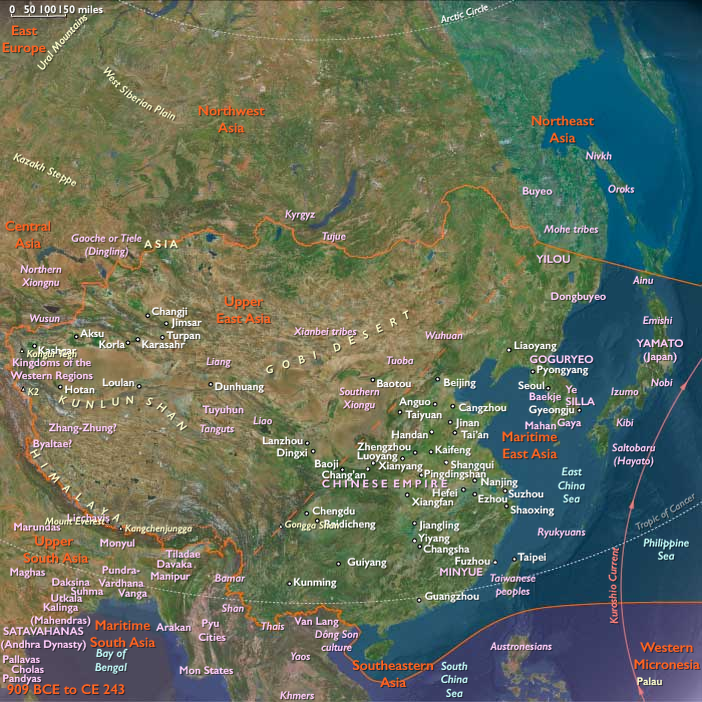
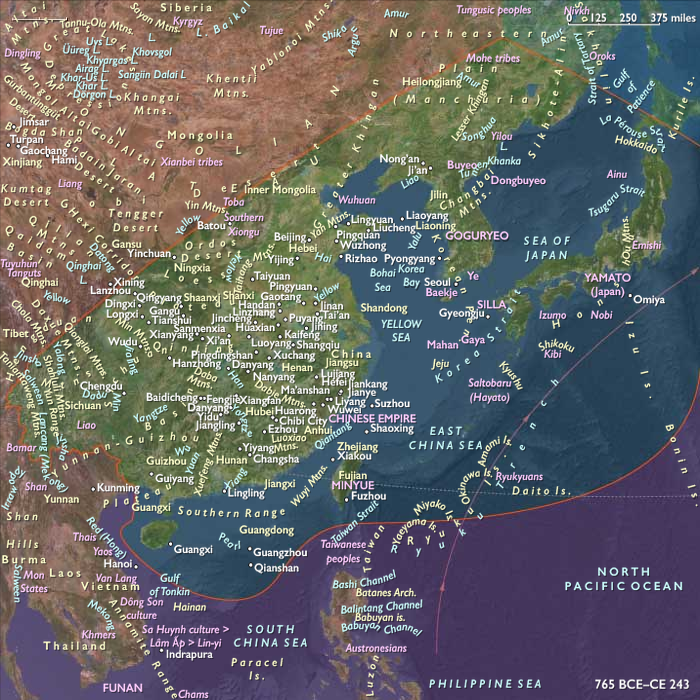
Cao is titled "Duke of Wei" in 213, given the nine bestowments, and given a fief of ten cities under his domain, known as Wei.
Locations
People
Groups
- Taoism
- Chinese (Han) people
- Chinese Empire, Tung (Eastern) Han Dynasty
- Way of the Five Pecks of Rice
Topics
Commodoties
Subjects
Regions
Subregions
Related Events
Filter results
Showing 10 events out of 60710 total
Zhang Song's true intentions are revealed to Liu Zhang by his elder brother Zhang Su.
Liu Zhang executes Zhang Song and begins his battle against Liu Bei, who then begins his conquest of Yi Province.
The Alemanni are first mentioned by Cassius Dio describing the campaign of Emperor Antoninus in 213.
At this time they apparently dwell in the basin of the Main, to the south of the Chatti.
Cassius Dio (78.13.4) portrays the Alemanni as victims of this treacherous emperor.
They had asked for his help, says Dio, but instead he colonized their country, changed their place names and executed their warriors under a pretext of coming to their aid.
When he became ill, the Alemanni claimed to have put a hex on him (78.15.2).
The emperor, it was claimed, tried to counter this influence by invoking his ancestral spirits.
In retribution, Antoninus leads the Legio II Traiana Fortis against the Alemanni.
The Romans do defeat the Alamanni in battle near the river Main, but fail to win a decisive victory over them.
After a peace agreement is brokered and a large bribe payment given to the invaders, the Senate confers upon him the empty title of Germanicus Maximus.
The legion is as a result honored with the name Germanica.
The Gallic hooded tunic the emperor habitually wears while campaigning, and which he makes fashionable, gives him his historical nickname, Caracalla.
The Historia Augusta, Life of Antoninus Caracalla, relates (10.5) that Caracalla then assumed the name Alemannicus, at which Helvius Pertinax jested that he should really be called Geticus Maximus, because in the year before he had murdered his brother, Geta.
Not on good terms with Caracalla, Geta had been invited to a family reconciliation, at which time he was ambushed by centurions in Caracalla's army and slain in his mother Julia's arms.
True or not, Caracalla, pursued by devils of his own, had left Rome, never to return.
Caracalla soon departs for the eastern frontier, where for the rest of his short reign he will be known for his unpredictable and arbitrary operations launched by surprise after a pretext of peace negotiations.
If he had any reasons of state for such actions they remained unknown to his contemporaries.
Whether or not the Alemanni had been previously neutral, they are certainly further influenced by Caracalla to become hereafter notoriously implacable enemies of Rome.
This mutually antagonistic relationship is perhaps the reason why the Roman writers persist in calling the Alemanni barbari, "savages".
The archaeology, however, shows that they were largely Romanized, lived in Roman-style houses and used Roman artifacts, the Alemannic women having adopted the Roman fashion of the tunic even earlier than the men.
Most of the Alemanni are probably at the time in fact resident in or close to the borders of Germania Superior.
Although Dio is the earliest writer to mention them, Ammianus Marcellinus used the name to refer to Germans on the Limes Germanicus in the time of Trajan's governorship of the province shortly after it was formed, circa 98/99.
At that time the entire frontier was being fortified for the first time.
Trees from the earliest fortifications found in Germania Inferior are dated by dendrochronology to 99/100.

Caracalla had devalued the Roman currency around the time of his accession, decreasing the silver purity of the denarius from 56.5% to 51.5%, the actual silver weight dropping from 1.81 grams to 1.66 gram—though the overall weight has slightly increased.
Caracalla raises the annual pay of an average legionary to 675 denarii during his time as emperor and lavishes many benefits on the army that he both fears and admires, as instructed by his father Septimius Severus, who had told him on his deathbed to always mind the soldiers and ignore everyone else.
Caracalla does manage to win the trust of the military with generous pay rises and popular gestures, like marching on foot among the ordinary soldiers, eating the same food, and even grinding his own flour with them.
His official portraiture marks a break with the detached images of the philosopher–emperors who preceded him: his close-cropped haircut is that of a soldier, his pugnacious scowl a realistic and threatening presence.
This rugged soldier–emperor iconic archetype will be adopted by most of the following emperors who depend on the support of the military to rule, like his eventual successor Maximinus Thrax.
Faced with a rapidly expanding military budget and cost overruns on his elaborate building projects, Caracalla has increased taxes as well as devalued the currency.
The Roman economy plunges into depression.
In 212 or 213, he issues—probably for financial reasons—an edict extending Roman citizenship to nearly all free provincials throughout the empire, including subject peoples, thereby widening the base of the inheritance tax, which only Roman citizens pay, and further undermining Italy's special status.
He grants benefits to property owners and makes them responsible for imperial taxes and services.
All Jews in the empire, who share in the newly granted citizenship and its privileges, gain access to Roman magistracies.
Caracalla leaves the capital in 213, about a year after the murder of Geta, and will spend the rest of his reign in the provinces, particularly those of the East.
He keeps the Senate and other wealthy families in check by forcing them to construct, at their own expense, palaces, theaters, and places of entertainment throughout the periphery.
New and heavy taxes are levied against the bulk of the population, with additional fees and confiscations targeted at the wealthiest families.
Such generals as Zhang Ren fight hard to defend their master, but Liu Bei's forces have the advantage, and by 214 they have surrounded Liu Zhang's capital at Chengdu.
Liu Zhang's advisors Liu Ba, Dong He, and Hu Jing plead to their master to resist at all costs, but Liu Zhang rejects their pleas, saying "I don't want my subjects to suffer any more."
He then surrenders to Liu Bei.
Sun Quan sends Lu Su as an emissary to demand the return of Jing Province after Liu Bei's conquest of Yi Province, but Liu refuses.
Sun Quan then sends Lü Meng and Ling Tong to lead twenty thousand men to attack southern Jing Province and they succeeded in capturing Changsha, …
…Guiyang, and …
…Lingling prefectures.
In the meantime, …
...Lu Su and Gan Ning advance to Yiyang with ten thousand men (to block Guan Yu) and take command of the army at Lukou.
Liu Bei personally goes to Gong'an while Guan Yu leads thirty thousand men to Yiyang.
When war is about to break out, Liu Bei receives news that Cao Cao is planning to attack Hanzhong, and he requests a border treaty with Sun Quan as he becomes worried about Cao Cao seizing Hanzhong.
Liu Bei asks Sun Quan to return Lingling prefecture and create a diversion for Cao Cao by attacking Hefei; in return, Liu Bei cedes Changsha and Guiyang prefectures to Sun Quan, setting the new border along the Xiang River.
Empress Fu was apparently never happy about Cao's domination of the political scene.
When Emperor Xian's concubine Consort Dong, whose father Dong Cheng had been killed in a failed conspiracy against Cao, was forcibly executed by Cao in 200 against Emperor Xian's wishes, Empress Fu had become angry and fearful, and had written her father Fu Wan a letter accusing Cao of cruelty and implicitly asking him to start a new conspiracy.
Fu Wan was fearful and did not act on the letter, but Empress Fu's letter is discovered in 214.
Cao is extremely angry and forces Emperor Xian to have Empress Fu deposed.
Emperor Xian is hesitant, and Cao sends his forces into the palace to force the issue.
Empress Fu hides inside the walls, but is finally discovered and dragged out.
As she is led away, she cries out to Emperor Xian for him to save her life, but his only response is that he cannot even know what will happen to him.
She is killed, along with her two sons and family.
Emperor Xian is not, but his status as a puppet is by now fully exposed.
Cao claims Empress Fu had died suddenly and buries her with the ceremony of an empress.
Cao Cao again launches a campaign to conquer Hanzhong in 215.
Initially, Zhang Lu has no hope of standing against Cao Cao's armies, and plans to surrender.
His younger brother Zhang Wei, however, insists on fighting and leads his army against the invading forces.
He is soon killed in battle, and again Zhang Lu considers surrendering.
His advisor Yan Pu tells him that in surrendering so readily, they would have no position to negotiate from.
Instead, Zhang Lu retreats to his fortress at Bazhong.
When leaving his capital, he does not destroy his wealth and treasures, nor attempt to take them with him, instead leaving them behind saying "These things belong to the country, not to me."
Cao Cao is greatly impressed by this, and sends a messenger to Zhang Lu asking him to surrender.
Yan Pu's plan is successful, as Zhang Lu and his forces are warmly welcomed by Cao Cao.
He is given the title General who Suppresses the South and his five sons are granted the rank of marquis.
He marries his daughter to a younger son of Cao Cao, Cao Yu.
As further demonstration of the bad blood between Zhang Lu and Ma Chao, when Cao Cao turns Ma Chao's son Ma Qiu over to Zhang Lu, he immediately executes him.
Following Cao Cao’s defeat of Zhang Lu and subsequent seizure of Hanzhong, Sima Yi and Liu Ye advise him to take advantage of the victory to attack Yi Province, since it is still unstable under Liu Bei's new government and Liu himself is away in Jing Province.
Cao Cao refuses and leaves Xiahou Yuan, Zhang He and Xu Huang to defend Hanzhong.
Years: 213 - 213
Locations
People
Groups
- Taoism
- Chinese (Han) people
- Chinese Empire, Tung (Eastern) Han Dynasty
- Way of the Five Pecks of Rice