
Cambodia breaks relations with the US in …
Years: 1965 - 1965
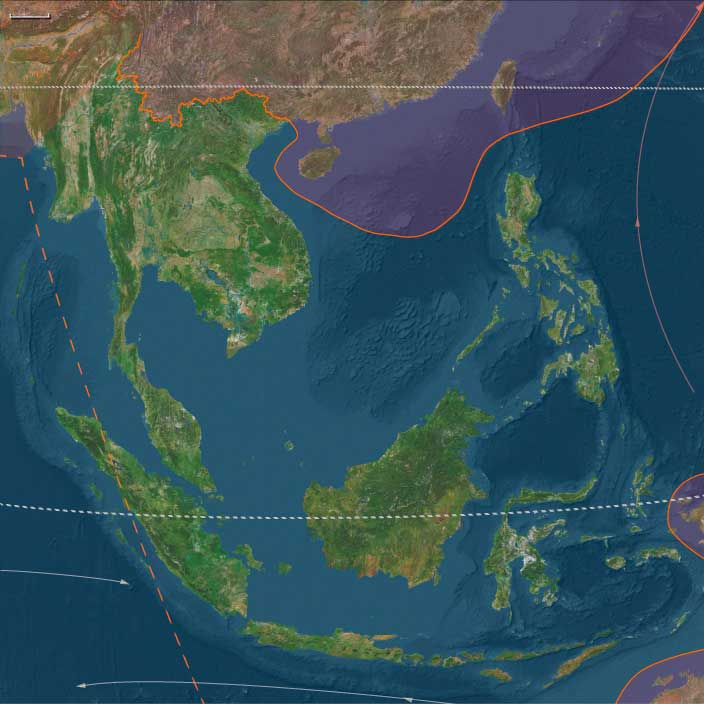
Cambodia breaks relations with the US in 1965 after South Vietnamese planes bomb Cambodia.
Related Events
Filter results
Showing 10 events out of 3270 total
Fighting in Vietnam escalates, in 1965, into a major war as US troops begin pouring in.
The US drops 315,000 tons of air ordnance on Vietnam over the twelve-month period from January to December.
In an accelerated effort to crush the popular resistance movement, the US Army destroys villages, interns peasants in concentration camps, isolates resistance leaders, and turns the South Vietnamese countryside into a ‘free-fire zone”, targeting anything that moves.
The US begins a secret war in Laos.
Singapore, populated overwhelmingly by ethnic Chinese, separates from the Malaysian union in 1965 and becomes an independent nation.
A covert CIA-assisted army coup topples Sukarno in 1965.
The US State Department provides assasination lists and weapons to the Indonesian military led by Suharto.
An estimated half-million to over one million Indonesians are killed in Indonesia in the space of a few weeks.
…an incident occurs that will have strong repercussions for the ruling family.
Khalid ibn Musad, a member of the Al-Saud family, on March 25, 1965, leads a protest against the introduction of a radio station in Saudi Arabia.
A guard standing outside is killed, perhaps by Khalid, in the late evening.
The death of the guard—a member of to the Oneiza tribe, one of Saudi Arabia's largest—nearly starts a riot.
Interior Minister Prince Fahd, the first son of Hassa Sudairi after her remarriage to Ibn Sa'ud, orders Khalid's immediate execution.
Faysal, awakening in the morning to the news of the execution, is unable to stop rumors blaming him for the act.
Having no choice but to accept responsibility, Faysal states that he stands by the Koran and Islamic tradition, implicitly protecting his half brother Fahd.
Saudi Arabia later in 1965 officially abolishes slavery.
Qatar's infrastructure, foreign labor force, and bureaucracy continue to grow in the 1960s under the guidance of Khalifa ibn Hamad.
Qatar even takes steps towards diversifying its economic base by the establishment of a cement factory, a national fishing company, and small-scale agriculture.
In 1965, Oman's land boundary with Saudi Arabia is delineated by treaty; Abu Dhabi, which lays claim to the area, does not publicly accept the alignment of the eastern segment.
The feudal monarchies of the Arabian Peninsula officially abolish slavery in 1965.
The presidential election of January 1965 results in a victory for Ayub Khan but also demonstrates the appeal of the opposition.
Four political parties merge to form the Combined Opposition Parties (COP).
These parties are the Council Muslim League, strongest in Punjab and Karachi; the Awami League, strongest in East Pakistan; the National Awami Party, strongest in the North-West Frontier Province, where it stands for dissolving the One Unit Plan; and the Jamaat-i-Islami, surprisingly supporting the candidacy of a woman.
The COP nominates Fatima Jinnah (sister of Mohammed Ali Jinnah, the Quaid-i-Azam, and known as Madar-i-Millet, the Mother of the Nation) their presidential candidate.
The nine-point program put forward by the COP emphasizes the restoration of parliamentary democracy.
Although Fatima Jinnah mounts a spirited challenge, Ayub Khan wins 63.3 percent of the electoral college vote.
His majority is larger in West Pakistan (73.6 percent) than in East Pakistan (53.1 percent).
Also elected is a national assembly of 156 members, with East and West Pakistan each allocated 75 seats, and six seats reserved for women, who had previously been denied the vote under Islamic strictures.
As the 1965 elections demonstrate, those who equate constitutional government with parliamentary democracy oppose the presidential system of government.
The Soviet Union strongly disapproves of Pakistan's alliance with the United States, but Moscow is interested in keeping doors open to both Pakistan and India.
Ayub Khan is able to secure Soviet neutrality during the 1965 Indo-Pakistani War.
Minor migrational shifts occur between India and West Pakistan following the border hostilities
With substantial military support from the United States, Ayub Khan feels ready by 1965 to test India's frontier outposts, initially in Sindh.
The first skirmish war is fought along undemarcated territory toward the western end of the Great Rann ("Salt Marsh") of Kachchh in the southeast in April 1965, and Pakistan's Patton tanks roll to what seems like an easy victory over India's Centurions.
The Commonwealth prime ministers and the UN quickly prevail upon both sides to agree to a cease-fire and withdrawal of forces to the prewar borders.
On the report of the United Nations secretary-general to the Security Council, the Rann of Kachchh dispute is referred to an international tribunal.
Pakistan believes it has won the Rann of Kachchh conflict and that India's army is weak.
Zulfikar Ali Bhutto, Ayub's foreign minister, urges another round of fighting in Kashmir in the summer, to which Ayub Khan agrees.
In the early spring of 1965, UN observers and India report increased activity by infiltrators from Pakistan into Indian-held Kashmir.
Pakistan hopes to support an uprising by Kashmiris against India, but no such uprising occurs.
In mid-August, Pakistan launches "Operation Grandslam" with the hope of cutting off Kashmir along its narrow southern "neck" before India can bring up its outmoded tanks.
India's forces, however, move a three-pronged tank attack aimed at Lahore and Sialkot across the international border in Punjab early in September, while Pakistan attacks in the Chamb sector in southwestern Kashmir.
Each country has limited objectives, and neither is economically capable of sustaining a long war because military supplies are immediately cut to both countries by the United States and Britain.
China's diplomatic support and transfer of military equipment is important to Pakistan during the conflict.
The great city of Lahore is in range of Indian tank fire by September 23, 1965, when both sides, whose armies have suffered considerable losses and whose ammunition has run low because of the embargo, agree upon a UN cease-fire, arranged through the Security Council.