
Caliph Al-Walid I, like his father, Abd …
Years: 713 - 713
Caliph Al-Walid I, like his father, Abd al-Malik ibn Marwan, has continued to allow his disreputable governor Al-Hajjaj bin Yousef free rein in the East, and his trust in Al-Hajjaj has paid off with the successful conquests of Transoxiana, Sindh, and Iberia.
Hajjaj has been responsible for picking the generals who led these successful campaigns, and is well known from his own successful campaign against Ibn Zubayr in the early 690s during the reign of Al-Walid's father.
Locations
People
Groups
Topics
- Arab-Byzantine Wars
- Arab-Khazar Wars
- Muslim Conquest of Sindh
- Byzantine-Muslim War of 692-718
- Muslim conquest of Transoxiana
Commodoties
Subjects
Regions
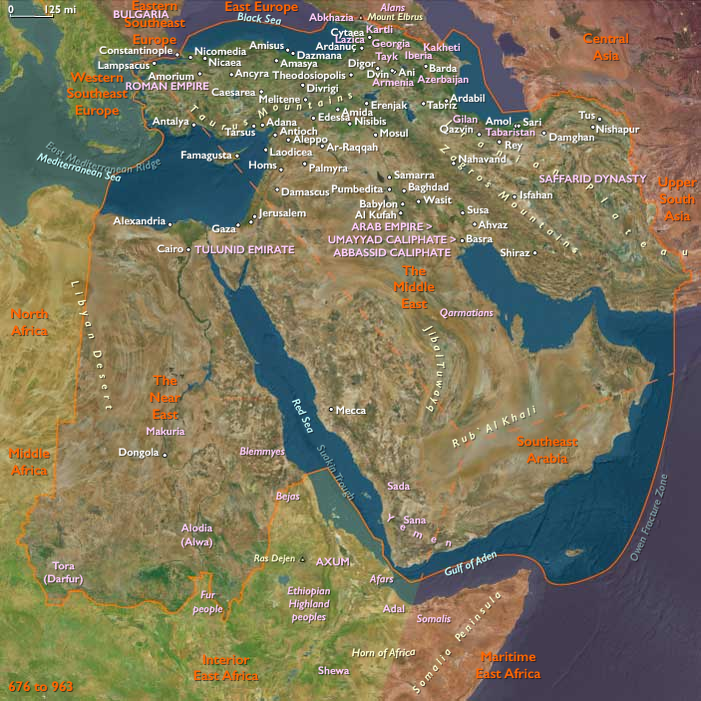
Subregions
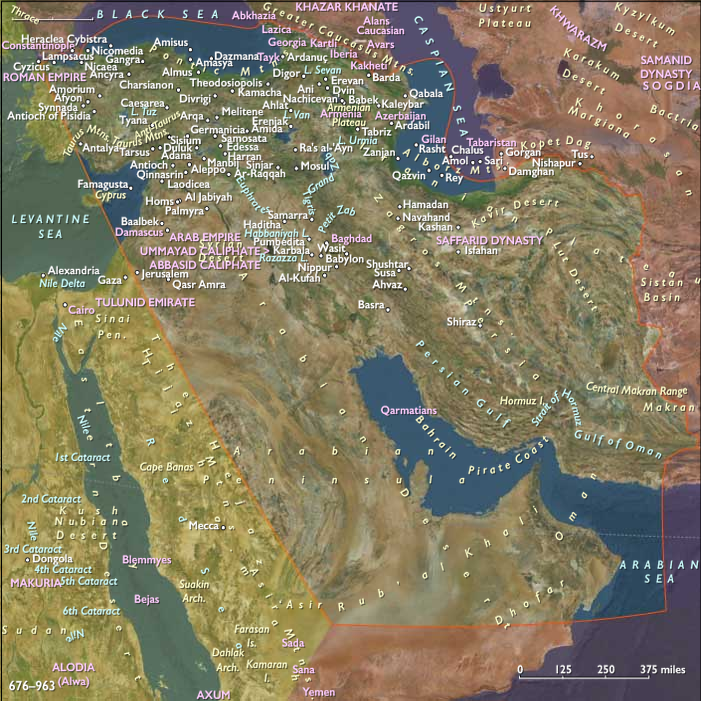
Related Events
Filter results
Showing 10 events out of 55746 total
Xuanzong wins a brief power struggle between himself and the princess Taiping in 713; she commits suicide and Xuanzong now assumes full authority as emperor.
Hs father retires into seclusion.
The highly lucrative Inexhaustible Treasury, which is run by a prominent Buddhist monastery in Chang'an, collects vast amounts of money, silk, and treasures through multitudes of rich people's repentances, left on the premises anonymously.
Although the monastery is generous in donations, Emperor Xuanzong issues a decree abolishing their treasury on the grounds that their banking practices are fraudulent, collects their riches, and distributes the wealth to various other Buddhist monasteries, Taoist abbeys, and to repair statues, halls, and bridges in the city.
Xuanzong allots twenty million copper coins and assigns about one thousand craftsmen to construct a hall at a Buddhist monastery with tons of painted portraits of himself, and of deities, ghosts, etc.
For the annual Lantern Festival of this year, recently abdicated Emperor Ruizong of Tang erects an enormous lantern wheel at a city gate, with a recorded height of two hundred feet.
The frame is draped in brocades and silk gauze, adorned with gold and jade jewelry, and when its total of some fifty thousand oil cups is lit, the radiance of it can be seen for miles.
Construction begins in 713 on the Leshan Giant Buddha near Leshan, Sichuan province, China.
Upon its completion in 803, it will become the largest stone carved Buddha in the world.
Manchuria's pastoral Tungus peoples had asserted their independence in 698, founding the Jin, or Chen kingdom, which in 713 becomes the P'o-hai, or Parhae, or Balhae, kingdom, centered in the modern province of Jilin (Kirin).
Founded by a former Korean general, Dae Jo-young (Tae Cho-yang), the kingdom’s ruling class consists largely of the former aristocrats of Goguryeo (Koguryo), which had occupied most of northern Korea and Manchuria before it was conquered by a Silla-T'ang alliance in 668.
Dae Jo-young has established his capital at Dongmu Mountain.
Since it had gained power under protection of the northern nomadic empire of Göktürk, T'ang China calls Dae Joyoung "Prefecture King of Balhae” in 713.
The Bohai (Balhae) Prefecture, modern Cangzhou in Hebei Province, faces the Bohai Sea and is remote from his realm.
Although the title is not accompanied by actual possession of the prefecture, "Balhae" will be used hereafter as the name of the country.
Qutayba builds a mosque in Bukhara’s citadel in 712/713, but although the Arab authorities encourage the conversion of the native population by paying them to attend prayers, Islamization proceeds slowly.
At the same time, Qutayba begins to adopt a measure that marked a radical departure from previous practice in the East: he orders the raising of native Khurasani auxiliary levies, usually some ten to twenty thousand strong and mostly composed of non-converts, to supplement the Arab tribal army, the muqatila.
This measure will later be expanded to include the newly conquered territories in Sogdiaand Khwarizm.
Gibb suggests that this move may be seen as an answer to the need for more troops to control the conquered territories and continue Muslim expansion, as well as a means of placing the local manpower in Arab service and depleting it at the same time, reducing the risk of anti-Arab revolts.
Gibb also suggests that the creation of an indigenous force may have been an attempt by Qutayba to establish a power base of his own. (Gibb, H. A. R. (1923). The Arab Conquests in Central Asia. London: The Royal Asiatic Society.)
From around 712, Qutayba also appears to have recruited a special corps, known as the "Archers", from among the Khurasani, Tokharian and Sogdian nobility.
Their skill is such that they are known as rumāt al-buduq ("archers who pierce the pupils of the eyes"), and they apparently serve as a bodyguard.
Among the local Khurasani converts, Hayyan an-Nabati emerges as the foremost leader, and appears frequently in Tabari's account both as the main military leader of the Khurasani conscripts and as chief negotiator with the Sogdians.
Qutayba's victories, parallel with the conquests of Muhammad ibn Qasim in northwestern India, awake such enthusiasm and hopes among the Muslims that al-Hajjaj is reputed to have offered the governorship of China to whomever of the two first reaches it.
Arab sources indicate that at about his time, the Sogdian princes called upon the Western Turks or the Turgesh for help against the Arabs, although the chronology and veracity of these accounts is open to question.
In any case, over the next two years Qutayba will engage in an effort to push the Caliphate's borders further and gain control of the Jaxartes valley.
A large force, supported by some twenty thousand Transoxianian levies, marches into the valley in early 713.
The native levies are dispatched against Shash, which is reportedly taken, while Qutayba with the Arabs marched in the direction of Khujand and Ferghana.
Little is known of these expeditions, although successful battles are recorded before Khujand and at Minak in Ushrusana, and the dispatch of an Arab embassy to the Chinese court is verified by Chinese sources.
Al-Tabari reports that Qutayba marched into Chinese-held territory up to Kashgar, but this claim is dismissed by modern scholars.
The Arabs capture several cities in 712-713.
The Opsikian army in Thrace on June 3, 713, overthrows and blinds Philippikos and, mainly at the instigation of the Senate and people, installs his chief secretary, Artemios, as Anastasios II.
Soon after his accession, Anastasios II imposes discipline on the army and executes those officers who had been directly involved in the conspiracy against Philippikos.
Andrew of Crete had been sent from his monastery in Jerusalem to Constantinople, where he had become deacon of the Hagia Sophia.
During the reign of Philippikos he had been made archbishop of Gortyna and had taken part in the Synod of Constantinople, where he had subscribed to Monothelitism; he recants his Monothelitic views in 713.
In developing the liturgy of the Greek Church, he is credited with inventing the kanon, a new genre of hymnography that consists of nine odes in stanzaic form, each sung to a different melody.
His canon replaces the kontakion, a homiletic hymn of which all stanzas were sung to the same melody.
Andrew is the author of many hymns and canons still used in Greek liturgical books.
Al-Walid himself continues the effective rule that had been characteristic of his father, developing a welfare system, building hospitals and educational institutions, and taking measures for the appreciation of art.
An enthusiast of architecture, al-Walid has repaired and refurbished the Masjid al Nabawi in Medina, the second holiest mosque in Islam.
In addition, he has converted the Christian Basilica of St. John the Baptist into a great mosque, now known as the Great Mosque of Damascus or simply the Umayyad Mosque (John the Baptist is considered a Prophet of Islam and is known as Yahya).
Al-Walid has also greatly expanded the military, building a strong navy.
His rein is considered as the apex of Islamic power.
He is also known for his own personal piety, and many stories tell of his continual reciting of the Qur'an and the large feasts he hosts for those who fast during Ramadan.
Al-Walid has appointed the first so-identified sahib al-masahif (“curator of books”), by which time the Umayyad collection includes hundreds of works on astrology, alchemy, medicine, and military science.
Abbas is the son of Caliph al-Walid I.
Little is known about his early life, and Arab and Byzantine sources are often at odds concerning details of his career.
He first appears in the 707 campaign against the important imperial fortress of Tyana in Cappadocia, where he led the Arab army alongside his uncle Maslama ibn Abd al-Malik.
The town withstood a long siege over the winter of 707–708, and surrendered only after an imperial relief army was defeated in spring.
During the latter battle, Abbas is said by Arab chroniclers to have distinguished himself for the crucial role he played in stopping the wavering Arabs from fleeing and driving them on to victory.
Abbas has participated regularly in the almost annual expeditions launched into Roman Asia Minor.
In 713, the Arabs under Abbas sack Antioch in Pisidia, which will never recover.
The Muslim Arabs in northwest India next invade the region of present day Madhya Pradesh, ruled until now by Hindu dynasties.
The Arabs conquer Sindh in 713, adding the formerly Hindu state to the caliphate and converting its people to Islam.
Years: 713 - 713
Locations
People
Groups
Topics
- Arab-Byzantine Wars
- Arab-Khazar Wars
- Muslim Conquest of Sindh
- Byzantine-Muslim War of 692-718
- Muslim conquest of Transoxiana
