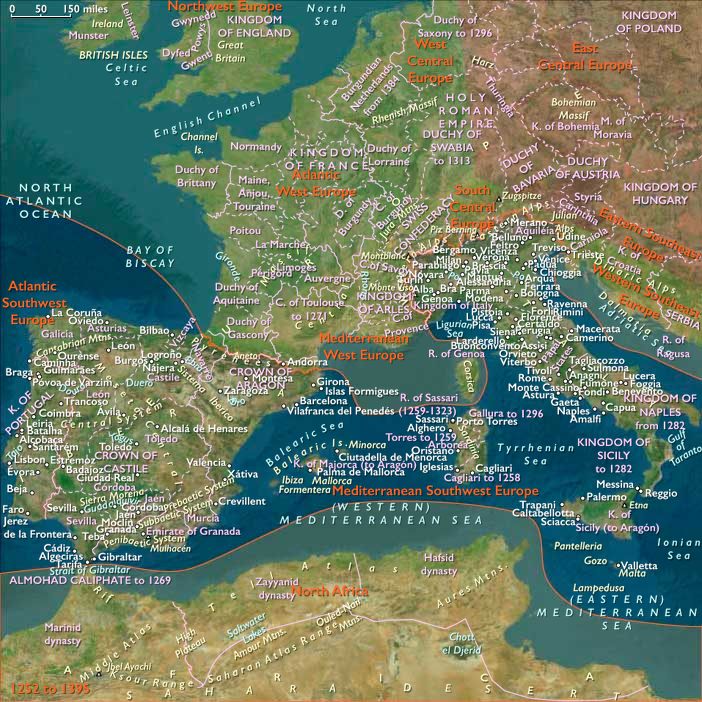
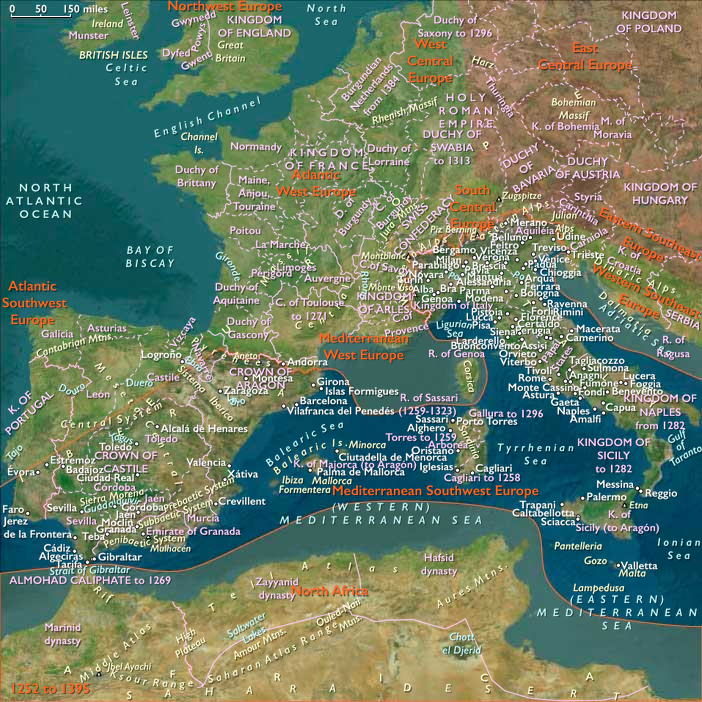
…Cagliari, but are unable to fully expel …
Years: 1326 - 1326
…Cagliari, but are unable to fully expel the Pisans and Genoese from Sardinia.
Locations
People
Groups
- Corsica, Medieval
- Pisa, (first) Republic of
- Genoa, (Most Serene) Republic of
- Aragón, Kingdom of
- Aragon, Crown of
- Sardinia, Kingdom of
Topics
Commodoties
Subjects
Regions
Subregions
Related Events
Filter results
Showing 10 events out of 44627 total
A war had erupted between cousins Louis V of Germany and Frederick the Fair of Austria for the imperial crown after the death of Henry VII, Holy Roman Emperor, in August 1313.
The ambitious Pope John XXII sees himself as the ultimate judge and arbiter in the conflict.
When Louis V ignored papal decrees and assumed full imperial authority, the pope had excommunicated Louis and rallied European nobility against him.
The Margraviate of Brandenburg was ruled by the House of Ascania, which became extinct with the deaths of Waldemar in 1319 and Henry II in 1320.
The succession crisis caused a lot of confusion.
Louis V considered the margraviate vacant and, after his victory in the Battle of Mühldorf, appoints his son also named Louis as Margrave of Brandenburg in 1323.
That has created a common border between possessions of Louis V and Polish King Władysław I, who compete for influence in the Duchy of Silesia.
The Poles also regard Lubusz Land, which has been incorporated into Neumark (East Brandenburg), as their territory.
Thus, it does not take much encouragement from Pope John XXII to convince King Władysław to attack Brandenburg.
In late 1324 or early 1325, Gediminas of Lithuania had concluded a military alliance with Poland primarily directed against the Teutonic Knights, a crusading military order.
The alliance had been cemented by the marriage of Gediminas' daughter Aldona and Władysław's son Casimir.
In 1322, Gediminas had sent a letter to Pope John XXII with vague promises to convert to Christianity.
Seeing a potential new ally, the Pope had sent a delegation to Lithuania and by threat of excommunication had compelled the Teutonic Knights, who support Louis V of Germany, to make peace with Gediminas in August 1324.
The peace will remain in effect for four years until 1328.
On February 7, 1326, with the help of papal legates, Władysław I concludes an armistice at Łęczyca with the Teutonic Knights and three Masovian dukes which guarantees safe passage for the Lithuanian troops through Prussia and Masovia while they are in "Polish service".
The truce is to last to Christmas 1326 and, according to chronicler Detmar von Lübeck, papal legates even accompany the army to ensure the Knights observe the armistice.
On February 10, 1326, David of Hrodna leads twelve hundred Lithuanian men to join the Polish forces.

The joint Polish-Lithuanian army loots and robs Frankfurt, Berlin, and surrounding territories.
Thus, the pagans reach Central Europe and strike the Holy Roman Empire, which shocks western rulers.
Not meeting any organized resistance, they plunder churches and monasteries for about a month.
Reportedly, they take six thousand prisoners as slaves and much booty.
The loot is large enough to allow Samogitian duke Margiris to pay twenty thousand florins to King John of Bohemia when he raids Medvėgalis in 1329.
German chronicles, including Nikolaus von Jeroschin, vividly describe atrocities committed by the invaders.
They are particularly scandalized by pagan Lithuanians who show no respect for Christian symbols, establishments, or personnel.
Reportedly distraught by Lithuanian cruelty, Masurian nobleman Andrew Gost ambushes and kills David of Hrodna and their way back to Lithuania.
The raid on the Neumark region is a successful military campaign and brings much loot, but it is not a political success.
The raid further antagonizes Poland and the Teutonic Knights.
The tension soon turns into the Polish–Teutonic War (1326–32).
Silesian Piasts turn against Poland and recognize the suzerainty of King John of Bohemia.
The alliance between the Pope and the pagan Lithuanians, subjects of the Lithuanian Crusade, scandalizes western rulers and damaged the Pope's reputation.
Louis will succeed in 1328 in installing Antipope Nicholas V.
The Polish–Lithuanian alliance, which will survive to 1331, ruins the Lithuanian alliance with the Duchy of Masovia, which has oscillated between Poland, Lithuania, and the Teutonic Knights in attempt to maintain its independence.
Gediminas' hopes of creating a Polish–Lithuanian–Hungarian alliance against the Teutonic–Bohemian alliance do not materialize.
Instead, the raid encourages John of Bohemia to join the Lithuanian Crusade and capture Medvėgalis in 1329.
Nicomedia, after a period of decline under the Eastern Roman Empire, falls in 1326 to the Ottomans, who rename it Izmit.
Corsica remains in the hands of the Genoese rulers.
The Aragonese defeat the Pisans by 1326 to take control of the Sardinian cities of Iglesias and …
Ibn Battuta of Tangier, twenty-one years old embarks, on a pilgrimage to Mecca in 1326.
He visits the holy places of Arabia, keeping a journal of his travels.
He returns to become a judge in his native city, but the travel bug has bitten him hard, and, on a separate trip, he visits southern Spain.
Marsilius of Padua and Defensor Pacis (1324): A Revolutionary Treatise on Sovereignty
In 1324, Marsilius of Padua published Defensor Pacis (The Defender of Peace), an anonymously written but vehemently anticlerical work of political philosophy. This groundbreaking treatise laid the foundation for modern doctrines of sovereignty, asserting that all authority rests with the people and that the Church is entirely subordinate to the state.
Key Arguments in Defensor Pacis
-
Sovereignty and the People
- Marsilius argued that ultimate authority resides in the people, making him one of the earliest proponents of popular sovereignty.
- The government should be rooted in the will of the citizenry, not in divine or hereditary rule.
-
The Church’s Subordination to the State
- Marsilius rejected papal supremacy, asserting that the Church must be subject to secular rulers.
- The Church, he argued, derives its jurisdiction (both spiritual and temporal) from the state, rather than exercising independent authority.
- The pope was not infallible and had no rightful power over secular rulers.
-
The Influence of Aristotle
- Marsilius extensively quoted Aristotle’s Politics, reviving Aristotle’s political theories in support of secular government.
- He treated political secularism and civil governance as entirely respectable and necessary for a well-ordered society.
Controversy and Political Ramifications
- Defensor Pacis provoked outrage within the papacy and clerical establishment, as it directly challenged the foundations of medieval papal authority.
- When Marsilius’s authorship became known in 1326, he was forced to flee Paris and sought refuge with Louis IV of Bavaria, the Holy Roman Emperor-elect, who was in an open power struggle with Pope John XXII.
- Louis IV embraced Marsilius’s theories, using them to justify imperial authority over the pope in their ongoing dispute.
Long-Term Impact and Legacy
- Defensor Pacis laid the intellectual groundwork for later secular political theories, influencing thinkers such as Machiavelli, Hobbes, and early modern theorists of state sovereignty.
- The treatise anticipated the Reformation-era struggles between Church and State, helping to shape emerging ideas of national governance free from papal interference.
- The controversy surrounding Marsilius’s ideas persisted throughout the 14th century, as his radical rejection of papal supremacy and ecclesiastical power continued to influence secular rulers and political philosophers.
Marsilius of Padua’s Defensor Pacis (1324) stands as one of the most revolutionary political texts of the Middle Ages, marking the transition from medieval theocracy to the modern concept of secular sovereignty.
A French invasion, supported by the English magnates and engineered by Isabella, King Edward II’s queen, and her lover, Roger de Mortimer, first Earl of March, the thirty-nine-year-old grandson of Edouard (Edward) I’s supporter of the same name, ends the oppressive rule of Edward and Despenser in 1326.
Together, Isabella and Mortimer depose her husband, who is succeeded by his fourteen-year-old-son son as Edward III, and take control of the government.
The Polish-Lithianian armies turn against the Teutonic Order in 1527, while in the south King John the Blind marches against Kraków.
Though he is urged by King Charles I of Hungary to retreat, he vassalizes many of the Duchies of Silesia.
Years: 1326 - 1326
Locations
People
Groups
- Corsica, Medieval
- Pisa, (first) Republic of
- Genoa, (Most Serene) Republic of
- Aragón, Kingdom of
- Aragon, Crown of
- Sardinia, Kingdom of