The prehistoric origins of the Shawnees are uncertain.
The other Algonquian nations regard the Shawnee as their southernmost branch.
Algonquian languages have words similar to the archaic shawano (now: shaawanwa) meaning "south".
However, the stem shaawa- does not mean "south" in Shawnee, but "moderate, warm (of weather)".
In one Shawnee tale, Shaawaki is the deity of the south.
Some scholars have speculated that the Shawnee are descendants of the people of the prehistoric Fort Ancient culture of the Ohio country; other scholars disagree.
No definitive proof has been established.
Europeans report encountering Shawnee over a widespread geographic area.
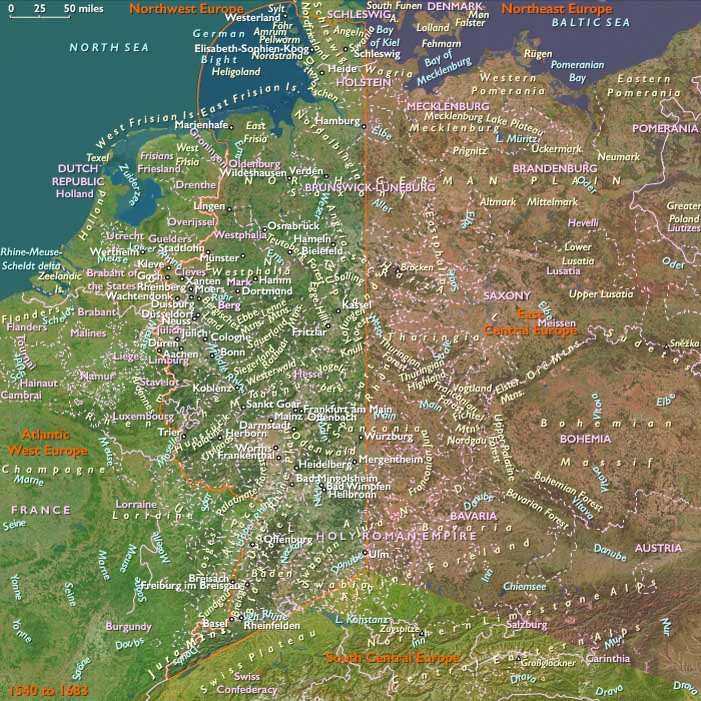
The earliest mention of the Shawnee may be a 1614 Dutch map showing the Sawwanew just east of the Delaware River.
Later seventeenth-century Dutch sources also place them in this general location.
Accounts by French explorers in this same century usually located the Shawnee along the Ohio River.
According to one legend, the Shawnee are descended from a party sent by Chief Opechancanough, ruler of the Powhatan Confederacy 1618-1644, to settle in the Shenandoah Valley, and led by his son, Sheewa-a-nee, for whom they are named.
Edward Bland, an explorer who accompanies Abraham Wood's expedition in 1650 and writes The Discoverie of New Brittaine, notes that in Opechancanough's day there had been a falling-out between the "Chawan" chief and the weroance of the Powhatan proper (also a relative of Opechancanough's family), and that the latter had murdered the former.
Historian Alan Gallay speculates that the Shawnee migrations of the middle to late seventeenth century were probably driven by the Iroquois Wars that began in the 1640s.
The Shawnee become known for their widespread settlements and migrations, and their frequent long-distance visits to other native groups.
Their language is to become a lingua franca among numerous tribes.
Together with their experience, this will help make them leaders in initiating and sustaining pan-native resistance to European and American expansion.