
The Eburones Rebellion and the Belgic Uprising …
Years: 54BCE - 54BCE
The Eburones Rebellion and the Belgic Uprising (54 BCE)
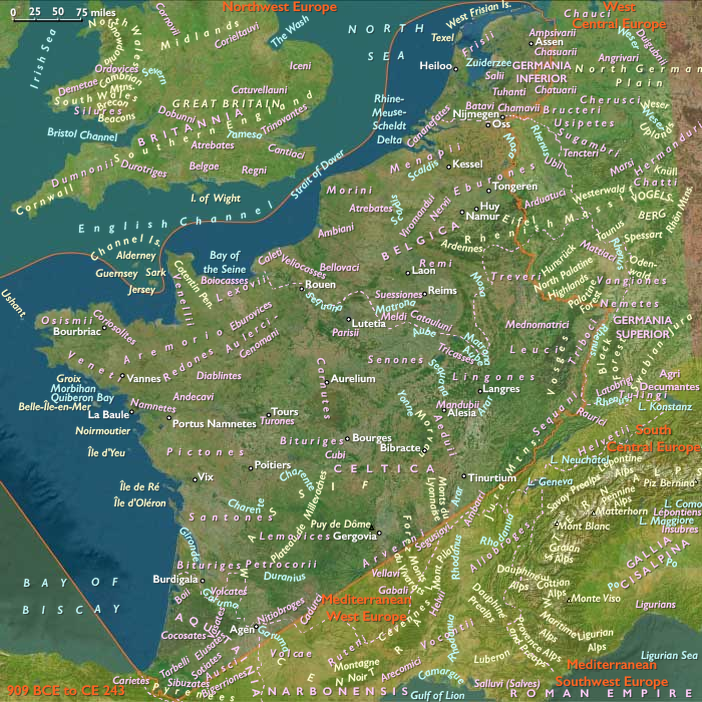
In 54 BCE, Julius Caesar’s legions were still in Belgic territory, having just returned from their second expedition to Britain. Due to a severe drought, crop yields were poor, making the forced winter quartering of Roman troops an increasing burden on local Gallic communities. This tension erupted into rebellion, led by the Eburones and their allies, marking one of the most devastating setbacks for Rome in the Gallic Wars.
The Ambush and Massacre of Sabinus and Cotta’s Legion
- Only fifteen days after their arrival in winter quarters, a Roman legion and five cohorts (approx. 6,000 men), commanded by Quintus Titurius Sabinus and Lucius Aurunculeius Cotta, were attacked by the Eburones.
- The Eburones were led by their kings, Ambiorix and Cativolcus, and encouraged by Indutiomarus, the Treveri king, to resist Roman rule.
- Ambiorix tricked the Roman commanders into abandoning their fortified camp, promising them safe passage.
- As soon as the Romans left their stronghold, they were ambushed and massacred, with nearly all 6,000 men killed—one of the worst Roman defeats in Gaul.
The Spread of the Revolt: An Attack on Cicero’s Camp
-
Emboldened by his victory, Ambiorix personally rode to the Aduatuci and the Nervii, calling for a coordinated attack on another Roman outpost.
-
The Nervii agreed, rallying reinforcements from their allied tribes:
- Centrones
- Grudii
- Levaci
- Pleumoxii
- Geiduni
-
They besieged the winter camp of Quintus Tullius Cicero (the brother of the famous orator, Marcus Tullius Cicero), who was stationed in Nervian territory.
-
However, Caesar arrived in time to relieve Cicero, causing the Belgic coalition to disperse.
-
Caesar, unwilling to pursue them too far into the forests and marshes, wrote:
"Fearing to pursue them very far, because woods and morasses intervened, and also [because] he saw that they suffered no small loss in abandoning their position."
(Gallic War, V.40–V.52)
Titus Labienus’ Campaign and the Death of Indutiomarus
-
Meanwhile, Titus Labienus, one of Caesar’s most trusted generals, was wintering among the Treveri, when the rebellion spread into his territory.
-
The Treveri, under King Indutiomarus, also prepared to rise against Rome.
-
Labienus, however, acted decisively—he launched a counteroffensive, ambushed Indutiomarus, and killed him in battle.
-
With the death of Indutiomarus, the Eburones and Nervii forces withdrew, and Caesar noted that:
"This affair having been known, all the forces of the Eburones and the Nervii which had assembled, depart; and for a short time after this action, Caesar was less harassed in the government of Gaul."
(Gallic War, V.58)
Significance of the Belgic Uprising
- The annihilation of Sabinus and Cotta’s legion was one of Caesar’s worst defeats, exposing the limits of Roman control in Gaul.
- The Belgic rebellion was the most serious resistance since Vercingetorix's coalition in 52 BCE and demonstrated the widespread discontent among Rome’s Gallic subjects.
- Caesar responded with brutal reprisals, leading to the eventual destruction of the Eburones in 53 BCE.
The Eburones rebellion of 54 BCE was one of the last major challenges to Rome’s dominance in Gaul, highlighting both the ferocity of Gallic resistance and the ruthless efficiency of Roman countermeasures.
Locations
People
Groups
- Gauls
- Roman Republic
- Nervii (Belgic tribe)
- Menapii (Gaulish tribe)
- Condrusi (Germanic tribe)
- Ubii (Germanic tribe)
- Sicambri (Germanic tribe)
- Aduatuci (Gallic Germanic tribe)
- Eburones (Gaulish tribe)
- Suebi (Germanic tribe)
- Tencteri and Usipetes (Germanic tribe or tribes)
Topics
- Classical antiquity
- Pre-Roman Iron Age of Northern Europe
- Roman Age Optimum
- Roman Republic, Crisis of the
- Gallic Wars
Commodoties
Subjects
Regions

Subregions
Years: 54BCE - 54BCE
Locations
People
Groups
- Gauls
- Roman Republic
- Nervii (Belgic tribe)
- Menapii (Gaulish tribe)
- Condrusi (Germanic tribe)
- Ubii (Germanic tribe)
- Sicambri (Germanic tribe)
- Aduatuci (Gallic Germanic tribe)
- Eburones (Gaulish tribe)
- Suebi (Germanic tribe)
- Tencteri and Usipetes (Germanic tribe or tribes)
Topics
- Classical antiquity
- Pre-Roman Iron Age of Northern Europe
- Roman Age Optimum
- Roman Republic, Crisis of the
- Gallic Wars
Commodoties
Subjects
Regions
Subregions