
Caesar institutes numerous other reforms, such as …
Years: 45BCE - 45BCE
April
Caesar institutes numerous other reforms, such as limiting the distribution of free grain, founding citizen colonies, and enlarging the Senate from six hundred members to nine hundred.
The commander of each legion is made directly responsible to the Senate.
At the same time he reduces debts, revises the tax structure, and extends Roman citizenship to non-Italians.
These popular reforms, while meeting genuine needs, also strengthen Caesar's control of the state at the expense of his opponents, whom he attempts to placate with ostentatious clemency.
Caesar is honored by portrayal on coins and by the erection of a temple to his clemency.
An accomplished orator and writer, Caesar introduces the genre of personal war commentaries in his two (surviving) works, On the Gallic War and On the Civil War, lucid narratives that, while holding the reader’s interest, serve as subtle propaganda for Caesar, who probably writes his Commentaries in this year.
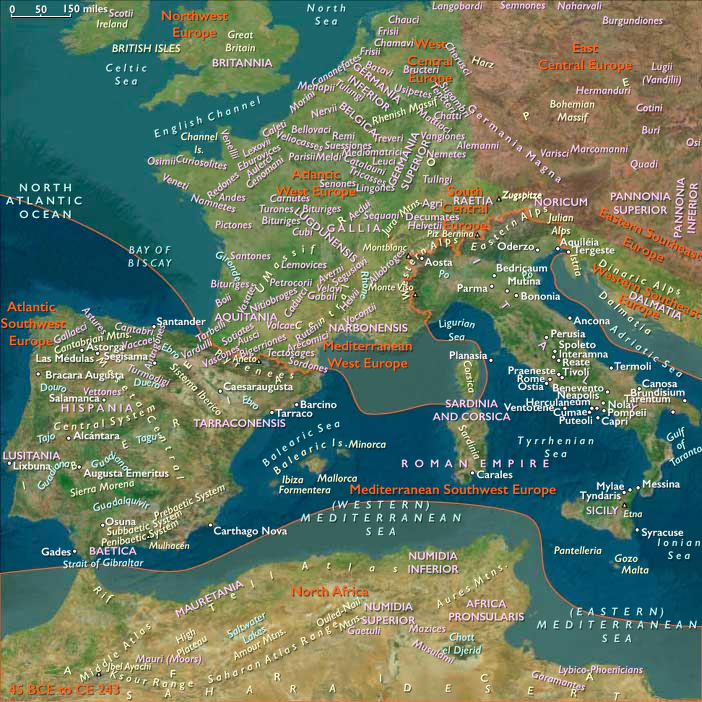
While he is still campaigning in Hispania, the Senate begins bestowing honors on him in absentia.
Named dictator for life, Caesar had not proscribed his enemies, instead pardoning almost all, and there is no serious public opposition to him.
One of Caesar’s greatest supporters, Marcus Aemilius Lepidus, the son of a prominent politician of the same name, had joined the Caesarian side during the civil war between Caesar and the adherents of Pompey, served as praetor in 49, governor of Hither Spain in 48–47, and consul in 46.
In 45, he replaces Mark Antony as Caesar's magister equitum (“master of the cavalry”), effectively deputy in the dictatorship.
Great games and celebrations are held on April 21 to honor Caesar’s victory at Munda.
Caesar returns in September to Rome to start putting the Greco-Roman world in order.
He files his will, naming his grandnephew and adopted son Gaius Octavius (Octavian) as the heir to everything, including his title.
The son of Gaius Octavius the Elder and Atia, the niece of Julius Caesar, Octavian had, at twelve, entered the public-speaking arena in 51 with a speech he delivered at his grandmother’s funeral.
Caesar also writes that if Octavian predeceases him, the next heir in succession is to be Marcus Junius Brutus, whose father had been a legati to Pompey the Great and whose mother, Servilia Caepionis, the half-sister of Cato the Younger, had later become Julius Caesar's mistress.
Though Brutus had taken the side of Pompey in the civil war, Caesar has forgiven him, nominating him in 45 to be a praetor.
Also, in June of this year, Brutus had divorced his wife and remarried his first cousin, Porcia Catonis, daughter of the late Cato.
Locations
People
- Augustus
- Cleopatra VII
- Julius Caesar
- Marcus Aemilius Lepidus (triumvir)
- Marcus Junius Brutus the Younger
- Ptolemy XIV
Groups
Topics
- Classical antiquity
- Roman colonization
- Roman Age Optimum
- Roman Republic, Crisis of the
- Roman-Parthian War of 55-36 BCE
- Roman Civil War, Great, or Caesar's Civil War
- Munda, Battle of
Commodoties
Subjects
- Commerce
- Symbols
- Writing
- Engineering
- Environment
- Labor and Service
- Conflict
- Faith
- Government
- Custom and Law
- Technology
Regions
Subregions
Years: 45BCE - 45BCE
April
Locations
People
- Augustus
- Cleopatra VII
- Julius Caesar
- Marcus Aemilius Lepidus (triumvir)
- Marcus Junius Brutus the Younger
- Ptolemy XIV
Groups
Topics
- Classical antiquity
- Roman colonization
- Roman Age Optimum
- Roman Republic, Crisis of the
- Roman-Parthian War of 55-36 BCE
- Roman Civil War, Great, or Caesar's Civil War
- Munda, Battle of
Commodoties
Subjects
- Commerce
- Symbols
- Writing
- Engineering
- Environment
- Labor and Service
- Conflict
- Faith
- Government
- Custom and Law
- Technology
Regions
Subregions