
Caesar, faced with inflexible opposition from such …
Years: 59BCE - 59BCE
Caesar, faced with inflexible opposition from such conservative Senators as Lucullus and Cato the Younger, now succeeds in organizing an irresistible coalition of political bosses.
He is already in Crassus' political debt, but he has also made overtures to Pompey, assiduously cultivating his friendship.
Pompey and Crassus have been at odds for a decade, so Caesar tries to reconcile them.
The three of them have enough money and political influence to control public business.
This informal alliance, known as the First Triumvirate ("rule of three men"), is cemented by the marriage of Pompey to Caesar's only child, Julia, in April 59.
This family alliance of its two great chiefs is regarded as the firmest bond between Caesar and Pompey, and is accordingly viewed with much alarm by the optimates (the oligarchal party in Rome), especially by Cicero and Cato the Younger.
Caesar also marries again, this time Calpurnia, As consul, Caesar champions a bill of Publius Servilius Rullus for the redistribution of Roman public lands in Italy to the poor, on which the first charge is to be a provision for Pompey's soldiers.
The proposal is supported by Pompey, by force of arms if need be, and by Crassus, making the triumvirate public.
Three tribunes of the plebs veto the bill, and Caesar's colleague Bibulus announces his intention of preventing the transaction of public business by watching the skies for portents whenever the public assembly is convened.
Pompey fills the city with soldiers, a move which intimidates the triumvirate's opponents.
Bibulus attempts to declare the omens unfavorable and thus void the new law, but is driven from the forum by Caesar's armed supporters.
His bodyguards have their ceremonial axes broken, two high magistrates accompanying him are wounded, and he has a bucket of excrement thrown over him.
In fear of his life, he retires to his house for the rest of the year, issuing occasional proclamations of bad omens.
These attempts to obstruct Caesar's legislation prove ineffective.
Roman satirists ever after referred to the year as "the consulship of Julius and Caesar."
In the same year, Clodius, who had been acquitted of the sacrilege charge in 61 by a jury probably bribed by Crassus, renounces his patrician status, is adopted into a plebian gens, and is elected a Tribune of the plebs.
Pompey's settlement of the East is ratified en bloc by an act negotiated by an agent of Caesar, the tribune of the plebs Publius Vatinius.
Caesar himself initiates a noncontroversial and much-needed act for punishing misconduct by governors of provinces.
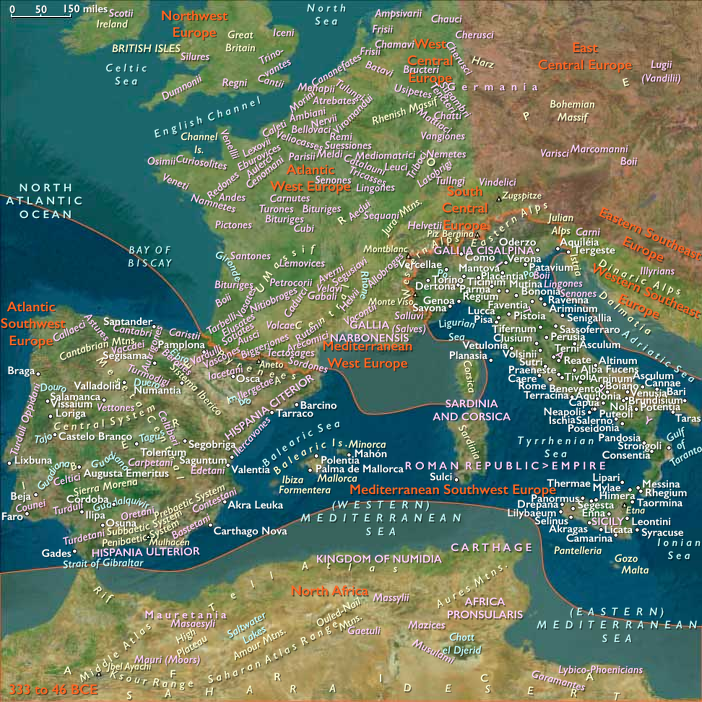
Another act negotiated by Vatinius gives Caesar Cisalpine Gaul (between the Alps, the Apennines, and the Adriatic) and Illyricum.
When Metelus Celer, the governor-designate of Transalpine Gaul (southern France) suddenly dies, this province, also, is assigned to Caesar at Pompey's instance, giving him four legions.
Cisalpine Gaul gives Caesar a military recruiting ground; Transalpine Gaul gives him a springboard for conquests beyond Rome's northwest frontier.
The term of his governorship, and thus his immunity from prosecution, is set at five years, rather than the usual one; his tenure is to last until February 28, 54.
When his consulship ends, Caesar narrowly avoids prosecution for the irregularities of his year in office, and quickly leaves for his province.
Locations
People
- Cato the Younger
- Cicero
- Julius Caesar
- Lucullus
- Marcus Licinius Crassus
- Pompey
- Publius Clodius Pulcher
- Quintus Caecilius Metellus Celer
Groups
Topics
Commodoties
Subjects
Regions
Subregions
Related Events
Showing 1 events out of 1 total
Years: 59BCE - 59BCE
Locations
People
- Cato the Younger
- Cicero
- Julius Caesar
- Lucullus
- Marcus Licinius Crassus
- Pompey
- Publius Clodius Pulcher
- Quintus Caecilius Metellus Celer
Groups
Topics
Commodoties
Subjects
Regions
Subregions