
Caesar follows his Optimate opponents to Africa …
Years: 47BCE - 47BCE
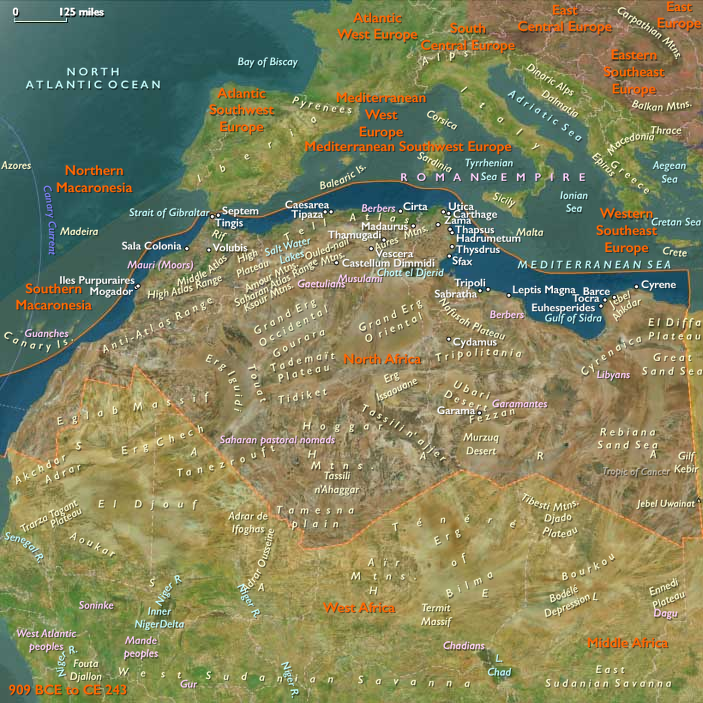
Caesar follows his Optimate opponents to Africa after his rapid pacification of the Eastern provinces, and a short visit to Rome, landing in Hadrumetum (modern Sousse, Tunisia) on December 28, 47 BCE.
Locations
People
- Cato the Younger
- Juba I of Numidia
- Julius Caesar
- Quintus Caecilius Metellus Pius Scipio Nasica
- Titus Atius Labienus
Groups
Topics
- Classical antiquity
- Roman Age Optimum
- Roman Republic, Crisis of the
- Roman Civil War, Great, or Caesar's Civil War
Commodoties
Subjects
Regions
Subregions
Related Events
Filter results
Showing 10 events out of 62480 total
Pharnaces, following his defeat in the Battle of Zela, manages to assemble a small force of Scythian and Sarmatian troops, with which he is able to gain control of a few cities.
His former governor and son-in-law Asander attacks his forces and kills him.
(The historian Appian states that he died in battle; Cassius Dio says he was captured and then killed.)
Caesar makes Mithridates of Pergamon king of the Bosporan Kingdom, by commanding him to declare war on his niece Dynamis and her husband Asander (who are now the ruling monarchs) to keep the kingship for himself.
Dynamis and Asander are defeated by Mithridates and his army, and Mithridates becomes the Bosporan king.
Pompey’s client Pharnaces II, son of Mithridates VI Eupator (Mithradates the Great), while the Romans are distracted by the civil war between the Roman triumvirs and Pompey, has decided to seize the opportunity to re-create his father’s kingdom of Pontus and expand his Bithynian domain in Asia Minor through conquest.
With the forces under his disposal and against little opposition, he has made himself the ruler of Colchis and Lesser Armenia.
Deiotarus, the ruler of Galatia, appeals to Gnaeus Domitius Calvinus, Caesar’s lieutenant in Asia, for support, and soon the Roman forces seek battle with Pharnaces II.
They meet at Nicomedia in Anatolia, and Pharnaces II defeats the Roman army and overruns Pontus.
Cassius had in 48 BCE sailed his ships to Sicily, where he had attacked and burned a large part of Caesar's navy.
He then proceeded to harass ships off the Italian coast.
News of Pompey's defeat at the Battle of Pharsalus had caused Cassius to head for Hellespont, with hopes of allying with the king of Pontus, Pharnaces II.
Caesar, having established Cleopatra as ruler of Egypt, meanwhile marches his army north through Syria into Asia Minor.
Cassius is overtaken by Caesar en route, and is forced to surrender unconditionally.
Caesar makes Cassius a legate, employing him in the war against the very same Pharnaces whom Cassius had hoped to join after Pompey's defeat at Pharsalus. (However, Cassius will refuse to join in the fight against Cato and Scipio in Africa, choosing instead to retire to Rome.)
Caesar’s superior troops, meeting Pharnace II and his army at the Battle of Zela in Pontus in May, 47, easily defeat those of Pharnaces.
Caesar promptly sends a message back to Rome: “Vini, vidi, vici” (“I came, I saw, I conquered”).
Pharnaces, escaping the rout with just a small detachment of cavalry, flees quickly back to the Bosporan kingdom.
Caesar demolishes the mountain strongholds of the Pontic territory and divides the region among minor kings.
Caesar has withstood the Siege of Alexandria between 48 and 47 BCE, a series of skirmishes and battles occurring between the forces of Julius Caesar, Cleopatra VII and Ptolemy XIII.
Utilizing soldiers he had brought with him and a minor Italian militia left over from previous issues in 55 BCE, Caesar had managed a defense of the city until relief came in the form of Mithridates of Pergamon, who had raised an army and marched overland from Asia Minor to assist Caesar, and Antipater the Idumaean.
Caesar, pressed hard by the native forces under Arsinoe and Ganymedes, negotiates an exchange of Ptolemy for Arsinoe.
The King immediately takes command of the Egyptians, but Caesar, reinforced by the Pergamene army, outmaneuvers the Ptolemaic forces and the fifteen-year-old King of Egypt is killed in a final pitched battle fought at the west side of the Nile, probably by drowning as he attempts to flee.
The victorious Caesar victorious installs Cleopatra as ruler.
Caesar and Cleopatra celebrate their victory in the spring of 47 BCE with a triumphant procession on the Nile.
The royal barge is accompanied by four hundred additional ships, and Caesar is introduced to the luxurious lifestyle of the Egyptian pharaohs.
Having won his victory on March 27, 47, Caesar leaves Egypt after a fortnight's amorous, if uncharacteristic, respite.
Arsinoe is sent to Rome to be led in Caesar's triumph.
Caesar and Cleopatra will never marry, as Roman law recognized marriages only between two Roman citizens.
Caesar throughout his last marriage is to continue his relationship with Cleopatra, which will last fourteen years—this does not constitute adultery in Roman eyes—and may have fathered a son called Caesarion (“Little Caesar”).
Whether Caesar is in fact the father of Cleopatra's son cannot now be known.
Cleopatra will visit Rome on more than one occasion, residing in Caesar's villa just outside Rome across the Tiber.
Caesar restores Hyrcanus to his office as a reward for the latter’s' support in 48 after Caesar’s defeat of Pompey at the Battle of Pharsalus.
Antipater, who had aided Caesar in Alexandria, is made chief minister of Judea, with the right to collect taxes.
Aulus Gabinius, recalled by Caesar in 49 BCE after the outbreak of the civil war, had entered his service but had taken no active part against his old patron Pompey.
Gabinius after the Battle of Pharsalu had been commissioned to transport some recently levied troops to Illyricum.
On his way thither by land, he is attacked by the Dalmatians and with difficulty makes his way to Salonae in Dalmatia, where he bravely defends himself against the attacks of the Pompeian commander, Marcus Octavius, but in a few months dies of illness in 48 or the beginning of 47.
After spending the first months of 47 BCE in Egypt, Caeasar goes to the East, where he annihilates the king of Pontus; his victory is so swift and complete that he mocks Pompey's previous victories over such poor enemies.
In this year also, the diaspora Jews, who have communities in all the major centers of the Roman Empire, and some who are citizens and elector in Rome, secure from Caesar the right to send to the Temple in Jerusalem an annual tribute (the fiscus judaicus).
The Romans had added Western Numidia to the lands of Bocchus, king of Mauretania, after the death of Jugurtha in 104 BCE, while the remainder (excluding Cyrene and its locality) had continued to be governed by native princes until the civil war between Caesar and Pompey.
Cato the Younger, who has held several posts during the civil war between Pompey and Caesar, had fled to Africa upon Pompey's defeat at Pharsalus and become governor of Utica.
Burebista, in battles mentioned by Strabo, defeats the Celts who menace his western borders after 48 BCE, forcing them back westward into Pannonia, a region originally peopled by the Pannonii (sometimes called Paeonii by the Greeks) and invaded from the fourth century BCE by various Celtic tribes.
Emesa in antiquity is a very wealthy city.
The city is a part of a trade route from the East, heading via Palmyra that passes through Emesa on its way to the coast.
Apart from Antioch, a very important city for the Romans as the Syrian port city, Emesa prospers under its Roman vassal rulers.
The economy of the Emesani Kingdom is based on agriculture.
With fertile volcanic soil in the Orontes Valley and a great lake, as well as a dam across the Orontes south of Emesa, which provides ample water, Emesa’s soil is ideal for cultivation.
Farms in Emesa provide wheat, vines and olives.
Each year neighborhood princes and rulers send generous gifts honoring and celebrating Emesa’s cult and its Temple of the Sun.
The priesthood of the cult of El-Gebal in Emesa is held by a family that may be assumed to be descended from Sampsiceramus I or the later Priest King Sohaemus, either by the priest-king or another member of the dynasty.
The priest that serves in the cult of El-Gebal wears a costume that is very similar to the dress of a Parthian Priest: an Emesani priest wears a long-sleeved and gold-embroidered purple tunic reaching to his feet, gold and purple trousers and a jeweled diadem on his head.
When Sampsiceramus I died in 48 BCE, he had been succeeded by Iamblichus I, during whose reign the prominence of Emesa grows after Iamblichus establishes it as the new capital of the Emesani dynasty.
Prior to succeeding his father, Iamblichus I had been considered by Cicero in 51 BCE (then Roman Governor of Cilicia), as a possible ally against Parthia.
Shortly after Iamblichus I becomes priest-king, he prudently supports the Roman politician Julius Caesar in his Alexandrian war against Pompey, sending troops to aid Caesar.
Years: 47BCE - 47BCE
Locations
People
- Cato the Younger
- Juba I of Numidia
- Julius Caesar
- Quintus Caecilius Metellus Pius Scipio Nasica
- Titus Atius Labienus
Groups
Topics
- Classical antiquity
- Roman Age Optimum
- Roman Republic, Crisis of the
- Roman Civil War, Great, or Caesar's Civil War
