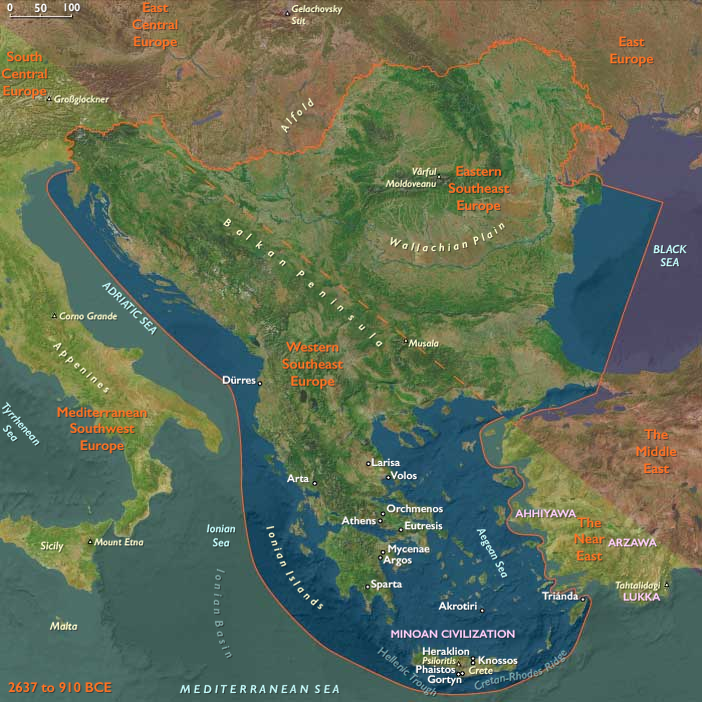
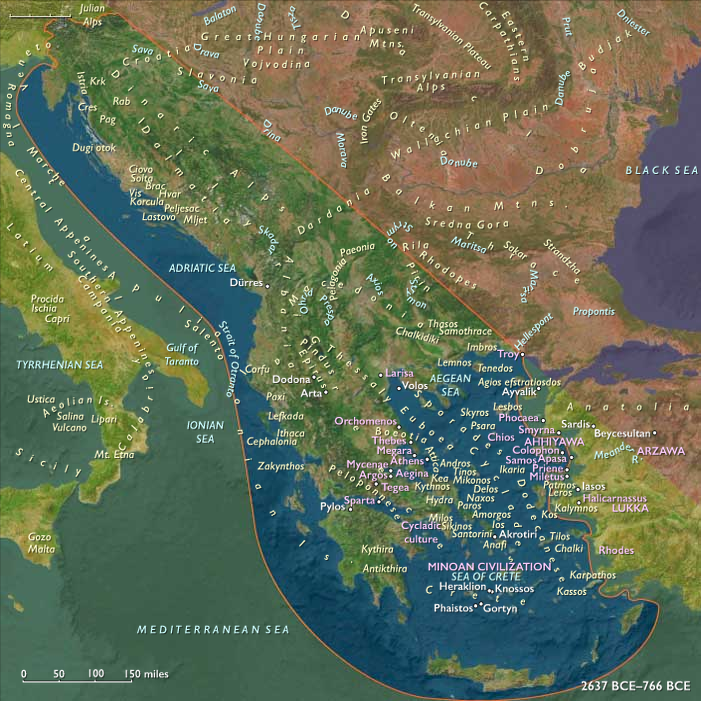
Cadmus founded the city of Thebes, and …
Years: 2061BCE - 1918BCE
Cadmus founded the city of Thebes, and its acropolis was originally named Cadmeia in his honor.
Cadmus, or Kadmos, in Greek mythology, was the son of Agenor and the brother of Phoenix, Cilix, and Europa.
He is the grandfather of the Greek god Dionysus, through his daughter with Harmonia, Semele.
Locations
Groups
Topics
Subjects
Regions
Subregions
Related Events
Filter results
Showing 9 events out of 9 total
Northwest Europe (1624–1635 CE): Rising Conflicts, Scientific Advancements, and Cultural Flourishing
England: The Late Reign of James I and Early Rule of Charles I
The final years of James I's reign saw continued political tensions between the monarchy and Parliament, largely over royal prerogatives and religious policies. Following James's death in 1625, his son Charles I ascended the throne. Charles immediately faced strained relations with Parliament due to his insistence on divine-right monarchy, leading to disputes over taxation and military funding. His marriage to the Catholic French princess Henrietta Maria heightened Protestant anxieties about Catholic influence.
In 1628, Parliament forced Charles to accept the Petition of Right, limiting royal authority and emphasizing Parliamentary consent for taxation and martial law. However, Charles's subsequent dissolution of Parliament in 1629 initiated the Personal Rule period (1629–1640), during which he governed without parliamentary approval, exacerbating tensions and laying groundwork for future conflicts.
Ireland: Intensifying Plantation Policies
The Plantation of Ulster continued to reshape Ireland's demographic and social structures significantly. English and Scottish settlers strengthened Protestant dominance, deepening divisions with the native Catholic Gaelic population. Tensions simmered, setting the stage for future conflicts, as the plantations entrenched long-lasting ethnic and religious hostilities.
Scotland: Religious and Political Strife
Under Charles I, Scotland experienced intensified religious and political discord. Charles’s efforts to impose Anglican-style ecclesiastical governance on the predominantly Presbyterian Church of Scotland led to increasing friction. His introduction of the Book of Common Prayer and new canons in 1637 (developed during this era) sparked widespread resistance, laying foundations for the subsequent Bishops' Wars.
Scandinavia: Danish-Norwegian Ambitions and Conflict
Christian IV continued aggressive foreign and colonial policies, but faced major setbacks in continental Europe. His ambitious intervention in the Thirty Years' War (1618–1648) culminated in severe Danish defeats, particularly at the Battle of Lutter am Barenberge (1626), significantly weakening Denmark's European influence and initiating domestic fiscal crises.
Maritime and Colonial Expansion
The English East India Company expanded its influence significantly, solidifying its presence in India and securing more commercial rights through diplomacy and occasional military action. The Mughal emperor extended hospitality to the English traders in Bengal in 1634, setting the stage for greater influence and commercial dominance. The company's mainstay businesses now included cotton, silk, indigo dye, saltpeter, and tea. In North America, English colonies continued to expand, notably in Massachusetts, where the founding of Boston in 1630 by Puritan settlers fleeing religious persecution established a prominent foothold that shaped future American society.
Scientific and Intellectual Progress
This era witnessed extraordinary scientific developments, particularly through the contributions of scholars such as William Harvey, whose groundbreaking publication De Motu Cordis (1628) explained the circulation of blood, revolutionizing medical understanding. Francis Bacon’s inductive methodologies continued to profoundly influence intellectual discourse, underpinning the advancement of empirical science. Bacon continued work in the tradition of John Dee under Rosicrucian influence, carefully downplaying magical elements in favor of inductive science to please the Catholic-leaning King.
Cultural Flourishing
The English cultural landscape remained vibrant. Literary output was robust, with playwrights such as John Ford and Philip Massinger dominating the stage. Poetry thrived under the metaphysical poets, including John Donne and George Herbert, whose intricate works profoundly shaped English literature.
Legacy of the Era
By 1635 CE, Northwest Europe stood at the threshold of significant turmoil. Charles I's authoritarian governance in England created profound political and religious tensions destined to erupt into civil war. Ireland and Scotland experienced deepening divisions exacerbated by English policies. Denmark-Norway's continental ambitions were severely curtailed, reshaping northern European power dynamics. Simultaneously, scientific innovation and cultural richness marked the region as a crucible for transformative developments in Western thought and culture.

Henriette Marie de France, the youngest daughter of King Henry IV of France (Henry III of Navarre) and his second wife, Marie de' Medici, had been brought up as a Catholic.
As daughter of the Bourbon king of France, she is a Fille de France, a member of the House of Bourbon, and the youngest sister of the King Louis XIII.
After her older sister, Christine Marie, married Victor Amadeus I, Duke of Savoy, in 1619, Henriette had taken the highly prestigious style of Madame Royale; this is used by the most senior royal princess at the French court.
Henrietta had been trained, along with her sisters, in riding, dancing and singing, and takes part in French court plays.
Although tutored in reading and writing, she is not known for her academic skills the princess has been heavily influenced by the Carmelites at French court.
Henrietta was by 1622 living in Paris with a household of some two hundred staff, and marriage plans were being discussed.
Henrietta had first met Prince Charles of England, her future husband, in Paris, in 1623, while he was traveling to Spain with the Duke of Buckingham to discuss a possible marriage with the Infanta Maria Anna of Spain—Charles first saw her at a French court entertainment.
The Spanish negotiations having failed, Charles looks to France instead.
The English agent Kensington is sent to Paris in 1624 to examine the potential French match, and the marriage is finally negotiated in Paris by James Hay and Henry Rich.
Buckingham had directed the marriage negotiations, but when Charles’s betrothal to Henrietta Maria of France is announced in 1624, the choice of a Catholic is widely condemned.
Charles is married by proxy to Henrietta Maria in front of the doors of the Notre Dame de Paris on May 11, 1625, before his first Parliament could meet to forbid the banns.
Many members are opposed to the king marrying a Roman Catholic, fearing that Charles would lift restrictions on Roman Catholics and undermine the official establishment of Protestantism.
Although he will state to Parliament that he will not relax restrictions relating to recusants, he promises to do exactly that in a secret marriage treaty with Louis XIII of France.
Moreover, the price of marriage with the French princess is a promise of English aid for the French crown in the suppressing of the Protestant Huguenots at La Rochelle, thereby reversing England's long held position in the French Wars of Religion.
The royal couple had been married in person on June 13, 1625 in Canterbury and Charles himself is crowned on February 2, 1626 at Westminster Abbey, but without his wife at his side due to the controversy.
Charles, on hearing rumors that Parliament intends to impeach his Catholic Queen, Henrietta Maria, decides to take drastic action that will not only end the diplomatic stalemate between himself and parliament, but signal the beginning of the civil war.
It is possibly Henrietta who persuades Charles to arrest the five members of the House of Commons who are perceived to be the most troublesome on charges of high treason.
Charles intends to carry out the arrests personally, but news of the warrant reaches Parliament ahead of him, and the wanted men, Pym, John Hampden, Denzil Holles, William Strode and Sir Arthur Haselrig have already slipped away by the time he arrives.
Charles enters the House of Commons with an armed force on January 4, 1642, but finds that his opponents have already escaped.
Having displaced the Speaker, William Lenthall, from his chair, the King asks him where the MPs had fled.
Lenthall famously replies, "May it please your Majesty, I have neither eyes to see nor tongue to speak in this place but as the House is pleased to direct me, whose servant I am here."
No monarch has entered the Commons chamber since without first seeking permission through the blackrod.
The botched arrest attempt is politically disastrous for Charles.
It causes acute embarrassment for the monarch and essentially triggers the total breakdown of government in England.
Afterwards, Charles can no longer feel safe in London and he begins traveling north to raise an army against Parliament; the Queen, at the same time, goes abroad to raise money to pay for it.
The Confederates receive modest subsidies from the monarchies of France and Spain, who want to recruit troops in Ireland but their main continental support comes from the Papacy.
Pope Innocent X strongly supports Confederate Ireland, over the objections of Mazarin and the Queen, Henrietta Maria, who in 1644 had moved to Paris.
Innocent had received the Confederation's envoy in February 1645 and resolved to send a nuncio extraordinary to Ireland, Giovanni Battista Rinuccini, archbishop of Fermo, who had embarked from La Rochelle with the Confederacy's secretary, Richard Bellings.
He had taken with him a large quantity of arms and military supplies and a very large sum of money.
These supplies mean that Rinuccini has a big influence on the Confederate's internal politics; he is backed by the more militant Confederates such as Owen Roe O'Neill.
Rinuccini is received at Kilkenny with great honors, asserting that the object of his mission is to sustain the King, but above all to help the Catholic people of Ireland in securing the free and public exercise of the Catholic religion, and the restoration of the churches and church property, but not any former monastic property.
After the ruling, the King is led from St. James's Palace, where he has been confined, to the Palace of Whitehall, where an execution scaffold has been erected in front of the Banqueting House.
Charles is beheaded on Tuesday, January 30, 1649.
His widow, Henrietta Marie, returns to her native France.
Thus begins the English Interregnum.
Innocent X has strongly supported the independent Confederate Ireland during the Civil War in England and Ireland, over the objections of Mazarin and the Queen Mother, Henrietta Maria, exiled in Paris.
The Pope had sent as nuncio extraordinary to Ireland, Giovanni Battista Rinuccini, archbishop of Fermo, who had arrived at Kilkenny with a large quantity of arms and military supplies including twenty thousand pounds of gunpowder with a very large sum of money.
At Kilkenny, Rinuccini had been received with great honors, asserting in his Latin declaration that the object of his mission was to sustain the King, but above all to rescue from pains and penalties the Catholic people of Ireland in securing the free and public exercise of the Catholic religion, and the restoration of the churches and church property.
Oliver Cromwell has in the end restored Ireland to the Parliamentarian side, with great bloodshed, and after four fruitless years in Rinuccini returns in 1649 to Rome.